

Financial institutions increasingly rely on external providers for technology infrastructure, payment processing, cybersecurity, customer verification and business operations. As banking services expand across borders, selecting vendors has become a more complex procurement exercise involving regulatory compliance, operational dependencies and geographical risk.
A provider that performs well in one market may not offer the same level of regulatory coverage or operational support elsewhere. Financial institutions therefore need a structured approach to comparing vendors across markets, particularly when services support critical banking functions.
Why Cross-Market Vendor Benchmarking Matters
BFSI institutions operate within regulatory environments that differ in their treatment of outsourcing, data protection, cybersecurity and third-party risk.
For example, India’s RBI guidelines establish expectations around outsourcing arrangements and regulated entities’ responsibility for maintaining appropriate oversight. In the European Union, the Digital Operational Resilience Act (DORA) establishes requirements concerning ICT risk management, third-party dependencies and digital operational resilience.
These differences affect how financial institutions assess providers operating across jurisdictions.
A cross-market assessment should examine:
- Regulatory permissions and applicable certifications.
- Data residency, privacy and information security arrangements.
- Financial stability and business continuity.
- Subcontractor dependencies and concentration risk.
- Incident management and service recovery.
- Local support capabilities and contractual accountability.
The objective is not simply to identify vendors with the widest geographical presence. It is to determine whether their capabilities match the requirements of each operating market.
Comparing Vendors Across Regulatory Environments
Compliance is one of the most important dimensions of BFSI procurement. However, compliance documentation should be assessed in relation to the actual services being purchased.
A cybersecurity provider, payment processor and customer verification platform may face different regulatory expectations even when they serve the same financial institution.
Procurement teams should examine the following:
- Regulatory coverage
Determine which jurisdictions the vendor serves and whether its operating model supports applicable financial sector requirements. - Data governance
Review data storage locations, processing arrangements, access controls, retention policies and cross-border transfers. - Auditability
Assess whether the provider can supply independent assurance reports, security assessments, control documentation and audit support. - Contractual accountability
Examine provisions relating to subcontracting, incident notification, service continuity, regulatory access and termination. - Compliance monitoring
Determine how frequently the provider reviews regulatory changes and updates its internal controls.
Risk Management and Operational Resilience
A vendor’s risk management capabilities should be assessed beyond its initial compliance documentation.
Financial institutions need to understand how providers manage disruptions, cyber incidents, infrastructure failures and changes in subcontractor relationships.
Operational resilience benchmarking should include:
- Historical service availability and outage frequency.
- Recovery time and recovery point objectives.
- Disaster recovery testing results.
- Cybersecurity incident response procedures.
- Capacity management and scalability.
- Alternative infrastructure and exit arrangements.
Concentration risk also deserves attention. Multiple vendors may depend on the same cloud infrastructure, telecommunications provider or data centre. Consequently, apparent supplier diversification may not provide meaningful operational independence.
Global BFSI Vendor Compliance and Risk Benchmarking Framework
A global BFSI vendor compliance and risk benchmarking exercise should use consistent evaluation criteria while accounting for jurisdiction-specific requirements.
A practical framework includes:
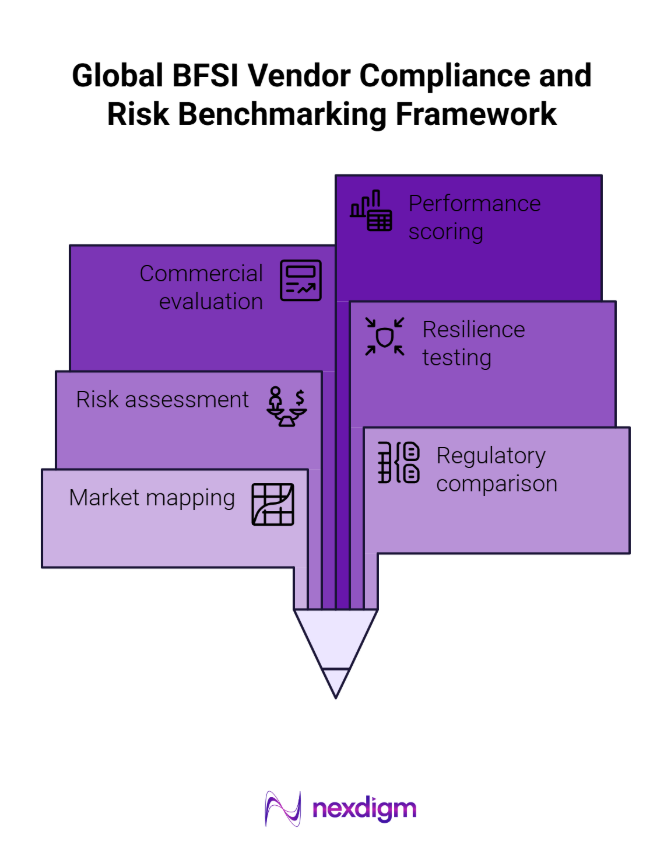
- Market mapping: Identify vendors operating across relevant geographies and service categories.
- Regulatory comparison: Map local compliance requirements against each provider’s documented capabilities.
- Risk assessment: Evaluate financial, cybersecurity, operational and third-party exposure.
- Resilience testing: Compare recovery arrangements, service continuity and incident response.
- Commercial evaluation: Assess pricing, scalability, contractual flexibility and service-level commitments.
- Performance scoring: Rank vendors using weighted criteria based on institutional priorities.
Nexdigm can assist financial institutions with global vendor research, supplier benchmarking, compliance comparisons and third-party risk assessments. These exercises help procurement teams evaluate providers consistently while identifying market-specific gaps and dependencies.
Nexdigm’s Case Study
Nexdigm benchmarked 15 BFSI vendors across 4 markets, evaluating regulatory compliance, cybersecurity, subcontractor exposure and operational resilience. The assessment identified 5 high-priority vendor risks and 3 common infrastructure dependencies, enabling the financial institution to introduce standardised risk scorecards and market-specific compliance requirements.
To take the next step, simply visit our Request a Consultation page and share your requirements with us.
Harsh Mittal
+91-8422857704