

Choosing a country for chemical industry expansion is not simply a matter of finding the fastest-growing economy. A market may have strong demand but high logistics costs, complex registration requirements or intense competition from established producers. Another may offer slower growth but better access to customers, reliable infrastructure and more attractive production economics.
For chemical manufacturers, country screening must connect market opportunity with the practical requirements of serving it. The objective is not to produce a ranking of countries in isolation. It is to determine where investment can generate sustainable returns, which entry route is appropriate and what conditions must be met before capital is committed.
Chemical Market Expansion Begins with a Clear Investment Thesis
The first step is to define what the business intends to achieve. Exporting finished products, establishing a distribution operation, acquiring a local producer and building a manufacturing facility involve different cost structures and risk profiles.
A company seeking export growth may prioritise import demand, tariffs, freight costs and distributor access. A manufacturer considering local production must also evaluate utilities, feedstock availability, skilled labour, environmental approvals and capacity utilisation. Without a clear investment thesis, country comparisons can combine incompatible opportunities and produce misleading conclusions.
India’s chemical industry illustrates why the distinction matters. The Department of Chemicals and Petrochemicals reported that selected major chemical and petrochemical production reached 58.62 million tonnes in FY2024–25, up from 45.64 million tonnes in FY2015–16. The sector also contributed 8.1% of manufacturing gross value added in FY2023–24, according to the Economic Survey 2025–26. Such indicators establish industrial scale, but individual investment decisions still require product-level and country-level evidence.
Five Factors That Determine Country Attractiveness
A useful screening model evaluates markets across a consistent set of commercial and operational criteria.
- Demand and customer access: Estimate consumption by product, end-use sector, customer segment and import dependence. Identify whether demand is concentrated among a few large buyers or spread across many smaller accounts.
- Competitive position: Assess local production capacity, major suppliers, imported alternatives, customer switching costs and the degree of price competition.
- Trade and logistics: Review tariffs, trade agreements, freight routes, port access, customs procedures and the cost of moving products from the proposed supply base.
- Operating conditions: Compare feedstock availability, utilities, labour, industrial land, infrastructure and the reliability of supporting services.
- Regulatory and investment risk: Examine chemical registration, environmental standards, hazardous-material rules, foreign ownership requirements and the predictability of policy implementation.
The relative importance of each factor should depend on the product and entry model. A high-value formulation may tolerate higher freight costs, while a low-margin bulk chemical may require proximity to feedstock and customers.
From Longlist to Shortlist: How to Compare Markets
Country screening should take place in stages. An initial longlist can use trade statistics, industry output, customer locations and sector growth to identify plausible markets. A second stage should test regulatory feasibility, competitive intensity and route-to-market requirements. Detailed financial modelling should be reserved for a smaller shortlist.
The process benefits from separating mandatory conditions from weighted preferences. A market that cannot meet a critical safety, registration or supply requirement should not compensate for that weakness merely by scoring well on market growth.
A practical screening process can follow three stages:
- Initial screening: Eliminate countries that lack sufficient demand, product access or basic operating feasibility.
- Comparative assessment: Score the remaining markets using consistent commercial, operational and risk criteria.
- Investment validation: Test customer assumptions, partner availability, landed costs, capital requirements and expected returns.
This process makes country rankings easier to explain and update when market conditions change.
Turning Market Attractiveness into Capital Allocation
A high-ranking country is not automatically the best destination for immediate investment. Capital allocation should account for the scale and reversibility of the commitment. Exporting through a distributor may test demand with limited fixed investment, while local production may require substantial capital before revenue begins.
The analysis should model different scenarios for sales ramp-up, raw material costs, exchange rates, duties, capacity utilisation and customer acquisition. It should also compare the expected returns with the cost of entering alternative markets.
For companies evaluating global chemical investment entry strategy consulting, the key output is a prioritised investment roadmap, not simply a country league table. The roadmap should identify which markets merit immediate validation, which require a partner or export-first approach, and which should be deferred until commercial conditions improve.
What Can Change a Country’s Ranking?
Market attractiveness is dynamic. Companies should revisit their assessment when there are material changes in:
- Trade policy, tariffs or product registration requirements.
- Feedstock prices, energy availability or freight economics.
- New capacity announcements and competitor investment.
- Major customer projects or changes in sector demand.
- Foreign exchange conditions and the cost of financing.
These triggers help management distinguish a temporary market fluctuation from a structural change in the investment case.
Nexdigm’s Chemical Country Prioritisation Framework
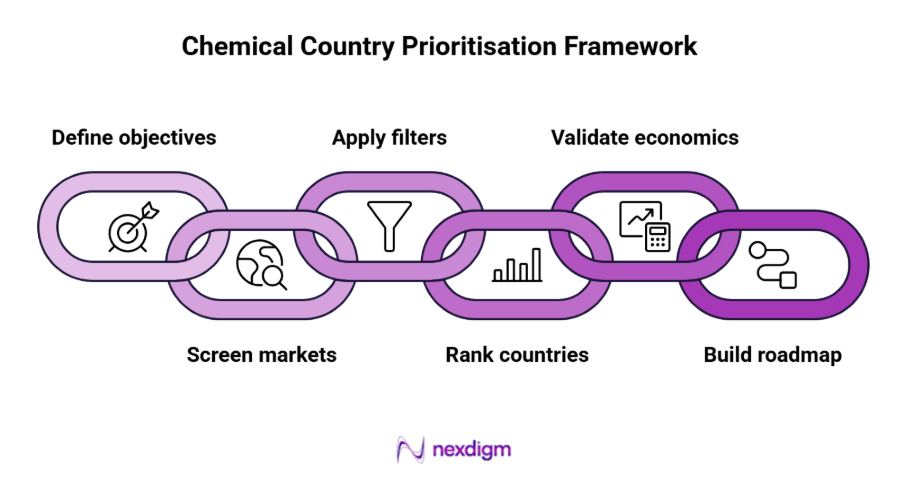
- Define the investment objective: Establish the target product segments, expansion goals and preferred entry route, whether through exports, distribution, partnerships, acquisition or local manufacturing.
- Screen markets for commercial potential: Compare countries based on product-level demand, import dependence, customer concentration, industry growth and access to target end-use sectors.
- Apply feasibility filters: Eliminate markets that fail critical requirements relating to chemical registration, environmental compliance, feedstock availability, infrastructure or trade restrictions.
- Rank shortlisted countries: Evaluate the remaining markets using weighted criteria covering competitive intensity, landed costs, customer accessibility, operating conditions and regulatory risk.
- Validate investment economics: Model revenue potential, capital expenditure, operating costs, capacity utilisation and expected returns under base, upside and downside scenarios.
- Build a phased investment roadmap: Prioritise markets for immediate entry, further validation or deferred investment, with clear milestones for customer acquisition, partner selection and capital commitment.
Nexdigm’s Case Study
A chemical manufacturer screened 9 countries across 2 product families to identify viable expansion markets. An initial assessment of import demand and regulatory requirements narrowed the list to 4 markets. Further analysis of landed costs, competitive intensity and customer access reduced the shortlist to 2 markets. Based on the findings, management prioritised an export-led entry into one market while deferring local manufacturing until sales volumes could demonstrate a viable business case. This phased approach helped align market-entry investment with validated demand rather than committing to production infrastructure too early.
To take the next step, simply visit our Request a Consultation page and share your requirements with us.
Harsh Mittal
+91-8422857704