

Global commodity price benchmarking helps businesses compare agricultural, energy, and raw-material prices across regions affected by supply disruptions, changing demand, logistics constraints, and currency movements. By combining pricing analysis, commodity market intelligence, and price trend analysis, companies can identify regional price gaps and strengthen market positioning.
These insights support contract negotiations, inventory planning, export pricing, margin protection, and faster responses to volatility, enabling organizations to establish commercially viable prices across diverse global commodity markets and customer segments.
Recent trade growth reinforces the value of Pricing Analysis Services. Global trade exceeded US$35 trillion in 2025, while goods trade increased approximately 6.5% and merchandise trade volume grew 4.6%, creating stronger opportunities for pricing analysis, sourcing optimization, and profitable market expansion.
Pricing Analysis for Commodities Facing Supply and Demand Volatility
Pricing analysis helps commodity businesses respond to supply shortages, demand swings, logistics disruptions, and regional price gaps, improving sourcing, price realization, margin protection, planning accuracy, and commercial resilience across volatile markets. Some advantages of Pricing Analysis are:
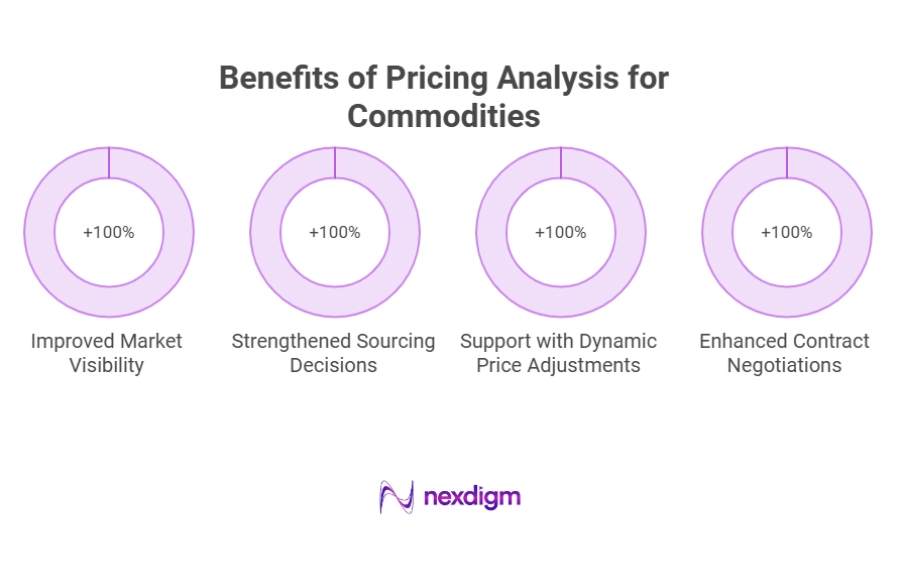
- Improved Market Visibility: Tracking commodity prices, inventory levels, trade flows, and regional demand provides timely market visibility, helps businesses detect volatility early and respond with informed pricing decisions.
- Strengthened Sourcing Decisions: Comparing supplier prices, landed costs, availability, and quality helps organizations select competitive sourcing options, reduce procurement risk, and protect margins during supply disruptions.
- Support with Dynamic Price Adjustments: Scenario-based pricing enables faster adjustments when demand, freight, currency, or supply conditions change, helping businesses maintain competitiveness without compromising targeted profitability.
- Enhanced Contract Negotiations: Reliable benchmarks and cost forecasts strengthen negotiations with suppliers, buyers, and distributors, enabling clearer price clauses, better commercial terms, and reduced exposure to unexpected market movements.
Nexdigm’s Expertise in Global Commodity Pricing Analysis
Nexdigm strengthens commercial decision-making through global commodity price analysis, pricing analysis services, commodity price benchmarking, market intelligence, price trend analysis, and sourcing cost optimization. By assessing supply-demand movements, regional price gaps, competitor benchmarks, logistics costs, and currency exposure, Nexdigm helps businesses optimize procurement, improve price realization, protect margins, manage volatility, and build resilient pricing strategies across global commodity markets.
Nexdigm Pricing Analysis Framework for Global Commodity Competitiveness
Nexdigm’s pricing framework strengthens global commodity competitiveness by combining market intelligence, benchmarking, cost analysis, and risk assessment to improve sourcing, margins, responsiveness, and commercial resilience across volatile international markets. Major framework models used by Nexdigm’s experts are:
- Global Price Benchmarking Framework: Compares commodity prices across regions, exchanges, suppliers, and trade corridors to identify pricing gaps, sourcing advantages, competitive positions, and emerging market opportunities.
- Supply–Demand Intelligence Framework: Tracks production, inventories, consumption, weather, trade flows, and capacity shifts to anticipate price movements and support proactive sourcing, sales, and contracting decisions.
- Landed-Cost Analysis Framework: Consolidates procurement, freight, duties, insurance, storage, handling, and currency costs to determine true market economics and protect margins across global commodity transactions.
- Volatility Scenario Planning Framework: Models alternative price, demand, logistics, and exchange-rate scenarios to evaluate commercial exposure, define response strategies, and improve resilience under changing market conditions.
Nexdigm’s Case
Nexdigm supported a commodity business in strengthening global price benchmarking across multiple sourcing regions. The engagement improved sourcing efficiency by 19%, increased supplier savings by 14%, enhanced pricing accuracy by 21%, and shortened procurement decision cycles, improving commercial resilience.
To take the next step, simply visit our Request a Consultation page and share your requirements with us.
Harsh Mittal
+91-8422857704