

Construction growth rarely follows a single trajectory. Public infrastructure programmes can expand while residential building slows. Industrial projects may accelerate in one region even as commercial property development weakens elsewhere. For construction companies, material suppliers and investors, the challenge is to distinguish broad market momentum from demand that can translate into viable projects.
Four forces deserve particular attention: capital investment, material availability, technology adoption and execution capacity.
Investment Is Creating Uneven Demand
Construction demand begins with financing. Government infrastructure budgets, private industrial investment, housing requirements and commercial development plans all influence the project pipeline, but their effects emerge at different speeds.
The European Construction Industry Federation’s 2026 Statistical Report estimated that EU construction investment contracted by 2.1% in real terms in 2025, following a 2.5% decline in 2024. It forecast a 2.7% recovery in 2026, with civil engineering remaining an important growth driver.
The regional picture matters. Transport infrastructure, energy networks and water projects may sustain demand even when housing construction remains subdued. Companies should therefore separate residential, commercial, industrial and civil engineering activity rather than treating construction as one market.
Project announcements also require scrutiny. An announced development, a funded project and an awarded contract represent different levels of commercial certainty.
Materials Can Change Project Economics
Steel, cement, aggregates, copper, timber and other construction inputs influence project costs and delivery schedules. Price volatility matters, but availability can be equally important. A material may be affordable yet difficult to procure within the required specification or delivery window.
Procurement teams should track supplier concentration, import dependence, lead times and transportation costs alongside commodity prices. Regional sourcing can reduce delivery uncertainty, although local suppliers may have capacity or quality limitations.
The useful question is not simply whether material prices are rising. It is whether a project can secure the necessary inputs at a predictable cost throughout its execution period.
Technology Is Changing How Projects Are Delivered
Digital tools are increasingly relevant to estimating, scheduling, procurement and site coordination. Building information modelling can improve coordination between design disciplines. Digital project controls can expose schedule slippage earlier, while prefabrication and modular construction can move selected activities into more controlled manufacturing environments.
These methods do not automatically improve performance. Their value depends on project complexity, workforce capability, design stability and the ability of contractors and suppliers to share consistent information.
Companies should assess technology against measurable outcomes: fewer design clashes, less material waste, shorter installation time or better schedule adherence.
Capacity Is the Constraint Behind The Opportunity
Even when demand and funding are strong, construction activity can be limited by skilled labour shortages, equipment availability, permitting delays and contractor financial health. A market with a large pipeline may therefore offer less immediately accessible work than a smaller market with established execution capacity.
global construction growth should be assessed against the ability of the local market to deliver projects, not just the amount of investment announced.
A practical assessment should combine project data, construction output, building permits, material costs, labour availability and contractor coverage. These indicators help distinguish a growing market from one where projects are accumulating faster than they can be executed.
Nexdigm’s Construction Growth Assessment Framework
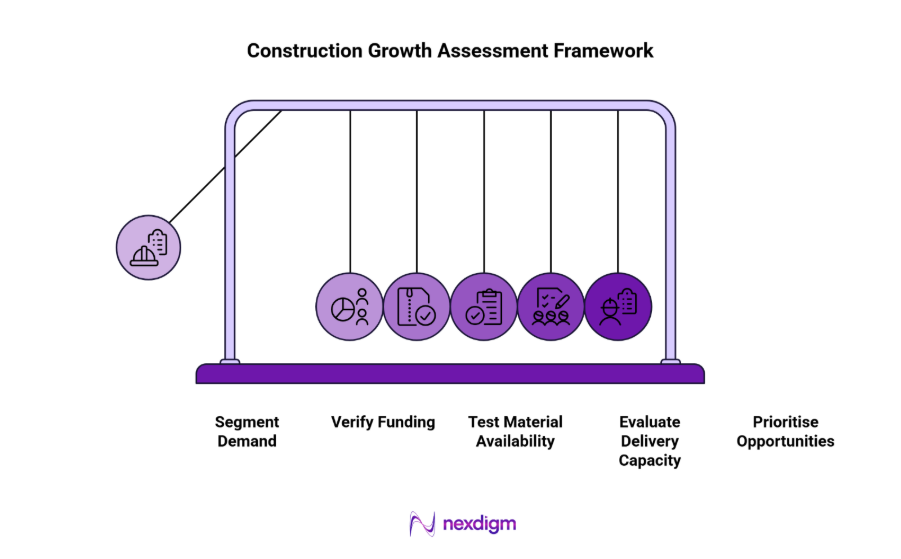
- Segment Demand: Separate building construction, industrial projects and civil infrastructure.
- Verify Funding: Distinguish announced investment from financed and awarded projects.
- Test Material Availability: Assess input costs, sourcing alternatives and supplier lead times.
- Evaluate Delivery Capacity: Review labour, equipment, contractor coverage and permitting.
- Prioritise Opportunities: Compare project timing, margins, execution risk and long-term demand.
Building A More Reliable Growth Outlook
Construction opportunities become clearer when investment signals are tested against the practical conditions required to deliver projects. Companies that combine market forecasts with material, technology and capacity assessments can direct resources towards demand that is more likely to convert into sustainable revenue.
Nexdigm’s Case Study: Selecting A Construction Segment
A construction materials supplier sees rising infrastructure investment but weakening residential activity in its target region. It compares funded transport projects, material specifications, contractor capacity and delivery distances. The supplier shifts its sales focus towards infrastructure contractors with confirmed procurement schedules rather than relying on the broader market outlook.
To take the next step, simply visit our Request a Consultation page and share your requirements with us.
Harsh Mittal
+91-8422857704