

For international schools, curriculum is becoming part of the market-positioning decision. Families are evaluating British, American, IB, Cambridge, national, and hybrid pathways according to university destinations, academic flexibility, affordability, and the ability to preserve domestic education options.
The demand is substantial. In June 2026, more than 705,000 students in 148 countries sat Cambridge examinations, with total entries reaching 1.7 million. Cambridge IGCSE and O Level alone generated almost one million entries across nearly 5,000 schools in 144 countries. The International Baccalaureate had more than 6,200 schools across over 160 countries by August 2026, offering more than 9,100 programmes to over 1.95 million students.
The expansion creates a more complicated commercial question. Which curriculum is gaining demand in a particular market, and what is causing families to choose it?
International Education Demand Is Becoming More Market-Specific
The international school sector cannot be treated as one global market. Curriculum preferences vary according to household income, migration patterns, university ambitions, regulatory requirements, and the strength of domestic education systems.
Cambridge’s 2025 data already showed growth across different school systems and geographies. Its June 2025 series included 5,507 schools across 149 countries, with the number of participating schools increasing 38% over five years and examination entries increasing 74%.
India provides a useful example of how local conditions shape demand. Cambridge crossed 1,000 schools across South Asia in 2025, with 47% of its schools in the region located in Tier-2 and Tier-3 cities.
That expansion is commercially different from growth in a Gulf expatriate market or an East Asian bilingual-school market. A curriculum that works in one geography may require substantial adaptation elsewhere.
Parents Are Choosing Pathways, Not Just Curricula
Curriculum preference is closely connected to what families expect to happen after school.
Families prioritize A Levels for the UK, AP or American diplomas for the US, and the IB for global portability. Cambridge’s 2025 student-destination research found that AS & A Level students were increasingly choosing destinations beyond the traditional UK, US, Canada, and Australia markets, while subjects such as computer science, artificial intelligence, and environmental science gained attention.
In India, Cambridge’s March 2026 examination series recorded more than 91,000 entries, up 7% year-on-year. AS & A Level entries increased 12%, with Mathematics, Physics, and Chemistry among the leading choices.
These patterns show why curriculum demand mapping needs to connect school-level demand with university destination flows.
Hybrid Models Are Changing the Competitive Landscape
International and national curricula are increasingly being combined rather than treated as mutually exclusive choices.
A school can preserve local curriculum requirements while adding Cambridge examinations or international subject pathways. This can allow families to maintain eligibility for domestic higher education while keeping international university options open.
The model also changes school economics. Curriculum architecture influences teacher recruitment, professional development, assessment costs, subject availability, academic administration, and ultimately tuition.
For operators, therefore, curriculum selection affects both demand and the cost base required to serve that demand.
Seven Variables Behind Curriculum Choice
A meaningful global curriculum demand mapping exercise needs to connect household behaviour with school economics.
- Curriculum penetration: Existing adoption reveals where a qualification already has recognition and where new entrants may face established competition.
- Household affordability: The relevant market is the population that can sustain tuition over several years, not simply households that can afford the first year’s fee.
- University destination: Student migration toward the UK, US, Canada, Australia, Europe, or domestic universities changes the perceived value of each curriculum.
- Regulation: Local requirements around language, national subjects, foreign-school licensing, and student composition can materially change which models are viable.
- Competitive capacity: Existing seats, occupancy, planned campuses, waiting lists, and fee bands reveal whether demand is underserved.
- Academic preference: Subject choices, perceived rigour, flexibility, examination structure, and future-oriented programmes influence parent decisions.
- School economics: Curriculum delivery costs, teacher availability, tuition potential, enrollment ramp-up, and long-term capacity determine whether demand can translate into a sustainable operating model.
Nexdigm’s Global Curriculum Demand Mapping Framework
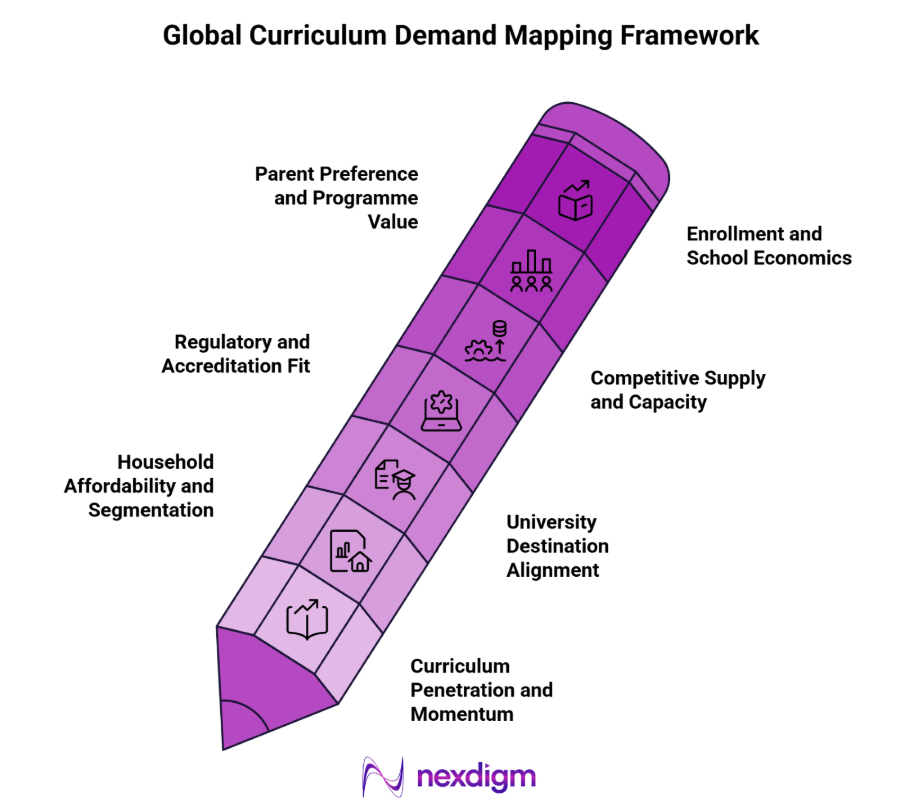
- Curriculum Penetration and Momentum
Measure existing school adoption, recent additions, examination participation, and growth across major curriculum systems. - Household Affordability and Segmentation
Map target-income households, tuition tolerance, education expenditure, and price sensitivity across the catchment. - University Destination Alignment
Track preferred tertiary destinations and determine how strongly each curriculum supports those pathways. - Regulatory and Accreditation Fit
Assess national curriculum mandates, language requirements, licensing conditions, and examination recognition. - Competitive Supply and Capacity
Map schools by curriculum, fees, enrollment, capacity, location, and upcoming supply. - Parent Preference and Programme Value
Evaluate the attributes families associate with academic quality, mobility, flexibility, and future career preparation. - Enrollment and School Economics
Translate demand into expected enrollment, tuition revenue, faculty requirements, operating costs, and capacity utilization.
Case Study: Curriculum Demand Mapping Across Growth Markets
A three-market assessment found similar affluent household pools Across Hyderabad, Ho Chi Minh City, and Riyadh, similar affluent density ($75k+ income) masked divergent operational needs: Hyderabad saw 80%+ demand for Cambridge STEM, Ho Chi Minh City required bilingual tracks under Decree 86, and Riyadh mandated Saudi-accredited dual pathways.
To take the next step, simply visit our Request a Consultation page and share your requirements with us.
Harsh Mittal
+91-8422857704