

Education markets increasingly compete not only for domestic learners but also for international students, faculty, investment, partnerships, and global recognition. Competitiveness therefore depends on a combination of educational quality, employability, affordability, research capability, institutional reputation, and international accessibility.
India illustrates the scale of this opportunity. Recent research-based data reveals that the country has more than 260 million students across school and higher education, supported by over 1.5 million schools and 43,000 higher education institutions. Its also highlights rising household aspirations, increasing private investment, digital infrastructure expansion, and policy support as important drivers of education-market development.
Yet scale alone does not make an education market globally competitive. Students increasingly compare destinations based on expected career outcomes, program quality, tuition costs, institutional reputation, industry exposure, and international mobility. For education providers, investors, and policymakers, a Global education competitiveness analysis can help determine which factors strengthen market attractiveness and where strategic improvements may be required.
What Defines a Globally Competitive Education Market?
A competitive education market combines quality with accessibility and relevance. Strong institutions need qualified talent, credible qualifications, effective learning outcomes, industry connections, and infrastructure, while students need education that offers a reasonable relationship between cost and future opportunity.
International appeal adds another dimension. Global partnerships, internationally recognized credentials, English-language delivery, student mobility, and post-study opportunities can influence whether learners choose one education destination over another.
Understanding The Growing Institutional Competitiveness in the Market
A strong global education proposition must work across multiple dimensions. High academic standards may attract students, but excessive tuition can limit accessibility. Affordable education may generate demand but struggle to compete internationally without credible outcomes or institutional recognition.
Research emphasizes the importance of evaluating program attributes, faculty quality, institutional reputation, placement outcomes, accreditation, fee structures, delivery models, and learner preferences when assessing education markets.
Nexdigm’s Expert-led International Market-Entry Support
International competitiveness is particularly relevant for education providers evaluating cross-border expansion. Nexdigm can assess destination attractiveness, regulatory requirements, competitor institutions, parental or student aspirations, affordability, curriculum preferences, and local market dynamics.
Our international K-12 work demonstrates this approach by combining market sizing, stakeholder research, competitive assessment, regulatory analysis, and business-model evaluation to help overseas education providers understand the feasibility of entering new markets.
Nexdigm’s Global Education Competitiveness Assessment Approach
Nexdigm brings together market intelligence, education-sector research, consumer analysis, competitive benchmarking, affordability assessment, and strategic advisory to evaluate the factors shaping education-market competitiveness.
Our Global education competitiveness analysis examines institutions, learners, programs, delivery models, pricing, outcomes, competitive positioning, and emerging demand. This enables stakeholders to assess competitiveness from both sides of the market.
Nexdigm’s Global Education Competitiveness Analysis
Nexdigm’s Global education competitiveness analysis assesses market attractiveness through several interconnected factors, such as:
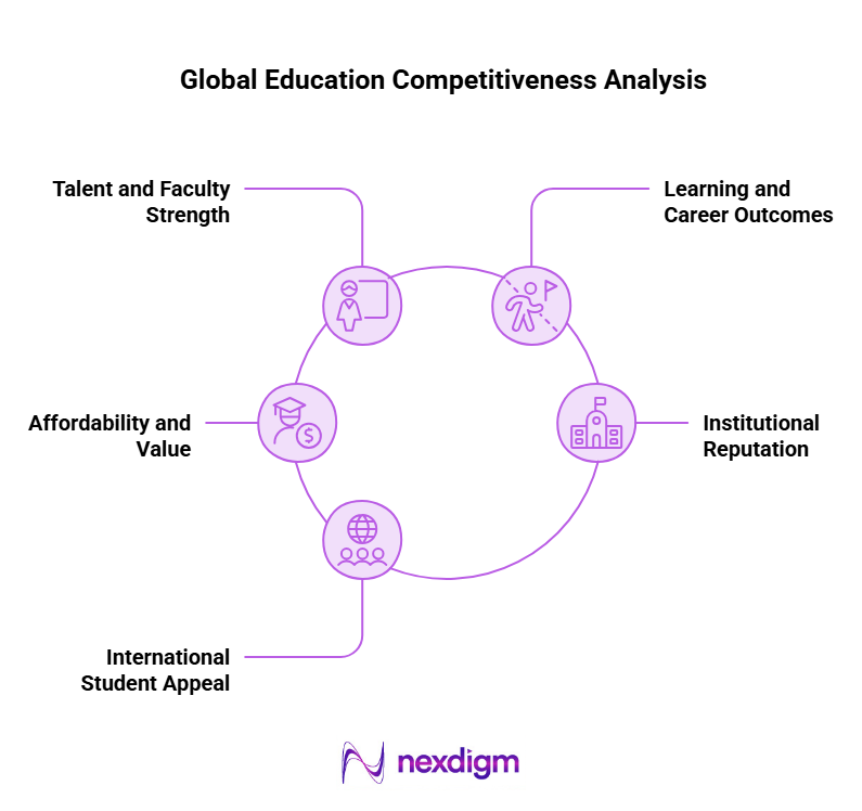
- Talent and Faculty Strength: Nexdigm evaluates faculty availability, qualifications, teaching capabilities, industry experience, and talent requirements to assess whether education markets can support high-quality academic delivery.
- Learning and Career Outcomes: Examination of completion, employability, placements, progression, certifications, and career pathways to determine whether education offerings deliver outcomes that strengthen market competitiveness.
- Affordability and Value: Assessment of tuition, household spending, financing availability, living costs, and perceived value to understand how education markets compare from a learner affordability perspective.
- Institutional Reputation: Nexdigm benchmarks institutional brands, accreditation, rankings, academic partnerships, facilities, and reputation to evaluate factors influencing student and stakeholder choice.
- International Student Appeal: Evaluation of international enrollment drivers, destination preferences, program availability, global recognition, student support, and mobility opportunities to assess a market’s ability to attract overseas learners.
These factors provide a broader view of competitiveness, helping stakeholders understand where an education market performs strongly, where gaps exist, and which capabilities could strengthen its global position.
Benefits of Nexdigm’s Global Education Competitiveness Analysis
Understanding competitiveness is not only about benchmarking current performance but also about identifying areas that can strengthen long-term market positioning. Nexdigm’s assessment helps stakeholders with:
- Investment Prioritization: Evaluate markets and education segments based on competitiveness indicators to support informed investment decisions and resource allocation strategies.
- Enhanced Student Attraction: Understand factors influencing student choice and enrollment decisions, helping institutions improve value propositions and attract domestic and international learners.
- Strengthened Academic Offerings: Assess talent availability, learning outcomes, and industry requirements to support the development of programs aligned with evolving learner and employer expectations.
- International Growth Opportunities : Identify capabilities required to attract international students, strengthen global recognition, expand partnerships, and improve competitiveness in global education markets.
By evaluating competitiveness across multiple dimensions, it helps stakeholders identify strengths, address capability gaps, prioritize strategic investments, and develop initiatives that enhance education quality, market attractiveness, and long-term growth potential.
Nexdigm’s Case
A leading UK-based educational institute engaged Nexdigm to assess the opportunity for establishing an international K-12 school in India. Nexdigm analyzed 25+ ecosystem stakeholders, evaluated competing international schools, reviewed programs for ages 5–17, and assessed regulatory and business-model considerations. The study enabled the client to formulate recommendations for its India market-entry strategy.
To take the next step, simply visit our Request a Consultation page and share your requirements with us.
Harsh Mittal
+91-8422857704