

A country with a large student population is not necessarily an attractive education market. For an international education provider, the commercial environment depends on a combination of demand, household affordability, competition, regulation, education funding and the ability to operate within the local system.
Nexdigm finds that tuition, living costs, financial support, visa requirements, work rights and post-study pathways jointly influence where international students choose to study and whether they remain after graduation. Country comparison therefore needs to move beyond population size.
Start With the Cost of Access
Affordability can change the composition of an education market before a provider ever enters it.
The OECD’s latest international mobility analysis finds that more than two-thirds of students in global surveys identify affordability as the primary consideration when choosing a study destination. It also reports substantial variation in annual living costs, from below US$10,000 in some OECD destinations to more than US$30,000 in the most expensive markets.
Tuition structures vary just as sharply. In several major English-speaking destinations, average public-institution tuition for international master’s students exceeds US$20,000 on a purchasing-power-parity basis. Germany, by contrast, generally has no tuition fees at public higher-education institutions, aside from administrative contributions.
The result is a very different addressable market even before differences in student population are considered.
Three Variables Change the Shape of Demand
A useful international comparison should examine three layers together.
- Demand depth
How many students are eligible, interested and geographically accessible? Demographics, participation rates, international mobility and programme preferences establish the potential market. - Affordability
What can students and families realistically pay after tuition, accommodation, transport and other costs? Scholarships and financing can materially alter the addressable pool. - Market structure
Who already supplies the market? Public universities, private institutions, international operators, vocational providers and digital platforms may occupy very different positions.
A large market with limited private participation may therefore require a different entry strategy from a smaller market with established private education demand.
Regulation Can Override Attractive Demand
Education markets are unusually dependent on regulation because the product itself can be subject to licensing, accreditation and immigration rules.
For international providers, the relevant questions include foreign ownership, institutional licensing, degree-recognition requirements, local partnerships, tuition controls and restrictions on delivery models.
The OECD’s 2026 analysis shows that countries also differ substantially in student visa requirements and proof-of-funds thresholds. All 29 responding OECD countries required international students to demonstrate sufficient financial means, while the required amounts can reach tens of thousands of US dollars.
These rules can directly affect recruitment.
Market Structure Matters as Much as Market Size
Public funding creates another major difference between countries.
Some systems provide extensive public support and low tuition, while others rely much more heavily on household payments and international student fees. OECD data shows that around two-thirds of countries with available data charge higher tuition to foreign students than domestic students at the master’s level.
For a private education operator, this changes the addressable market, pricing model and competitive position.
The commercial opportunity may therefore sit in a specialised segment rather than the mass market, particularly where public institutions already dominate broad-based provision.
A Better Way to Compare Countries
For organisations considering global education market research consulting, country screening should combine demand with the conditions required to convert that demand into revenue.
Nexdigm’s International Education Market Screening Framework
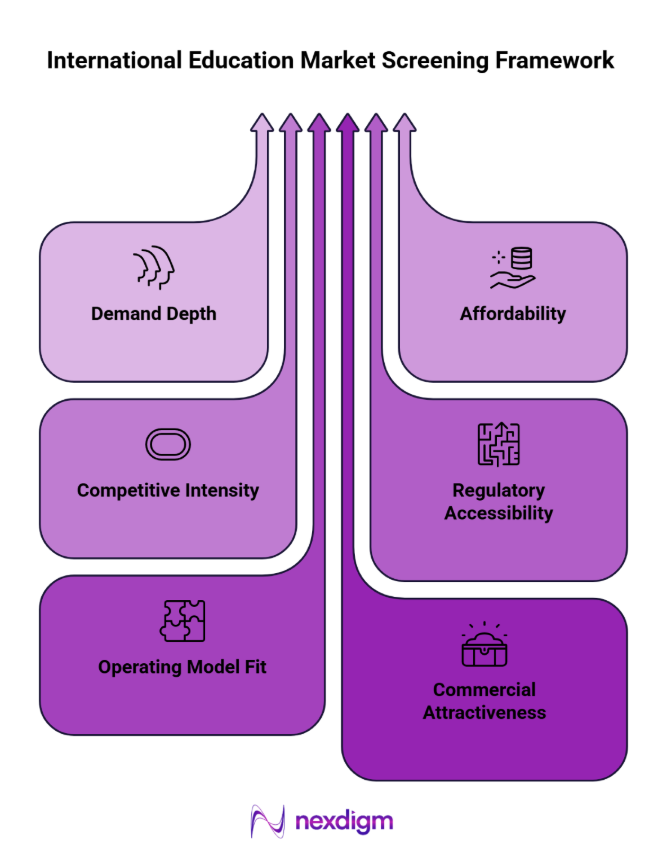
- Demand Depth
Size student populations, participation, mobility and programme-level demand. - Affordability
Benchmark tuition, household purchasing power, living costs and available financial support. - Competitive Intensity
Map public and private providers, capacity, pricing and institutional positioning. - Regulatory Accessibility
Assess licensing, accreditation, ownership and delivery restrictions. - Operating Model Fit
Determine whether campus, partnership, digital or hybrid delivery is compatible with the market. - Commercial Attractiveness
Combine addressable demand, investment requirements, pricing potential and market-access conditions.
Case Study: Looking Beyond Student Population
An international education provider compared three target markets using student demand, household affordability, private-sector participation and regulatory requirements. The largest market had 18% greater student demand but substantially higher private-sector concentration, while a smaller market showed lower competitive density and 27% lower estimated market-entry costs. International education expansion is ultimately a comparison of systems, not populations. The most useful market is the one where demand can be reached, priced appropriately and served within a workable regulatory and operating model.
Nexdigm can support international education providers and investors with country screening, demand analysis, affordability research, competitive benchmarking and market-entry assessment.
To take the next step, simply visit our Request a Consultation page and share your requirements with us.
Harsh Mittal
+91-8422857704