

A global food and beverage business may negotiate central contracts for ingredients, packaging, and logistics, yet still pay significantly different prices across countries. Local supplier availability, import duties, currency movements, transport infrastructure, and product specifications all affect the final cost. A category that offers substantial savings in one market may have very limited potential in another.
Global procurement benchmarking should therefore identify savings at two levels: the category itself and the individual markets in which it is purchased.
Global Market Context: Agricultural Trade Is Expanding
UN Trade and Development’s State of Commodity Dependence 2025 reports that global agricultural exports increased by 34% between 2012-14 and 2021-23, reaching nearly US$2.3 trillion. Food products represented close to 90% of that agricultural export value.
This expansion creates a larger international sourcing environment, but it does not remove concentration risk. During 2021-23, 95 of 143 developing economies were classified as commodity-dependent, meaning commodities represented more than 60% of their merchandise exports. Agricultural supply can therefore remain exposed to national production conditions, trade policy, and external price shocks.
India provides another example of the relationship between domestic production and international sourcing. Oilseed production reached 42.99 million tonnes in 2024-25, but edible-oil import dependence was still 56.25% in 2023-24. For multinational food businesses buying oils and fats in India, domestic supply growth does not eliminate exposure to international markets.
Where Do Market Conditions Create Opportunities?
Ingredients should be assessed separately across markets. Cereals, edible oils, dairy, sugar, proteins, and specialised additives have different production locations, trade exposure, and supplier structures.
A category benchmark should examine:
- Annual spend by ingredient and sourcing market.
- Domestic versus imported sourcing share.
- Price differences between equivalent specifications.
- Supplier concentration and available alternatives.
- Freight, duties, currency effects, and contract adjustments.
The FAO Food Price Index averaged 136.0 points in September 2026, up 5.8% year on year. However, its component indices moved in different directions. This makes it important to connect each purchased input to the relevant commodity indicator rather than apply a single global inflation assumption.
Can Purchasing Be Coordinated Across Markets?
Packaging often offers opportunities for coordinated procurement where specifications are common across business units. Cartons, labels, flexible packaging, containers, closures, and standardised materials may be suitable for regional or global negotiations.
However, local food-contact regulations, printing languages, pack dimensions, recycling requirements, and supplier capabilities can limit standardisation.
The comparison should include:
- Material and conversion cost.
- Printing, tooling, and minimum production runs.
- Freight and import duties.
- Storage and obsolete-stock exposure.
- Local compliance and technical requirements.
Global volume leverage is useful only when the specifications and delivery conditions are sufficiently comparable.
Logistics and Contract Manufacturing: The Landed-Cost Difference
A low factory-gate price can become uncompetitive after freight, insurance, customs, warehousing, and local handling are included. Contract manufacturing also varies by production scale, labour costs, quality systems, capacity, and minimum runs.
For global F&B procurement category benchmarking, the landed-cost comparison should identify whether a price difference is caused by the supplier, the market, or the logistics structure. Buyers should also evaluate lead times and inventory requirements because longer sourcing routes may require additional working capital.
Supplier Dependencies: Where Is Diversification Necessary?
Global supplier lists can create a misleading impression of resilience. Several vendors may depend on the same raw-material producer, processing region, port, or transport corridor.
Dependency mapping should identify:
- Country and regional sourcing concentration.
- Shared upstream processors and material suppliers.
- Exposure to trade restrictions and export controls.
- Alternative production capacity and qualification time.
- The cost of maintaining secondary sources.
Diversification is most valuable where a disruption could affect several purchasing categories simultaneously.
Global F&B Category Benchmarking Framework
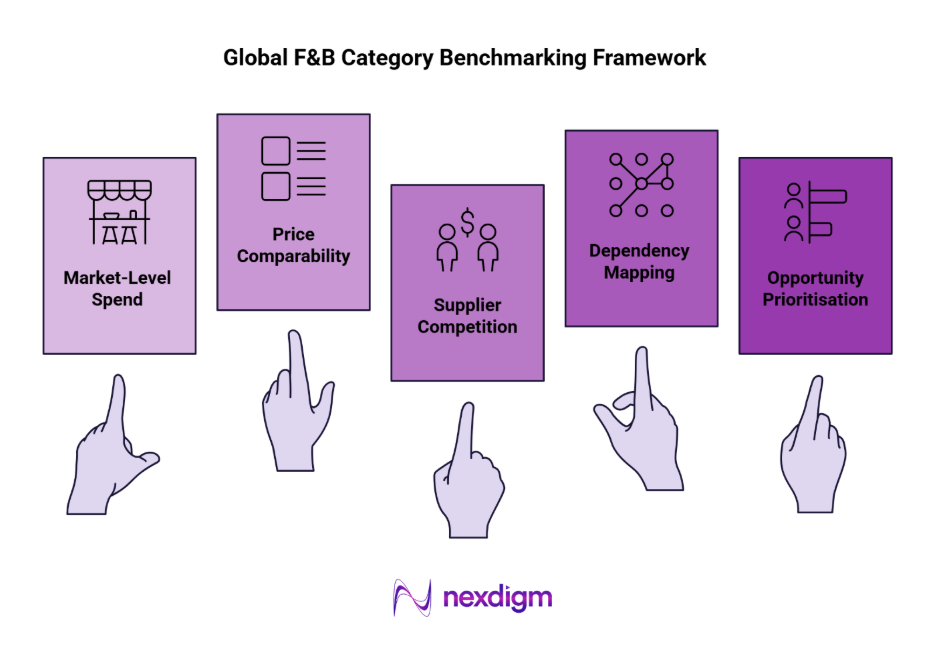
- Market-Level Spend: Rank category expenditure by country, business unit, supplier, and sourcing currency.
- Price Comparability: Standardise product specifications, units, delivery terms, and landed-cost components across markets.
- Supplier Competition: Assess qualified alternatives, market concentration, capacity, and technical switching requirements.
- Dependency Mapping: Trace critical materials through upstream suppliers, production regions, ports, and logistics routes.
- Opportunity Prioritisation: Rank global negotiations, regional sourcing, specification alignment, and supplier diversification by savings potential, implementation effort, and continuity risk.
Global Leverage, Regional Decisions
The most effective global procurement model is selective. Standardised packaging and common operating supplies may benefit from coordinated negotiations, while fresh ingredients and locally regulated products may require regional sourcing. Critical materials may justify secondary suppliers even where their quoted prices are higher.
The objective is to identify where the global scale creates leverage and where local market knowledge produces better commercial decisions.
Nexdigm’s Case Study
A food manufacturer considering international expansion needed to identify markets offering favourable demand, competitive supply conditions and accessible distribution networks. Nexdigm compared 9 markets across 6 F&B categories, examining import dependence, local production, market growth and competitive intensity. The assessment shortlisted 3 markets and 2 priority categories, helping the client focus its expansion strategy on opportunities with projected annual demand growth of 7–10%.
To take the next step, simply visit our Request a Consultation page and share your requirements with us.
Harsh Mittal
+91-8422857704