

Global food and beverage procurement combines purchases across agricultural commodities, processed ingredients, packaging, contract manufacturing, freight, storage, and quality assurance. The cost of a product can change significantly between its source country and destination market because of currency movements, duties, transport, handling, and local specifications.
A global spend review should therefore identify three things: where expenditure sits, which cost factors explain it, and where supplier dependencies could expose the business to disruption.
Market Exposure: Different Inputs Follow Different Cycles
Food procurement cannot be benchmarked using a single inflation rate. The FAO Food Price Index averaged 136.0 points in September 2026, up 5.8% year on year. Within the index, cereals rose 17.2% year on year and vegetable oils 16%, while sugar declined 8.5% and dairy declined 18.8%.
These movements have different implications for buyers. A manufacturer purchasing oils and cereal-based ingredients may face different cost pressures from a business buying dairy ingredients or sugar-heavy products. Currency changes, local supplier margins, contract timing, and freight can further separate international prices from actual purchase costs.
Global procurement teams should track market indicators by input and sourcing region, then compare those movements with supplier price changes. The purpose is to identify the relevant cost driver, not assume that an international index directly determines a local invoice.
Spend Concentration: Where Is the Money Committed?
Global spend should be consolidated by category, supplier, country of origin, destination market, business unit, and currency. This helps distinguish a large global contract from a category in which purchasing is fragmented across multiple regions.
The review should identify:
- The categories responsible for the largest share of total expenditure.
- Suppliers with a high share of category or regional spend.
- Price differences between sites buying comparable products.
- Expenditure outside negotiated contracts.
- Costs that are recorded separately, such as freight, duties, storage, testing, and handling.
For global F&B procurement spend analysis consulting, supplier spend should be reconciled with landed cost. A low factory-gate price may be offset by transport, insurance, tariffs, longer inventory cycles, or higher quality-assurance requirements.
Supplier Dependencies: Direct Vendors Are Only Part of the Picture
A business may buy from several suppliers while remaining dependent on the same upstream producer, crop origin, packaging material, or shipping route. Supplier-count analysis alone can therefore overstate diversification.
UN Trade and Development data show that food exports are relatively dispersed across economies compared with several other major product groups. Its export concentration index for food stood at approximately 0.11 in 2025, indicating a more diversified geographic origin profile than manufactured goods. This is a measure of economy-level export concentration, not a guarantee that an individual ingredient has multiple viable sources.
The practical question is whether the particular product can be substituted. A commodity may be widely traded globally while a required grade, certification, processing method, or delivery route remains concentrated.
Commercial Terms: How Do Contracts Change the Economics?
Cross-border contracts may include currency clauses, price-adjustment formulas, volume commitments, minimum orders, payment periods, duties, and delivery terms. Each affects the buyer’s exposure.
A long-term contract can stabilise supply and pricing but become restrictive if market prices fall. Spot purchasing may capture lower prices but increase exposure to volatility and availability. Regional sourcing may shorten lead times, though it does not necessarily produce the lowest landed cost.
Benchmarking should compare the full contract economics, including the cost of inventory held to protect against long lead times and the financial impact of delayed or disrupted deliveries.
Global F&B Procurement Spend Analysis Framework
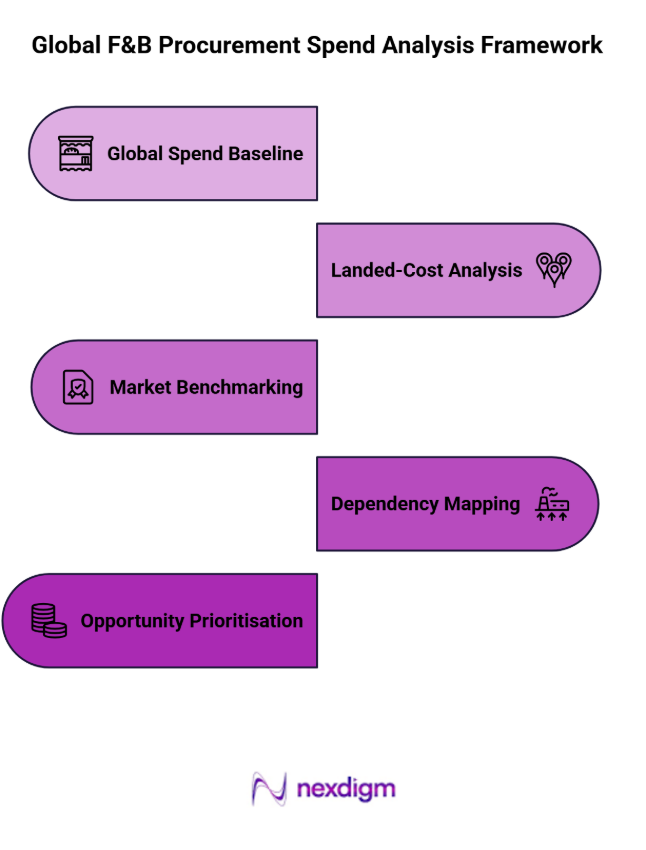
- Global Spend Baseline: Consolidate purchasing by category, supplier, market, currency, and destination using consistent units and supplier identifiers.
- Landed-Cost Analysis: Separate supplier price, freight, duties, insurance, handling, storage, and currency effects to identify the true cost at the point of use.
- Market Benchmarking: Compare prices with relevant commodity indicators, regional quotations, historical contracts, and equivalent product specifications.
- Dependency Mapping: Trace critical inputs through upstream processors, production regions, ports, and logistics routes to identify common points of failure.
- Opportunity Prioritisation: Evaluate coordinated negotiations, regional sourcing, alternative suppliers, contract redesign, and inventory changes according to savings potential, qualification time, and supply risk.
Outlook: Global Leverage Needs Local Evidence
The next stage of procurement intelligence is selective rather than uniform. Common packaging or standardised ingredients may offer opportunities for coordinated global negotiations. Fresh, specialised, or locally regulated products may be better managed regionally. Critical materials may justify qualified secondary suppliers even when the alternative source is more expensive.
The right decision balances price, availability, quality, and disruption exposure. Savings should be measured after the full cost of sourcing and implementation is considered.
Nexdigm’s Case Study
In a representative global procurement assessment, spend across five markets was consolidated by category, supplier, currency, and landed cost. The analysis identified inconsistent commercial terms and several vendors sharing upstream dependencies. A targeted negotiation and alternative-sourcing plan was developed to improve price comparability and supply resilience, with financial outcomes to be validated against actual purchasing data.
To take the next step, simply visit our Request a Consultation page and share your requirements with us.
Harsh Mittal
+91-8422857704