

Food and beverage companies sourcing across international markets face a supplier environment shaped by different regulatory systems, production standards, infrastructure conditions and trade requirements. A vendor may meet the quality requirements of its domestic market but lack the documentation, testing capability or operational controls needed to supply another country.
The complexity increases when a company sources several categories across multiple regions. An ingredient supplier in Southeast Asia, a packaging manufacturer in Europe and a frozen-food processor in South America may all operate under different compliance regimes. Managing these relationships requires an understanding of both individual supplier capabilities and the broader market conditions in which they operate.
International Food Trade Is Increasingly Exposed to Regulatory Change
FAO’s December 2025 update to its global trade database shows that food commodities accounted for 86% of international trade in crop and livestock products in 2024. It also found that exports remain concentrated among a relatively small number of countries. The two largest exporters of soybeans and palm oil, for example, accounted for approximately 85% of global exports in those categories.
This concentration creates commercial exposure for businesses sourcing internationally. A disruption in a major producing country can affect availability across several importing markets, while changes in export restrictions, testing requirements or trade policy can alter supplier access.
Regulatory requirements are also changing. WTO members submitted 2,496 sanitary and phytosanitary notifications in 2025, a record annual total and a 16% increase over 2024. These notifications cover proposed or modified measures relating to food safety, animal and plant health, and related trade requirements.
For international F&B businesses, regulatory monitoring has become an important part of evaluating supplier markets. A supplier’s current compliance status needs to be considered alongside its ability to adapt to new requirements in the countries it serves.
Five Dimensions of Cross-Border Supplier Exposure
- Regulatory Differences Between Markets
Food safety standards, permissible additives, pesticide residue limits, labelling rules and import documentation can differ across destinations. A product approved for domestic sale may require additional testing, certification or documentation before it can enter another market.
Businesses should examine the regulations applicable to the specific product and destination, including the requirements for manufacturing facilities and exporting establishments. - Country and Commodity Concentration
FAO’s trade data highlights the concentration of global exports in selected agricultural commodities. When procurement depends on a limited number of producing countries, companies may be exposed to weather events, export restrictions, geopolitical developments and changes in freight availability.
The relevant risk is category-specific. Dependence on a small number of palm oil or soybean exporters creates a different exposure from sourcing dairy ingredients, seafood or processed fruit. - Production and Quality Infrastructure
Supplier capabilities vary across markets. Some regions have established processing clusters, accredited testing laboratories and specialised storage infrastructure. Others may offer competitive production costs but have limited capacity for specific product standards or export requirements.
Assessment should consider production scale, testing facilities, quality-management systems, traceability and the supplier’s ability to meet customer specifications consistently. - Logistics and Supply Continuity
International suppliers depend on ports, shipping routes, customs processes, refrigerated transport and local distribution infrastructure. For perishable and temperature-sensitive products, a delay can affect product quality as well as delivery schedules.
Companies should compare route reliability, transit time, storage availability, alternative ports and the practical availability of substitute suppliers. - Documentation and Audit Readiness
Cross-border sourcing requires consistent records covering product origin, ingredients, manufacturing processes, testing, batch identification and export documentation. Gaps can delay customs clearance, complicate customer audits or make it difficult to investigate a product issue.
The assessment should establish whether suppliers can provide the required records in the correct format and maintain them across production facilities and shipments.
Why Supplier Risk Must Be Compared by Market and Category
A country-level risk score can hide important differences between industries. One market may have a well-developed dairy-processing ecosystem but limited capacity for frozen seafood exports. Another may offer competitive fruit-processing facilities while depending heavily on imported packaging materials.
Similarly, two suppliers operating in the same country may have very different capabilities. One may have established export operations and destination-market approvals, while another may primarily serve domestic customers.
International businesses therefore need supplier intelligence at both the country and category levels. This makes it possible to distinguish between market-wide exposure and risks specific to an individual vendor or product.
How Nexdigm Supports Global F&B Supplier Assessment
A global F&B vendor compliance and risk consulting engagement can combine international market research, supplier mapping, regulatory analysis and assessment of production and logistics infrastructure. Nexdigm can help businesses compare supplier ecosystems across countries, identify concentration risks and understand the commercial implications of differences in operating standards.
This analysis is particularly useful when entering new markets, diversifying sourcing locations or reviewing the resilience of an international supplier network.
Market-by-Market Framework for Supplier Risk
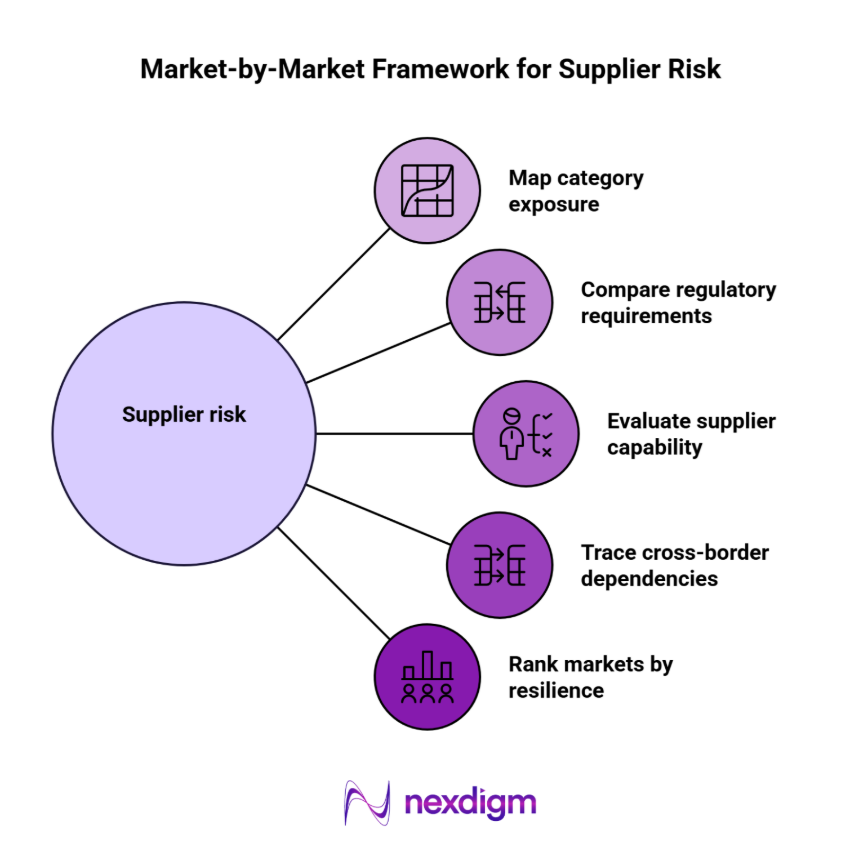
- Map category exposure: Identify the countries, production clusters and supplier groups responsible for critical ingredients, finished products and packaging materials.
- Compare regulatory requirements: Examine destination-specific food safety standards, testing requirements, documentation and facility approvals.
- Evaluate supplier capability: Compare production capacity, quality systems, traceability, testing infrastructure and export experience.
- Trace cross-border dependencies: Assess shipping routes, port access, cold-chain infrastructure, customs requirements and alternative supply corridors.
- Rank markets by resilience: Combine regulatory, production, concentration and logistics findings to identify markets offering stronger supply continuity and viable alternatives.
The framework produces a market-level view of supplier exposure while retaining the detail required for category-specific decisions. It can help management determine where to diversify, which markets require closer monitoring and where additional supplier qualification may be necessary.
Nexdigm’s Case Study
A multinational food manufacturer reviewed 46 suppliers across 8 countries and 6 product categories. The assessment identified 12 high-exposure supplier relationships and 3 markets with concentrated sourcing dependencies. The client diversified 5 critical categories across 4 additional markets, reducing its highest country-level sourcing concentration from 48% to 31%.
To take the next step, simply visit our Request a Consultation page and share your requirements with us.
Harsh Mittal
+91-8422857704