

F&B companies looking beyond their home markets face a deceptively simple question: where will the next meaningful pools of demand come from?
Market size alone rarely answers it. Consumer preferences, income levels, local food culture, retail infrastructure, convenience expectations, and competitive intensity can produce very different outcomes for the same category across countries. A market with a large population may offer limited addressable demand for a particular proposition, while a smaller market can contain a highly attractive premium or functional consumer segment.
India demonstrates how quickly these demand pools can diversify. The country’s food services market is expected to exceed US$125 billion by 2030, with the organized segment growing at twice the rate of the unorganized segment. Swiggy and Kearney also reported rising demand for healthy meals, hyper-regional cuisines, local beverages, and convenience-led food formats.
Demand Is Splitting Across More Distinct Consumer Needs
One important shift is the increasing fragmentation of consumption occasions.
Convenience is expanding through delivery, quick commerce, ready-to-eat products, ready-to-cook formats, and smaller meal occasions. Health is creating demand around protein, functional ingredients, reduced sugar, and nutritional transparency. Premiumization continues where consumers perceive a meaningful improvement in quality or experience.
At the same time, localization remains commercially important. Regional cuisines, flavors, formats, and consumption habits can determine whether an international proposition feels relevant or foreign.
This creates several potential growth pools within the same market:
- Everyday convenience and time-saving consumption
- Affordable indulgence and accessible premium products
- Health and functional nutrition
- Regionally adapted flavors and formats
- Digital-first and delivery-led consumption
- Premium experiences for higher-income consumers
The opportunity is to determine which of these pools is large enough, growing enough, and accessible enough to justify investment.
From Country Potential to Addressable Demand
Evaluate the actual size of the commercially addressable consumer pool rather than relying solely on aggregate market figures.
Assess Core Demand Drivers: Analyze key consumer metrics, including:
- Category penetration and consumption frequency
- Household spending and willingness to pay
- Demographic profiles and local consumer preferences
- Competitive landscape and product availability
Evaluate Physical Channel Viability: Factor in infrastructure and route-to-market constraints that impact scalability, such as:
- Modern trade coverage and retail presence
- Cold-chain and logistics readiness
- Channel margins and distribution economics
Leverage emerging digital touchpoints and fast-evolving fulfillment models (e.g., in India’s top eight metros during Q4 2025, e-commerce accounted for 18% of FMCG sales, with quick commerce driving over 75% of those volumes).
Finding the Markets Worth Building Around
This is where global F&B demand assessment services can help companies move from broad market screening to specific opportunity identification.
Nexdigm’s approach connects four layers of market entry analysis:
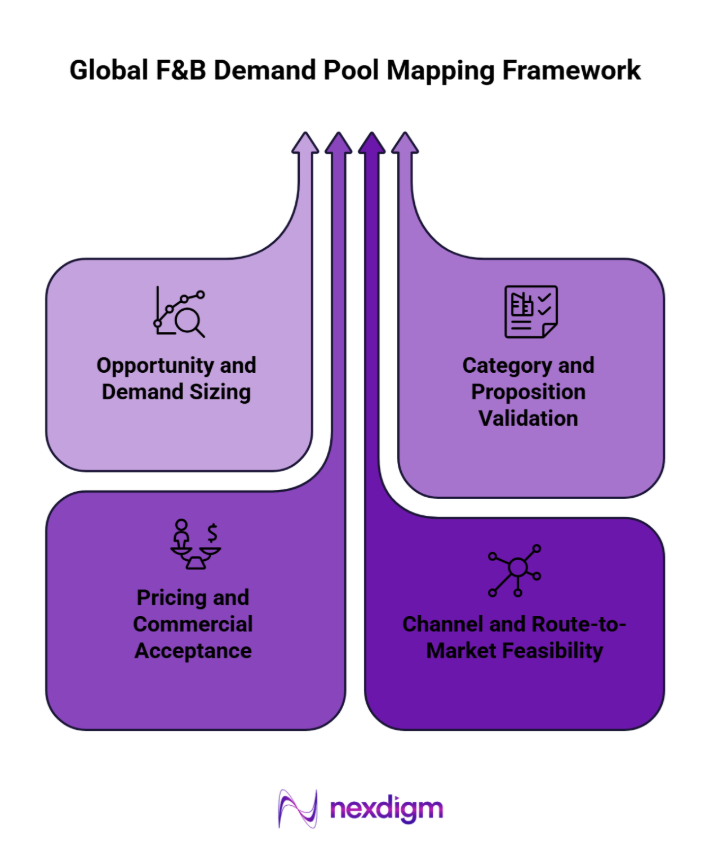
- Opportunity and Demand Sizing: Quantify addressable demand pools, map geographic concentration, and identify which consumer segments account for incremental growth.
- Category and Proposition Validation: Assess white spaces to determine where a new proposition can win and evaluate how much product localization is required against existing alternatives.
- Pricing and Commercial Acceptance: Benchmark competitive price corridors to establish viable price points that meet consumer willingness to pay while safeguarding margins.
- Channel and Route-to-Market Feasibility: Evaluate physical and digital channels across modern trade, general trade, and quick commerce to identify routes that deliver sufficient reach, infrastructure readiness, and sustainable unit economics.
This integrated assessment provides a clear foundation for decisions around market prioritization, product adaptation, positioning, channel mix, and entry sequencing.
From Vietnam’s FMCG Landscape to an Investment Decision
Nexdigm assessed Vietnam’s FMCG sector against China and Thailand, examining GDP and FMCG spending, modern trade, premiumization, e-commerce, city-level wealth distribution, and consumer trends. Primary research and comparative analysis supported the client’s IPO strategy and prospectus development.
To take the next step, simply visit our Request a Consultation page and share your requirements with us.
Harsh Mittal
+91-8422857704