

Global F&B expansion creates a portfolio problem. Companies may have several countries showing attractive category growth, but limited capital, management attention, and operating capacity make it impossible to pursue all of them simultaneously.
The challenge is therefore not simply identifying high-growth markets. It is determining which opportunities are sufficiently attractive, accessible, differentiated, and scalable to justify investment.
That requires moving from broad market screening to a more disciplined prioritization process.
Growth Alone Does Not Define Market Attractiveness
A country can record strong category growth while remaining difficult for a new entrant.
Consumer preferences may differ from the company’s existing proposition. Local competitors may have strong distribution advantages. Regulatory requirements may increase entry costs. Premium products may face limited willingness to pay. Alternatively, a smaller market with lower headline growth may provide better access to an underserved consumer segment.
Global F&B assessment therefore needs to consider several dimensions simultaneously:
Market demand establishes the size and trajectory of the opportunity.
Consumer fit determines whether the company’s proposition is relevant.
Competitive intensity shows how difficult it will be to capture demand.
Channel readiness determines whether the product can reach consumers efficiently.
Commercial economics establish whether growth can translate into viable returns.
The First Screen Should Establish Where Demand Is Moving
Market screening can begin with category size, growth rates, consumption expenditure, demographic trends, urbanization, and household purchasing patterns.
The analysis should then become more specific.
Which categories are gaining penetration? Which consumer segments are increasing spending? Which consumption occasions are changing? Which markets are seeing faster development in modern retail, e-commerce, foodservice, or convenience channels?
This distinction matters because the most attractive opportunity may sit within a particular category-consumer combination rather than across the entire national market.
Consumer Fit Determines Whether Growth Is Addressable
Once high-potential markets are identified, companies need to establish whether consumers actually want the proposition being considered.
Primary research can assess awareness, purchase drivers, consumption frequency, unmet needs, willingness to pay, switching behavior, and perceptions of existing brands.
Localization may then become necessary.
Taste preferences, pack sizes, claims, portion formats, ingredients, pricing, and consumption occasions can differ significantly across countries. A product that requires extensive adaptation may still be attractive, but the cost and complexity of that adaptation need to be reflected in the market assessment.
Competition and Channels Decide How Much of the Market Is Captureable
Market size represents potential demand. Competitive and channel analysis help determine how much of that demand a new entrant can realistically address.
Competitive benchmarking can examine leading brands, price positioning, product portfolios, distribution coverage, market shares, consumer perceptions, and barriers to entry.
Channel assessment should then establish whether the market has the infrastructure required for scale. This can include modern trade, traditional retail, foodservice, e-commerce, distributors, local partners, and direct-to-consumer channels.
The result is a more realistic view of addressable opportunity.
A Global F&B Opportunity Prioritization Framework
Nexdigm’s global F&B opportunity assessment consulting can structure portfolio prioritization across five stages.
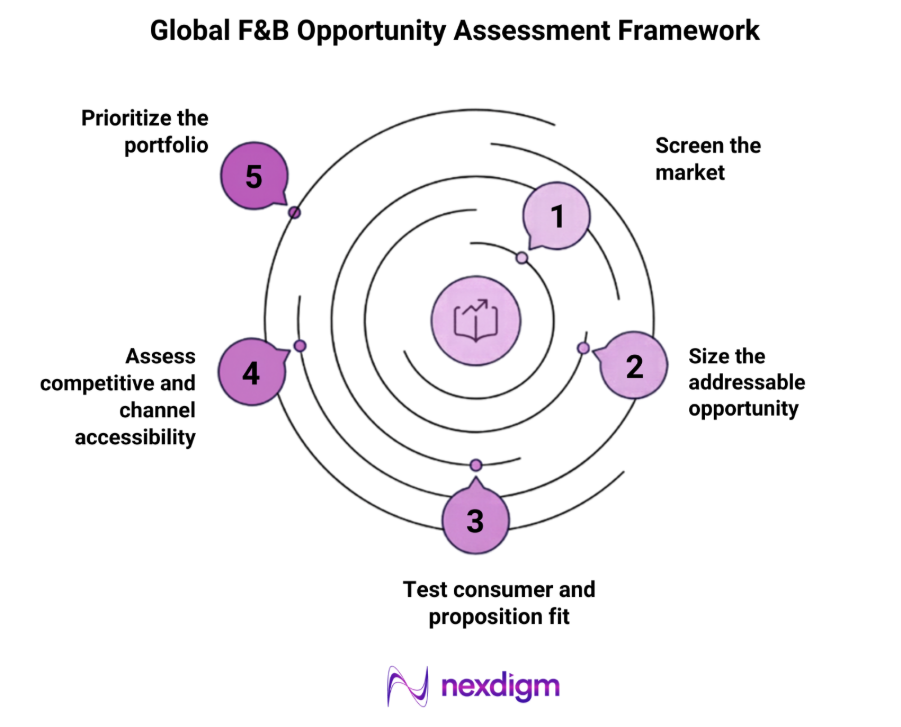
- Screen the market
Identify countries and categories with attractive demand growth, consumer spending, demographic development, and category penetration. - Size the addressable opportunity
Move from total market size to the portion relevant to the company’s product, target consumer, price positioning, and route to market. - Test consumer and proposition fit
Use primary research to understand purchase drivers, unmet needs, willingness to pay, consumption occasions, and the degree of localization required. - Assess competitive and channel accessibility
Benchmark competitors and evaluate distribution infrastructure, partner availability, channel economics, regulatory requirements, and market-entry barriers. - Prioritize the portfolio
Combine market attractiveness with accessibility, investment requirements, competitive intensity, and expected commercial potential to determine which markets deserve immediate investment, further validation, partnership exploration, or longer-term monitoring.
This framework allows management teams to move from a long list of possible markets to a focused expansion pipeline.
Why Comparative Research Matters
Cross-market benchmarking becomes particularly valuable when companies are evaluating emerging markets.
Nexdigm’s Vietnam FMCG assessment, for example, compared Vietnam with China and Thailand to understand how economic development, FMCG spending, modern trade, premiumization, e-commerce, wealth distribution, and consumer trends were shaping Vietnam’s growth trajectory. The research combined primary and secondary research and supported the development of an IPO prospectus.
The broader lesson for global F&B companies is that market attractiveness becomes more meaningful when evaluated against comparable markets rather than in isolation.
A Documented F&B Go-to-Market Engagement
Nexdigm supported an F&B client in evaluating channels, customer segments, and price points. The engagement delivered a 29% improvement in channel prioritization, 28% improvement in customer-targeting accuracy, and 24% improvement in pricing optimization.
These outcomes demonstrate how market assessment can move beyond identifying attractive demand to improving the commercial choices required to capture it.
To take the next step, simply visit our Request a Consultation page and share your requirements with us.
Harsh Mittal
+91-8422857704