

Global food trade is expanding across an increasingly fragmented supply landscape. Food products account for nearly 87% of global agricultural export value, making food a major component of international commodity trade. At the broader level, global merchandise exports reached $26.3 trillion in 2025, with developing economies accounting for 46% of global exports.
The geography of growth is also changing. In 2025, exports from developing Asia and Oceania increased by 8.7%, while developing Africa recorded export growth of 10.2%. These shifts create new sourcing and market opportunities, but businesses need to distinguish between broad trade growth and product-specific commercial potential.
For food producers, processors, exporters, importers, distributors, and investors, the critical questions are increasingly specific: Where is import demand growing? Which countries are strengthening their export positions? Who supplies these markets? Which buyers are active? And where is competitive positioning changing?
This makes global food trade analysis valuable for turning international trade movements into actionable market, sourcing, and competitive intelligence.
Mapping the New Geography of Food Demand
Food demand does not move uniformly across regions. Changes in population, income, dietary preferences, domestic production, climate conditions, and food-security requirements can influence import requirements at the product level.
A market showing strong growth in cereals may behave very differently from one expanding in processed foods, beverages, dairy, meat, or specialty ingredients. Examining product-level import values, volumes, origins, and growth rates can therefore provide a more precise picture of where demand is forming.
Understanding Where Export Supply Is Strengthening
Export growth can reveal countries that are becoming increasingly important suppliers within global food value chains. In 2025, developing economies recorded strong export growth, with Asia and Oceania increasing exports by 8.7% and developing Africa by 10.2%.
However, aggregate export growth does not explain which products or companies are driving the change. Businesses need to examine product categories, destination markets, supplier shares, shipment activity, and pricing to understand whether an emerging export market creates a relevant opportunity for their own portfolio.
Nexdigm’s Food Industry and Trade Expertise
Food trade patterns are shaped by factors that extend beyond customs records, including crop and production cycles, processing capacity, sourcing structures, consumption patterns, distribution networks, and regulatory requirements. Nexdigm brings market-research and industry expertise to interpret these factors alongside international trade movements.
Our Global food trade analysis can examine product categories, origin markets, destination markets, suppliers, buyers, pricing, and competitive positions while considering the broader structure of the food value chain. This enables businesses to understand not only where trade is growing, but what is driving that growth and where it can translate into commercially relevant opportunities.
Why Businesses Partner with Nexdigm
Nexdigm combines global food trade analysis with market research, competitive intelligence, pricing assessment, supplier and buyer mapping, and primary research.
Our Trade Analysis can be tailored from broad food categories enables businesses to examine not only where food is moving, but also who is driving those movements and what they mean commercially.
The approach can support market expansion, export planning, sourcing diversification, procurement, pricing, competitive positioning, and international growth strategy.
Nexdigm’s Food Trade Intelligence Assessment Framework
To convert food trade data into actionable business outcomes, organizations need a structured assessment approach that goes beyond trade volumes and market size. Nexdigm applies an integrated framework to identify commercially relevant opportunities. This involves:
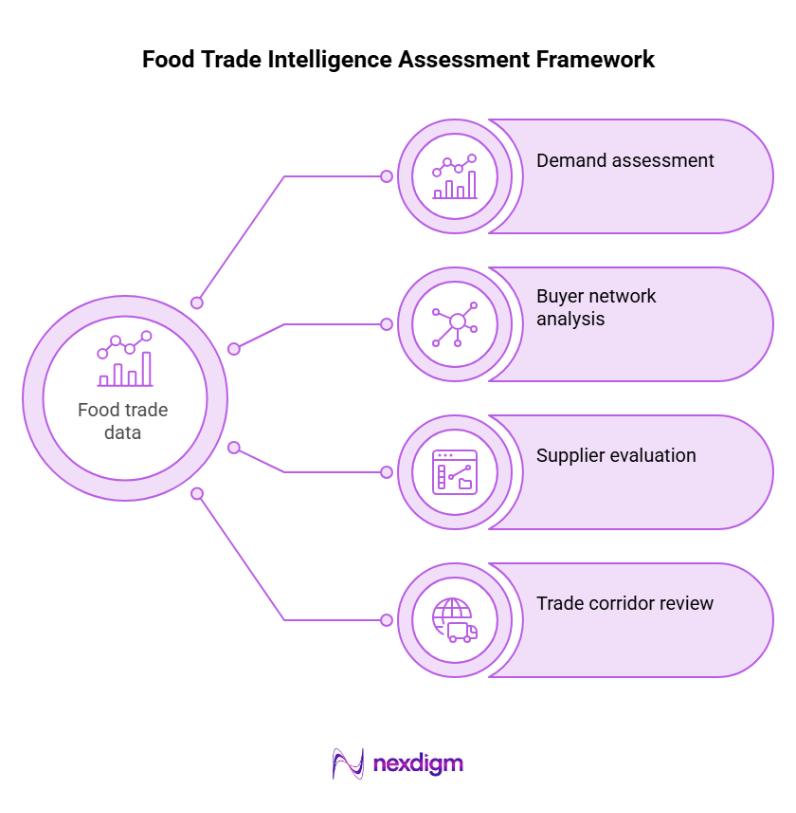
- Demand and Consumption Assessment: Aanalysis of import activity, consumption trends, and category-level demand patterns to identify markets where food products demonstrate sustained commercial potential.
- Buyer and Distribution Network Analysis: Nexdigm evaluates importers, distributors, channel participants, and purchasing patterns to understand how products reach end markets and customers.
- Supplier and Sourcing Landscape Evaluation: Assessment of supplier networks, sourcing structures, and trade relationships to identify supply dependencies, alternative sourcing options, and competitive dynamics.
- Trade Corridor and Market Accessibility Review: Nexdigm analyzes trade routes, origin-destination relationships, and market-entry conditions to identify practical pathways for market expansion and exports.
By applying an assessment framework, Nexdigm helps food and beverage businesses identify high-potential opportunities, strengthen market positioning, and pursue sustainable domestic and international growth.
Nexdigm’s Assessment Framework Driving Sustainable Food Trade Growth
Achieving sustainable growth requires more than identifying attractive markets or demand opportunities. Businesses must understand where growth is commercially viable and which opportunities can deliver long-term value. Nexdigm’s assessment framework helps organizations make these decisions by:
- Identifying Scalable Growth Opportunities: Nexdigm evaluates demand patterns, market potential, and trade trends to identify opportunities that can support long-term revenue growth rather than short-term market gains.
- Strengthening Market Expansion Strategies: Through analysis of buyers, competitors, distribution networks, and market-entry conditions, Nexdigm helps businesses prioritize markets with the highest potential for successful expansion.
This helps food and beverage businesses identify sustainable growth avenues, optimize market and sourcing strategies, strengthen competitive positioning, and pursue long-term domestic and international expansion with greater confidence.
Nexdigm’s Case
Nexdigm supported an India-based industrial-products company through product-wise import-export analysis across key markets. The resulting insights contributed to a 27% increase in qualified export opportunities and an 8% improvement in price realization, while supporting sharper product prioritization.
To take the next step, simply visit our Request a Consultation page and share your requirements with us.
Harsh Mittal
+91-8422857704