

Global food trade is becoming more interconnected while exposure to supply and market shocks is increasing. According to FAO’s State of Agricultural Commodity Markets 2026, the value of food and agricultural trade increased fivefold between 2000 and 2024, reaching around US$2 trillion. At the same time, low- and middle-income countries have become increasingly integrated into global food-trade networks.
This makes shipment values and volumes only one part of the picture. Food businesses need to understand which products are driving trade, where import demand is strengthening, which countries are gaining export share, how supplier relationships are changing, and whether competitive shifts are structural or temporary.
This is where global food trade intelligence can provide greater commercial visibility, connecting trade movements with product-level demand, supplier positioning, pricing, sourcing patterns, and market developments to identify where meaningful opportunities and risks are emerging.
Understanding the Changing Supplier Patterns
Supplier movements can provide early indications of competitive change. A country’s share may decline because buyers are switching origins, new suppliers are becoming more competitive, or logistics and trade-policy conditions have changed.
Tracking supplier shares across products and destinations allows businesses to identify who is gaining, who is losing, and where sourcing relationships are being reshaped. These movements can be particularly valuable for exporters seeking new markets and importers evaluating alternative sources.
How Food Trade Intelligence Adds Commercial Context
Food trade data becomes more useful when it is connected to the realities of the food value chain. Production cycles, processing capacity, distribution structures, import dependence, consumer demand, and regulatory conditions can all influence international trade.
Nexdigm combines trade intelligence, market research, competitive intelligence, pricing analysis, and primary research to interpret these factors. The Global food trade intelligence examines products, brands, companies, countries, regions, ports, and trade corridors.
Nexdigm’s Food Industry Trade Intelligence Approach
Food trade opportunities are shaped by demand trends, sourcing dynamics, pricing movements, and competitive activity across the value chain. Nexdigm combines trade intelligence with market insights to help businesses understand where opportunities exist through:
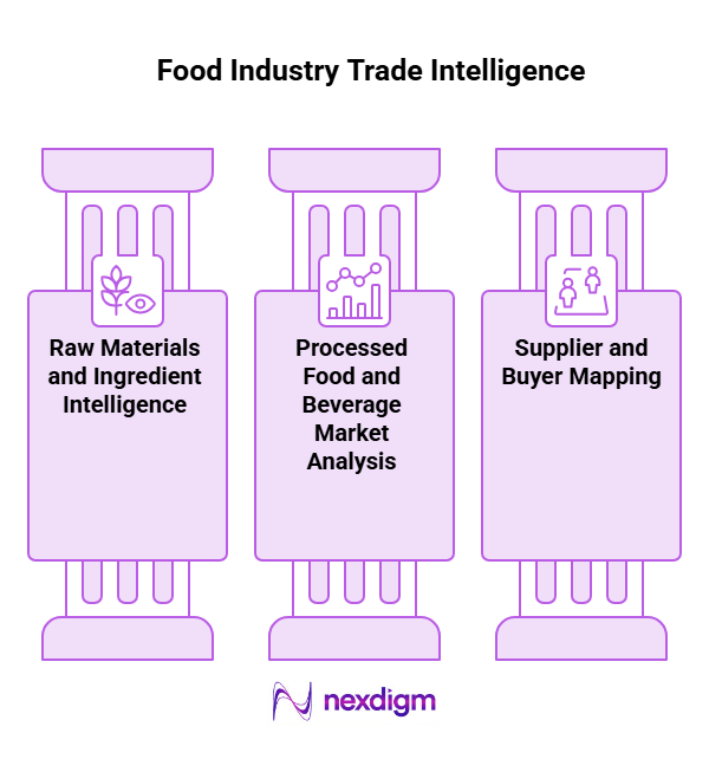
- Raw Materials and Ingredient Intelligence: Analysis of sourcing patterns, trade flows, and supplier activity for agricultural commodities and ingredients to identify supply availability and procurement opportunities.
- Processed Food and Beverage Market Analysis: Evaluation of demand trends, import activity, and market growth across processed food and beverage categories to identify attractive commercial opportunities.
- Supplier and Buyer Mapping: Identification of active suppliers, importers, distributors, and purchasing companies to help businesses understand market participants and potential trading relationships.
With Nexdigm’s strategic approach, businesses get to understand what is driving trade activity and where sustainable commercial opportunities exist.
What Makes Nexdigm’s Food Trade Intelligence Different
Food trade decisions require more than visibility into import and export transactions. Understanding commercial opportunities often requires connecting trade movements with demand drivers, sourcing structures, buyer behavior, pricing dynamics, and competitive realities. Nexdigm combines trade intelligence with industry expertise and market validation to help businesses understand:
- Trade Data with Industry Context: Nexdigm examines trade movements alongside value-chain dynamics, helping businesses understand the commercial factors influencing food markets.
- Go Beyond Transactional Intelligence: Nexdigm combines shipment analysis with market research and competitive intelligence to provide a more comprehensive view of opportunities.
- Validation Through Market Insights: Trade findings are supplemented with primary research and channel intelligence to strengthen confidence in key business decisions.
This integrated perspective enables businesses to move beyond trade statistics and develop a deeper understanding of the opportunities shaping food markets.
How Nexdigm’s Approach Enables Strategic Decision-Making Across the Food Value Chain
Trade intelligence is most valuable when it supports business decisions across sourcing, production, distribution, and market expansion. Nexdigm helps organizations translate market insights into strategic actions by providing:
- Procurement Decision Support: Nexdigm helps businesses evaluate sourcing options, supplier landscapes, and trade dependencies to support procurement planning.
- Market Expansion Guidance: Assistance in identifying attractive growth markets and validates opportunities before businesses commit resources.
- Commercial Strategy Development: Nexdigm analyzes demand, pricing, competitors, and buyer ecosystems to support informed commercial and growth strategies.
- Distribution and Channel Optimization: Evaluation across distribution networks, channel structures, and market-access dynamics to help businesses improve product reach, availability, and market penetration.
- Investment and Growth Prioritization: Nexdigm assesses market attractiveness, demand potential, and competitive dynamics to help organizations prioritize investments and focus resources on high-impact growth opportunities.
This integrated approach enables food businesses to make data-driven decisions across the value chain and pursue growth with greater confidence.
Nexdigm’s Food Trade Intelligence Case
Nexdigm supported a food-sector client in assessing its international sourcing network by analyzing supplier concentration, country-of-origin shares, shipment frequency, product-level imports, and indicative unit values. The assessment identified 14 alternative suppliers across 4 countries, highlighted three high-dependency sourcing markets, and supported a sourcing strategy that reduced supplier concentration by 19% while improving procurement flexibility.
To take the next step, simply visit our Request a Consultation page and share your requirements with us.
Harsh Mittal
+91-8422857704