
Global food trade is undergoing a structural shift as consumption growth, production capacity, sourcing strategies, and geopolitical conditions reshape cross-border flows. According to the FAO’s 2026 State of Agricultural Commodity Markets, food and agricultural trade increased fivefold between 2000 and 2024, reaching about US$2 trillion. However, deeper integration has also increased exposure to climate, geopolitical, economic, and supply-chain shocks.
The geography of food trade is changing alongside its scale. FAO data shows that Asia’s agricultural trade deficit has widened over time, reflecting greater reliance on imports to meet food and feed requirements. Meanwhile, global commodity trade remains concentrated, with the top two exporters of soybeans and palm oil accounting for approximately 85% of exports in 2024.
These developments make global food trade trends increasingly relevant for companies evaluating export expansion, sourcing diversification, market entry, and supply-chain resilience. The opportunity is not simply to identify where trade volumes are increasing, but to understand which products, countries, suppliers, buyers, and trade routes are driving those changes.
Demand Is Rebalancing Across Global Markets
Food demand is becoming increasingly differentiated by geography and product. Population growth, urbanization, changing diets, rising incomes, food-processing requirements, and demand for convenience can shift import requirements across individual categories.
For businesses, this makes country-level growth an incomplete indicator. Examining product-specific imports, consumption drivers, sourcing patterns, and historical trade movements can reveal where demand is strengthening and whether the opportunity is likely to persist.
Supply Is Becoming More Strategically Distributed
Export supply is also changing as producing countries expand agricultural output, processing capabilities, infrastructure, and access to international markets.
New exporting origins can gain relevance by offering competitive pricing, reliable supply, quality consistency, or access to new destinations. Tracking these developments can help businesses identify emerging production centres and potential alternatives to concentrated sourcing networks.
Nexdigm in Offering Food Supply and Export Intelligence Services
Nexdigm assesses global food trade trends by connecting agricultural production, processing capacity, export performance, supplier competitiveness, and international market access. This helps businesses understand:
- Production and Processing Strength: Nexdigm evaluates agricultural output, raw-material availability, processing infrastructure, and quality capabilities to determine whether growing exports are supported by a scalable food-supply ecosystem.
- Export Capability: Nexdigm analyses export volumes, product mix, destination coverage, supplier shares, and pricing to identify origins building stronger positions across international food markets.
- Supply Diversification: Nexdigm maps established and emerging origins to identify alternative sourcing opportunities, supplier dependencies, and countries gaining relevance within global food supply networks.
By assessing these areas, Nexdigm helps businesses understand which emerging food-export centres represent sustainable competitive shifts and where new sourcing or market opportunities may exist.
How Nexdigm’s Food Trade Offerings Create Deeper Trade Intelligence
Nexdigm’s offering goes beyond tracking import and export movements by combining trade intelligence with market research, industry expertise, competitive assessment, supply-chain intelligence, and primary research. This allows businesses to access:
- Trade Intelligence and Industry Expertise: Nexdigm connects product-level trade data with food-industry knowledge to explain supplier shifts, demand movements, pricing changes, and evolving trade relationships.
- Primary Research: Trade signals can be validated through distributor interviews, buyer discussions, market visits, channel checks, and other primary research to understand on-ground market conditions.
- Market Opportunity and Supply Assessment: Nexdigm evaluates demand alongside production capabilities, processing capacity, logistics, regulatory requirements, and route-to-market economics to assess whether an opportunity is commercially executable.
- Strategy Analysis: Findings are translated into practical recommendations covering market prioritization, export expansion, sourcing diversification, partner identification, competitive positioning, and investment decisions.
This integrated model helps businesses move from “where trade is moving” to “why it is moving, whether the shift is sustainable, and what action the business should take.”
Nexdigm’s Global Food Trade Intelligence Framework
Nexdigm can structure global food trade analysis through five connected stages, combining trade intelligence, food-industry expertise, market research, and commercial assessment to translate changing trade patterns into actionable opportunities. This framework involves the following steps:
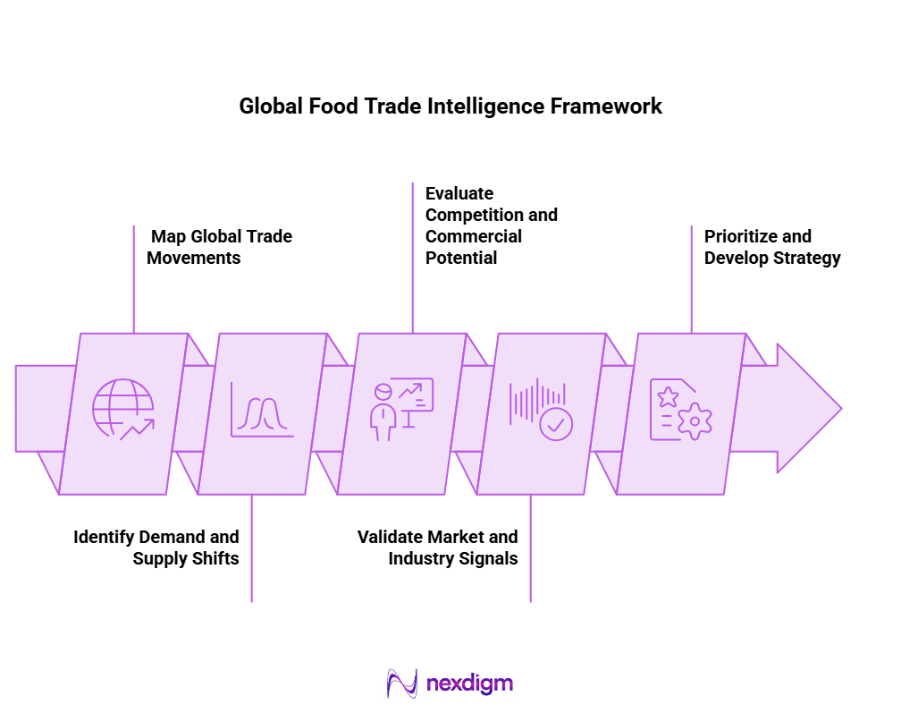
- Map Global Trade Movements: Analyze products, importers, exporters, origins, destinations, shipment activity, ports, and trade corridors to establish how food products are moving across markets.
- Identify Demand and Supply Shifts: Assess import growth, export momentum, production capacity, supplier participation, sourcing concentration, and product-level trends to identify changing demand centres and emerging supply origins.
- Evaluate Competition and Commercial Potential: Benchmark suppliers, buyers, pricing, market shares, product positioning, tariffs, regulations, logistics, and distribution structures to determine which markets and products offer stronger commercial potential.
- Validate Market and Industry Signals: Combine trade data with primary research, buyer and distributor discussions, channel checks, market visits, and industry research to validate trade movements and understand the factors driving them.
- Prioritize and Develop Strategy: Rank opportunities based on demand, supply strength, competition, pricing, accessibility, and strategic fit, then translate findings into export, sourcing, market-entry, partnership, or investment strategies.
This five-step approach enables Nexdigm to connect what is happening in global food trade with why it is happening and what businesses should do next.
Nexdigm’s Case
Nexdigm supported an agribusiness client evaluating product-market combinations across 12 international markets. By analyzing demand growth, supplier movements, pricing, buyer activity, and market accessibility, the engagement identified 7 priority opportunities and 11 emerging supplier gaps. The resulting strategy contributed to a 24% increase in qualified leads and a 15% reduction in market-development costs.
To take the next step, simply visit our Request a Consultation page and share your requirements with us.
Harsh Mittal
+91-8422857704