

Global gas markets are being reshaped by rising LNG capacity, changing regional demand, infrastructure constraints, and shifting price signals. GECF reported that global gas trade reached 1.20 trillion cubic metres in 2025, up 3%, while LNG trade increased 6.5% to a record 437 million tonnes.
Europe’s LNG imports rose by 29 million tonnes, whereas Asia’s declined by 8 million tonnes. In 2026, U.S. LNG exports averaged 17.4 billion cubic feet per day during the first half, 23% above the same period in 2025. EIA also reports that U.S. LNG exports reached 16.74 Bcf/d in July 2026, the highest July level since large-scale U.S. LNG exports began.
These movements show why global gas trade analysis needs to examine more than shipment volumes. Supply availability, destination demand, LNG capacity, pipeline infrastructure, pricing, storage, and supplier relationships can reveal where the global gas market is rebalancing.
LNG Is Changing the Geography of Gas Trade
The expansion of LNG is allowing gas to move between markets that are not connected by pipelines. This creates greater flexibility but also increases competition for cargoes when supply is constrained. GECF reported that Europe accounted for 30% of global LNG trade in 2025, while Asia remained the largest importing region with 63%.
Price Signals Influence Where Gas Flows
Gas does not necessarily move toward the market with the highest demand; transportation costs, contract structures, infrastructure, storage levels, and regional price differences also influence destination choices. In 2026, EIA reported that higher LNG prices in Europe and Asia helped incentivize U.S. exports, while disruptions through the Strait of Hormuz redirected U.S. LNG toward Asian buyers.
- Destination Shifts: Track changing LNG and pipeline imports to identify markets gaining or losing supply.
- Price Signals: Compare regional prices and trade economics to understand why cargoes move between competing destinations.
By analyzing destination shifts and regional price signals, businesses can better understand changing gas trade flows and make more informed sourcing, trading, and market-entry decisions.
Nexdigm’s Role in Navigating Global Gas Markets
As gas markets become more interconnected, businesses need to understand which markets are accessible, how pricing is evolving, and where competitive conditions are changing. Nexdigm brings these perspectives together to gain:
- Market-Level Insights: Nexdigm evaluates supply, demand, imports, exports, infrastructure, and pricing across markets to identify where gas-market conditions are changing.
- Commercial-Level Insights: Supplier activity, buyer relationships, trade routes, pricing, and competitive positioning are assessed to identify commercially relevant opportunities.
- Strategic-Level Insights: Market findings are translated into priorities for sourcing, market entry, supplier diversification, LNG planning, and risk management.
This enables businesses to build a more connected view of global gas movements and the commercial decisions influenced by them.
Why Businesses Partner with Nexdigm
Nexdigm helps businesses move beyond isolated market indicators by conducting global gas trade analysis. Through this integrated and industry-focused approach, Nexdigm translates complex LNG and pipeline gas market signals into actionable insights, enabling organizations to strengthen sourcing strategies, identify growth opportunities, enhance supply resilience, and make more confident commercial and expansion decisions.
What Nexdigm Assesses Within the Global Gas Markets
Understanding gas-market shifts requires looking beyond import and export volumes. Nexdigm examines the supply, demand, infrastructure, pricing, and competitive factors that determine how gas moves between markets:
- Supply and Production: Assess gas production, LNG liquefaction capacity, pipeline supply, exporter participation, and supplier concentration.
- Demand and Market Balance: Examine imports, consumption, storage, buyer activity, import dependence, and changing regional requirements.
- Pricing and Trade Economics: Compare regional prices, indicative trade values, transportation costs, and supplier economics to understand market attractiveness.
Together, these focus areas establish the basis for a structured global gas trade assessment, helping businesses understand where supply is available and which markets offer stronger commercial potential.
Nexdigm’s Global Gas Trade Assessment
Nexdigm can assess global gas markets through four connected stages, linking supply, trade flows, infrastructure, demand, pricing, and competition to identify commercially relevant opportunities and risks. These stages are as follows:
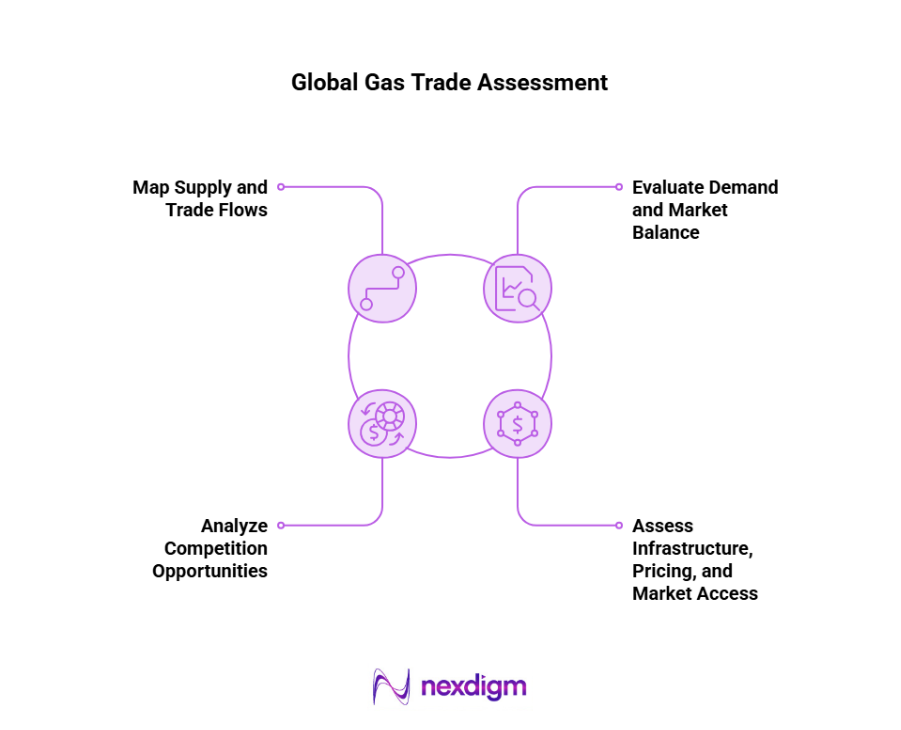
- Map Supply and Trade Flows: Assess gas production, LNG liquefaction capacity, pipeline suppliers, exporter participation, imports, exports, origins, destinations, volumes, and shipment activity.
- Evaluate Demand and Market Balance: Examine consumption, import dependence, storage levels, buyer activity, seasonal requirements, market growth, and supply availability to identify markets where demand is strengthening or supply conditions are tightening.
- Assess Infrastructure, Pricing, and Market Access: Evaluate pipelines, LNG terminals, regasification capacity, storage, ports, shipping routes, logistics, regional prices, and transportation costs to determine how accessible and commercially attractive different markets are.
- Analyze Competition Opportunities: Compare suppliers, buyers, companies, contracts, market shares, alternative sources, trade corridors, and competitive conditions to identify attractive markets, sourcing alternatives, emerging opportunities, and potential risks.
This four-step approach helps businesses move from understanding where gas is moving to determining which markets, suppliers, routes, and commercial opportunities deserve strategic attention.
Nexdigm’s Case
Nexdigm supported an energy-sector client by evaluating 6 regions, 50+ trade, pricing, supply, and infrastructure indicators, and multiple gas-supply routes. The assessment identified priority markets, 12 potential supply sources, and high-priority trade corridors, supporting more focused sourcing and international expansion decisions.
To take the next step, simply visit our Request a Consultation page and share your requirements with us.
Harsh Mittal
+91-8422857704