

Global Healthcare Pricing Benchmarking Consulting helps healthcare organizations understand how service prices, reimbursement levels, operating costs, and patient affordability differ significantly across regions. Through structured Pricing Strategy Analysis, providers, payers, and healthcare investors can compare market rates, identify pricing gaps, and develop locally relevant pricing models.
This approach combines competitive benchmarking, cost analysis, regulatory insights, payer dynamics, and demand assessment to support informed decisions. Global healthcare pricing benchmarking consulting also helps organizations balance accessibility and profitability while building sustainable pricing strategies for diverse healthcare systems and market conditions worldwide.
A recent study shows that health spending averaged nearly USD 6,000 per person, while the US exceeded USD 14,880 about 2.5 times the average. This substantial variation highlights how market-specific benchmarking can improve pricing accuracy, affordability, investment planning, and commercial sustainability.
Pricing Strategy Analysis for Sustainable Health Insurance Premiums
Pricing Analysis helps health insurers understand claims pressure, assess market realities, and implement balanced pricing decisions that protect affordability, competitiveness, retention, profitability, and long-term portfolio sustainability. Its major focus areas are:
- Diagnose Claims and Cost Drivers: Review claims ratios, medical inflation, utilization patterns, member profiles, and benefit costs to understand why current premiums may no longer support sustainable portfolio performance.
- Assess Market and Regulatory Conditions: Compare competitor premiums, customer affordability, regulatory requirements, and market trends to identify realistic pricing boundaries and ensure proposed premium changes remain compliant, relevant, and competitive.
- Segment Customers and Portfolio Risks: Group members by risk profile, geography, age, plan type, and claims behavior to develop pricing approaches that more accurately reflect expected costs and customer needs.
- Model and Test Premium Scenarios: Evaluate premium increases, benefit changes, retention risks, and claims projections under multiple scenarios to understand financial outcomes and customer impact before making final pricing decisions.
Nexdigm’s Strategic Pricing Support for Diverse Healthcare Markets
Nexdigm helps healthcare organizations make confident pricing decisions across diverse markets through comprehensive Global Healthcare Pricing Benchmarking Consulting, Healthcare Pricing Analysis, and Pricing Strategy Analysis. By combining market benchmarking, cost and reimbursement analysis, competitive intelligence, affordability assessment, and regional pricing insights, Nexdigm develops data-driven pricing strategies that improve market competitiveness, optimize pricing structures, support informed expansion decisions, and drive sustainable revenue growth across global healthcare ecosystems.
Nexdigm’s Blueprint for Healthcare Pricing Across Diverse Markets
Nexdigm’s blueprint helps healthcare organizations compare markets, understand pricing differences, and build practical strategies that balance affordability and long-term growth across diverse healthcare systems with confidence. Its key steps and measures include:
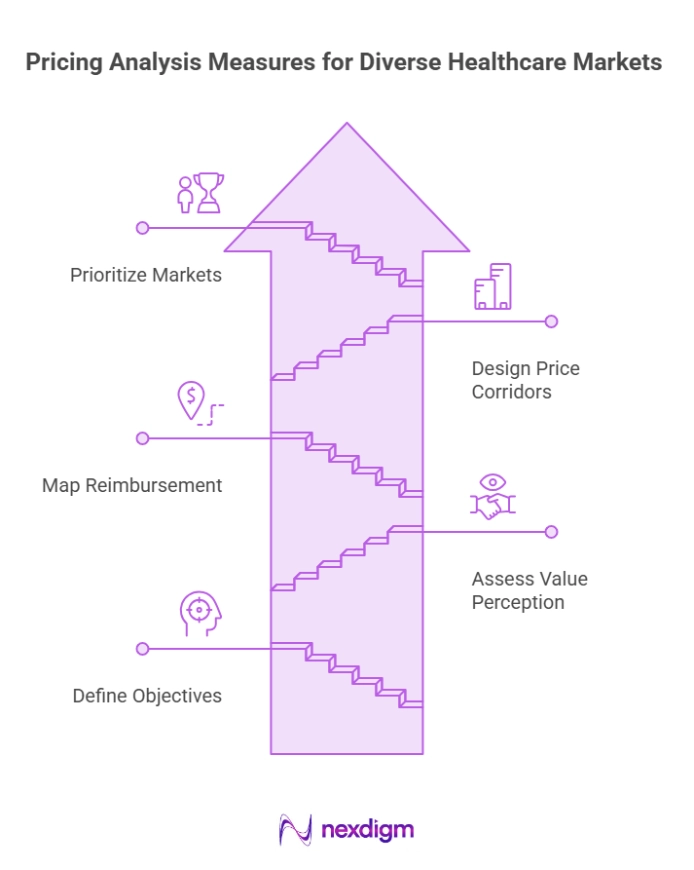
- Defining Strategic Pricing Objectives: Clarifying growth priorities, target segments, margin expectations, affordability goals, and market-entry ambitions to establish clear criteria for evaluating pricing decisions across diverse healthcare markets.
- Assessing Local Value Perception: Examining how patients, providers, payers, and partners value healthcare services to understand willingness to pay, perceived differentiation, and acceptable pricing levels within each market.
- Mapping Reimbursement and Access Pathways: Reviewing payer structures, reimbursement mechanisms, funding models, regulatory controls, and access barriers to determine how local healthcare systems influence achievable prices and revenue potential.
- Designing Market-Specific Price Corridors: Developing minimum, target, and premium price ranges based on value, affordability, competition, costs, reimbursement potential, and commercial objectives for each priority healthcare market and segment.
- Prioritizing Markets and Pricing Actions: Ranking markets and initiatives according to revenue potential, implementation complexity, access readiness, strategic importance, and pricing flexibility to focus resources on the strongest opportunities first.
Nexdigm’s Case
A healthcare group engaged Nexdigm to benchmark service pricing across six diverse markets. Nexdigm identified pricing gaps exceeding 20%, enabling targeted adjustments that improved projected margins by 12%, increased revenue potential by 9%, and reduced cross-market pricing inconsistencies by 18%, while maintaining local affordability and competitive positioning across priority regions.
To take the next step, simply visit our Request a Consultation page and share your requirements with us.
Harsh Mittal
+91-8422857704