

Healthcare products move through highly interconnected international supply networks. Pharmaceuticals depend on APIs, intermediates, formulation and distribution; medical devices rely on specialized components, manufacturing sites, regulatory approvals, and healthcare procurement channels. In 2025, pharmaceuticals were among the stronger-performing merchandise sectors, with global pharmaceutical trade growing 17% year-on-year according to UNCTAD.
The scale and complexity of these flows make healthcare trade analysis increasingly important. A country’s high pharmaceutical imports may indicate strong patient demand, limited domestic manufacturing, or dependence on overseas suppliers. Similarly, medical-device imports can reveal investment in hospitals, diagnostic infrastructure, specialty care, or replacement demand.
For businesses, the objective is therefore not simply to identify where healthcare products are traded, but to understand what products are moving, who supplies them, where dependencies exist, which markets are expanding, and how supply networks reach healthcare providers.
Healthcare Trade Is Becoming More Product-Specific
Pharmaceuticals, APIs, medical devices, diagnostic equipment, hospital supplies, and healthcare consumables follow different demand and supply patterns.
A market showing strong pharmaceutical imports may have very different commercial characteristics from one importing advanced imaging equipment. Product-level analysis therefore helps businesses distinguish therapy demand, manufacturing gaps, hospital investment, procurement requirements, and specialized equipment needs.
Supply Networks Extend Beyond the Finished Product
In pharmaceutical and medical device industries, supply chains often span multiple countries, suppliers, and operational stages. Understanding these interconnected networks helps businesses identify dependencies through:
- Supply Chain Dependency Mapping: Mapping suppliers, manufacturing sites, components, packaging sources, and logistics partners to identify concentration risks and critical dependencies.
- Disruption and Alternative Source Assessment: Evaluating potential disruption points and alternative sourcing options to improve resilience, reduce risk exposure, and maintain continuity.
A comprehensive supply network assessment enables organizations to strengthen supply chain resilience, mitigate disruption risks, and support informed strategic decision-making.
Nexdigm’s Healthcare Market and Supply Chain Expertise
Navigating healthcare supply chains requires a clear understanding of supplier dependencies, market dynamics, and operational risks. Leveraging deep industry knowledge and data-driven analysis, Nexdigm helps organizations gain visibility into complex value chains, evaluate supply risks, and make informed strategic decisions that support resilience, continuity, and long-term growth.
Why Businesses Turn to Nexdigm
As healthcare supply chains become more interconnected and vulnerable to disruption, organizations require strategic intelligence that extends beyond supplier visibility. Nexdigm provides the following insights to help businesses identify risks, uncover dependencies, and strengthen supply chain resilience:
- End-to-End Value Chain Perspective: Nexdigm evaluates healthcare ecosystems across suppliers, manufacturing, logistics, and distribution networks to deliver comprehensive supply chain visibility.
- Data-Driven Decision Support: Combining market intelligence with supply network analytics enables organizations to make informed sourcing, investment, and risk management decisions.
- Focus on Actionable Insights: Nexdigm translates complex supply chain data into practical recommendations that support resilience, operational continuity, and sustainable growth.
This combination of industry knowledge and analytical rigor forms the foundation of Nexdigm’s Supply Network Intelligence Assessment.
Nexdigm’s Global Healthcare Trade and Supply Network Assessment
Nexdigm evaluates healthcare supply networks across suppliers, manufacturing locations, intermediates, logistics channels, and distribution ecosystems through global healthcare trade analysis to identify dependencies, risks, and resilience opportunities by conducting:
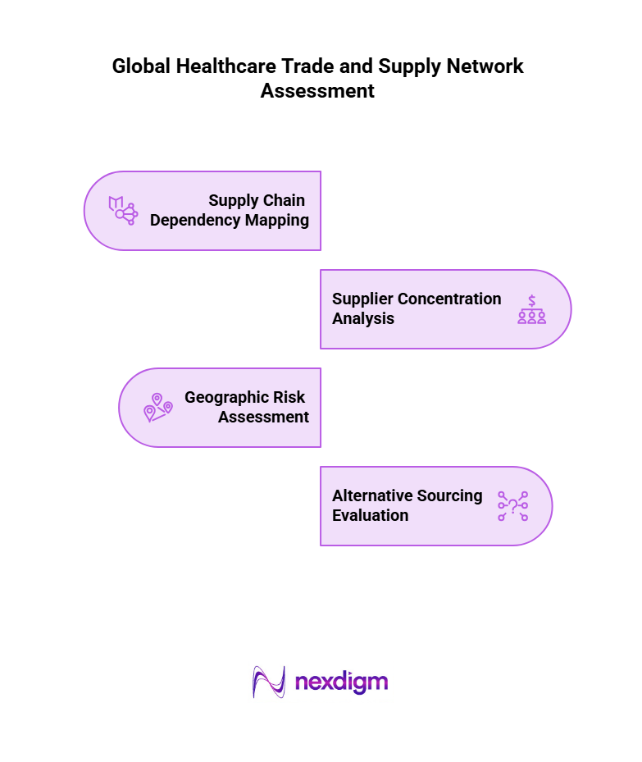
- Supply Chain Dependency Mapping: Analysis of supplier relationships across APIs, intermediates, components, packaging materials, manufacturing facilities, and distribution channels to uncover critical dependencies.
- Supplier Concentration Analysis: Assessment of reliance on specific suppliers, regions, or manufacturing hubs to identify areas where excessive concentration may increase supply risk.
- Geographic Risk Assessment: Evaluation of sourcing and production footprints across countries to understand potential exposure to geopolitical, regulatory, trade, or environmental disruptions.
- Alternative Sourcing Evaluation: Identifying viable backup suppliers and manufacturing options to reduce dependency on single-source supply arrangements and improve resilience.
Through this comprehensive assessment of supply network structures and dependencies, Nexdigm helps healthcare organizations strengthen resilience, mitigate disruption risks, and support long-term supply chain sustainability.
How Businesses Can Apply Nexdigm’s Global Healthcare Trade Assessment Insights
Supply network intelligence can support a range of strategic and operational decisions across the healthcare value chain. By leveraging Nexdigm’s assessment, organizations can proactively address supply risks while strengthening long-term competitiveness through:
- Supplier Diversification Planning: Identifying alternative suppliers and sourcing regions to reduce concentration risks and improve supply chain resilience.
- Manufacturing Footprint Optimization: Evaluating production dependencies and facility locations to enhance operational flexibility and continuity planning.
- Market Entry and Expansion Decisions: Assessing supply ecosystem readiness and sourcing capabilities when evaluating new markets or growth opportunities.
- Risk Mitigation Strategies: Addressing potential vulnerabilities arising from supplier concentration, geographic exposure, and logistics dependencies.
- Procurement Planning: Supporting sourcing and procurement decisions through greater visibility into supplier networks, availability, and supply continuity.
By applying these insights, healthcare organizations can strengthen supply chain resilience, improve operational decision-making, and support sustainable business growth.
Nexdigm’s Case
Nexdigm supported a global pharmaceutical company that was procuring chemical raw materials through an intermediary. Its spend and volume analysis identified materials suitable for direct manufacturer sourcing. The resulting approach reduced raw-material costs by approximately 23% and improved delivery speed by up to 30%.
To take the next step, simply visit our Request a Consultation page and share your requirements with us.
Harsh Mittal
+91-8422857704