

Businesses can no longer rely on intuition when making expansion, sourcing, or investment decisions. The global marketplace is influenced by changing consumer preferences, geopolitical developments, trade agreements, supply chain disruptions, and economic cycles. To identify these complexities, organizations are turning to Global Import Export Data as a powerful source of market intelligence.
More than just a record of goods, import-export data provides valuable insights into demand patterns, supply capabilities, competitive dynamics, and emerging growth opportunities. When analyzed effectively, it can help businesses identify high-potential markets, optimize sourcing strategies, and stay ahead of market trends.
Understanding the Value of Global Import Export Data
Global Import Export Data includes information about international trade transactions, including the products being traded, trade volumes, values, origin and destination countries, suppliers, and buyers. This data serves as real-time information about global economic activity. By tracking trade flows, businesses can gain a deeper understanding of how industries are evolving, where demand is increasing, and which markets are becoming strategically important.
For example, a sudden increase in imports of vehicle components into a region may indicate growing manufacturing activity. Similarly, rising exports of consumer goods from a country could signal an increase in production capabilities.
Identifying Demand Trends Across Markets
One of the most important applications of Global Import Export Data is understanding market demand. When a country consistently imports large volumes of a specific product category, it suggests strong domestic demand that local production may not be able to satisfy. Businesses can use these insights to identify attractive export markets and evaluate expansion opportunities.
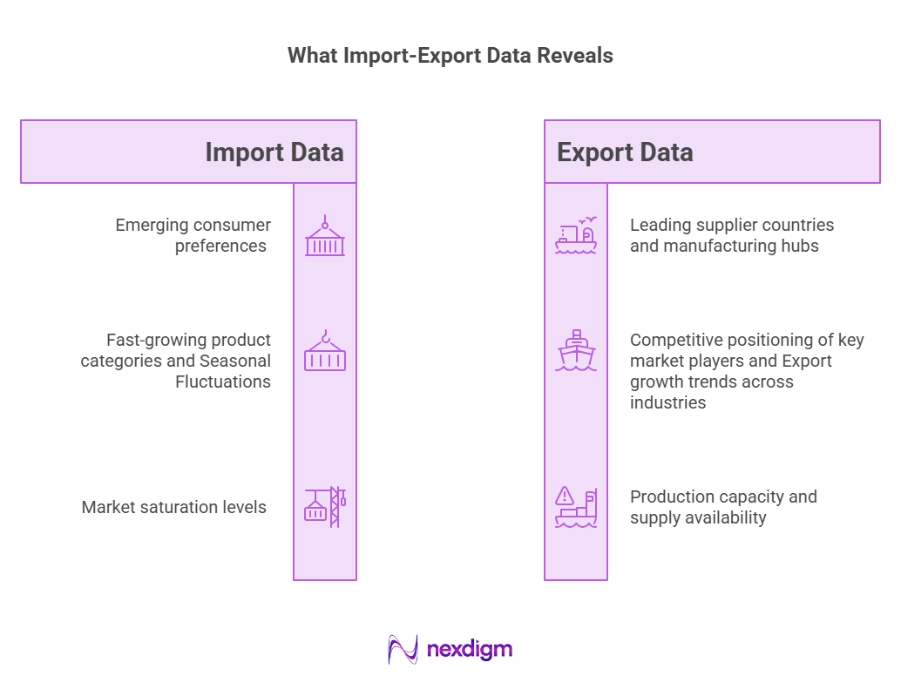
What Import data reveals is:
- Fast-growing product categories
- Seasonal demand fluctuations
- Emerging consumer preferences
- Market saturation levels
Analyzing export trends also allows businesses to identify regions with strong production capacities, emerging manufacturing hubs, and reliable sourcing opportunities.
What Export data reveals is:
- Leading supplier countries and manufacturing hubs
- Emerging sourcing destinations
- Export growth trends across industries
- Competitive positioning of key market players
- Production capacity and supply availability
By combining import and export data, businesses gain a comprehensive view of market opportunities, supply ecosystems, and industry trends. This enables organizations to make more informed decisions regarding market expansion, supplier diversification, sourcing strategies, and long-term growth planning.
Understanding Global Supply Markets for Long-Term Growth
Apart from demand analysis, trade data provides visibility to global supply ecosystems. Organizations looking for opportunities to diversify suppliers or build more resilient supply chains can analyze trade data to identify countries and suppliers with strong production capacities. This becomes especially valuable in an era where businesses are increasingly focused on reducing dependency on single-source suppliers.
In such case, Trade data helps organizations identify leading countries, monitor shifts in production and sourcing landscapes, and assess the availability of goods across regions. It can also highlight emerging trade hubs and changes in global supply dynamics driven by economic, regulatory, or geopolitical developments.
Using Trade Data to Evaluate Market Potential
A market that demonstrates increases in imports or exports over multiple years may indicate expanding industrial activity, rising consumer demand, or favorable business conditions. On the other hand, declining trade volumes can suggest weakening demand, economic slowdown, or competitive challenges. By tracking historical and current trade patterns, organizations can identify:
- High-growth markets: Trade data helps identify countries experiencing consistent increases in import and export activity, indicating strong economic growth, rising demand, and expanding business opportunities
- Emerging industries: Growing trade volumes in specific product categories can signal the rise of new industries and sectors with significant future growth potential.
- Expanding trade corridors: Increasing trade flows between regions highlight important trade routes that offer improved market access, logistics efficiency, and commercial opportunities.
- New investment areas: Strong trade activity indicates favorable business conditions, helping organizations identify attractive markets for future investments and expansion.
- Shifting global manufacturing hubs: Changes in export patterns can reveal regions gaining prominence in manufacturing, helping businesses understand evolving production and sourcing landscapes.
This ability to measure market momentum helps companies allocate resources more effectively and prioritize opportunities with the greatest growth potential.
How Nexdigm Helps Businesses Transform Trade Data into Actionable Insights
Nexdigm helps organizations transform Global Import Export Data into actionable growth opportunities through comprehensive trade intelligence and market analysis solutions. By combining data-driven insights with industry expertise, Nexdigm enables businesses to:
- Identify high-potential export and import markets
- Assess demand trends and competitive dynamics
- Evaluate supplier ecosystems and sourcing opportunities
- Analyze trade corridors and logistics performance
- Mitigate geopolitical, regulatory, and supply chain risks
- Develop long-term trade and market expansion strategies
With a structured and insight-led approach, Nexdigm allows businesses to leverage trade intelligence effectively with better positioning to capture opportunities, reduce risks, and achieve sustainable growth across international markets.
Nexdigm’s Case
Nexdigm supported a global trading enterprise in analyzing import–export data, supplier networks, and demand trends across key markets. The engagement identified high-growth trade opportunities and optimized sourcing decisions. Outcomes included a 19% improvement in demand forecast accuracy, 16% faster supplier identification, and a 13% increase in export opportunities within nine months.
To take the next step, simply visit our Request a Consultation page and share your requirements with us.
Harsh Mittal
+91-8422857704