

With an increasingly competitive global trade environment, identifying market demand is no longer about making assumptions based on industry reports. Exporters, manufacturers, and international business development teams need evidence of current trends. This is where importer intelligence becomes an important resource.
Leveraging a Global Importer Database allows businesses to move beyond assumption and focus on verified buyers who are already participating in international trade businesses. By analyzing importer behavior, organizations can uncover new opportunities, prioritize target markets, and accelerate export growth with greater confidence
The Evolution of Global Market Research
Earlier businesses relied on trade fairs, government reports, and industry networks to identify potential buyers. While these methods still help, they often lack real-time visibility required to navigate modern global markets. These days, the international trade ecosystem generates vast amounts of customs, shipment, and trade transaction data. This information provides direct insights into importing activities across countries and industries. Companies can now access this data to identify:
- Active importers and their purchasing patterns
- Product categories being sourced internationally
- Import frequency and shipment volumes
- Supplier relationships and sourcing origins
- Emerging demand trends across regions
This intelligence helps businesses identify markets where actual buying activity exists.
Why Is Importer Intelligence Important
Expanding into international markets often comes with a critical challenge, that is understanding where purchasing activity exists. In such case, Importer intelligence supports by providing visibility into real-world trade activity. Instead of depending on market potential estimates, businesses can analyze which companies are importing specific products, the frequency of their purchases, and the sourcing patterns they follow. Importer intelligence allows businesses to answer some important questions:
Who is buying?
Identifying active importers allows exporters to focus their strategies on companies already purchasing relevant products. Rather than building prospect lists from a business database, organizations can directly target buyers with demonstrated activities.
How much are they buying?
Shipment records and import volumes provide in-depth insights into buying capacity. Businesses can prioritize prospects based on the scale of their imports and potential order value.
Where are they sourcing from?
Analyzing supplier relationships reveals competitive dynamics. Companies can understand which countries dominate specific product categories and identify opportunities to position themselves as alternative suppliers.
How often do they import?
Import frequency helps determine purchasing cycles and engagement timing. Regular importers may represent ongoing partnership opportunities, while seasonal buyers require a different outreach strategy.
Using Importer Database to Identify Market Opportunities
An Importer Database serves as a strategic tool for businesses to leverage trade opportunities. It provides valuable insights into buyer behavior, sourcing patterns, and market demand across different regions. By analyzing importer data, businesses can use importer data to:
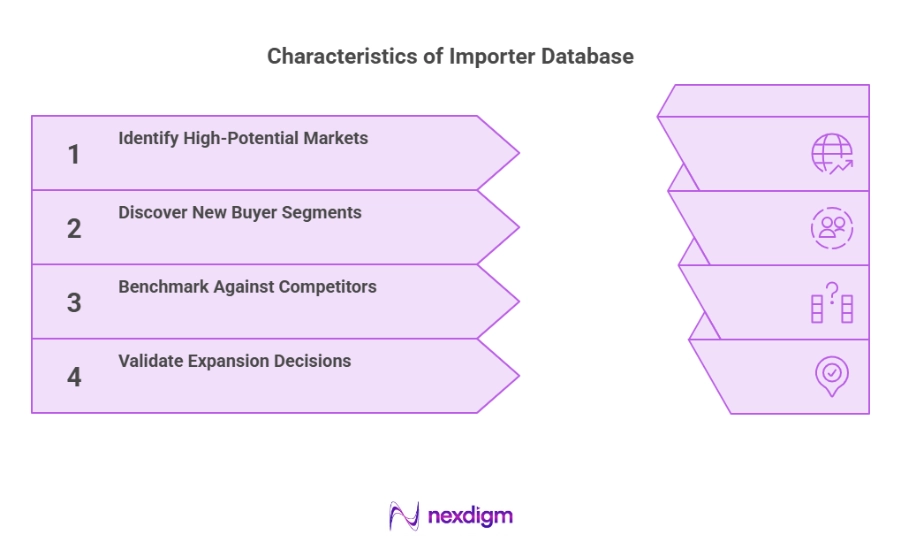
- Identify High-Potential Markets: By comparing import activity across countries, organizations can identify regions experiencing rising demand. Exporters can prioritize regions showing sustained import growth.
- Discover New Buyer Segments: Trade data reveals buyer categories that may not appear in traditional market research. Wholesalers, distributors, retailers, manufacturers, and specialized importers may all represent relevant opportunities depending on the product category.
- Benchmark Against Competitors: Importer data provides insights into competitor supply chains. Businesses can assess which buyers’ competitors serve and identify gaps.
- Validate Expansion Decisions: Market entry initiatives require significant investment. Access to importer insights helps organizations make strategic decisions, improving resource allocation.
Leveraging Importer Database for Strategic Growth
Successful exporters are increasingly adopting data-driven approaches to international expansion, by leveraging the Importer database effectively. They focus on:
- Analyzing importer demand by country and industry.
- Shortlisting high-potential buyers.
- Understanding sourcing preferences
- Tailoring value propositions to specific importer needs
- Establishing relationships based on purchasing behavior
This targeted approach ensures that business development efforts are directed towards target audiences with their buying patterns.
The Future of Importer Intelligence
As global commerce becomes increasingly interconnected, access to accurate importer intelligence will become a competitive advantage rather than a strategic advantage. Organizations that leverage trade data effectively can identify demand earlier, target buyers more precisely, and build stronger international partnerships.
On the other hand, businesses relying on traditional market research may struggle to keep pace with evolving global opportunities. A well-structured Importer Database will allow exporters to transform trade data into actionable growth strategies, helping them identify buying behavior patterns, trends and where the next opportunity lies.
Nexdigm’s Market Expansion Support Using Importer Intelligence
Nexdigm helps businesses leverage trade intelligence and market research to identify high-potential export opportunities, evaluate new markets, and build targeted international growth strategies. Through its research-driven approach, Nexdigm supports organizations with:
- Global market assessment and opportunity mapping: Nexdigm evaluates market potential, industry trends, demand patterns, and competitive landscapes to identify the most promising countries and sectors for expansion.
- Importer and buyer identification: Nexdigm helps businesses identify qualified importers, distributors, and buyers by analyzing trade data, sourcing patterns, and purchasing behavior.
- Export market entry strategy development: Nexdigm develops customized market entry strategies covering target segments, positioning, channel selection, regulatory considerations, and growth roadmaps.
- Cross-border business expansion support: Nexdigm supports international expansion through market intelligence, partner identification, risk assessment, and strategic guidance to establish a sustainable global presence.
By combining deep market expertise with comprehensive trade intelligence capabilities, Nexdigm enables businesses to uncover genuine demand, connect with relevant buyers, and pursue global expansion with greater confidence and precision.
Nexdigm’s Case
Nexdigm supported a manufacturer using importer intelligence, trade-flow analysis, and pricing benchmarking to identify active global buyers and validate demand. The engagement increased qualified importer leads by 24%, improved market prioritization accuracy and accelerated export opportunity conversion by 16%, enabling faster market expansion and sustainable revenue growth.
To take the next step, simply visit our Request a Consultation page and share your requirements with us.
Harsh Mittal
+91-8422857704