

Global logistics customer pricing research helps freight and delivery providers understand what customers value, how much they will pay, and where price sensitivity varies across markets. Global logistics customer pricing research combines pricing analysis with segmentation, willingness-to-pay studies, service preferences, delivery speed, reliability, visibility, sustainability, and competitor benchmarks.
By quantifying customer trade-offs across freight modes, routes, and service levels, businesses can design differentiated offers, optimize price points, reduce unnecessary discounting, strengthen conversion, protect margins, and align pricing strategies with evolving customer expectations across global logistics markets more effectively today.
A recent study shows that over 70% of consumers are willing to pay for premium delivery services, while 96% reporting a positive delivery experience are more likely to repurchase. These findings support value-based pricing, stronger customer retention, premium monetization, and improved logistics revenue potential.
Global Logistics Pricing Analysis for Customer Preferences Across Freight Markets
Global logistics pricing analysis evaluates customer preferences, service expectations, price sensitivity, and perceived value to establish accepted rates, strengthen conversion, improve segmentation, and support profitable service positioning across markets. Key aspects of logistics pricing analysis are:
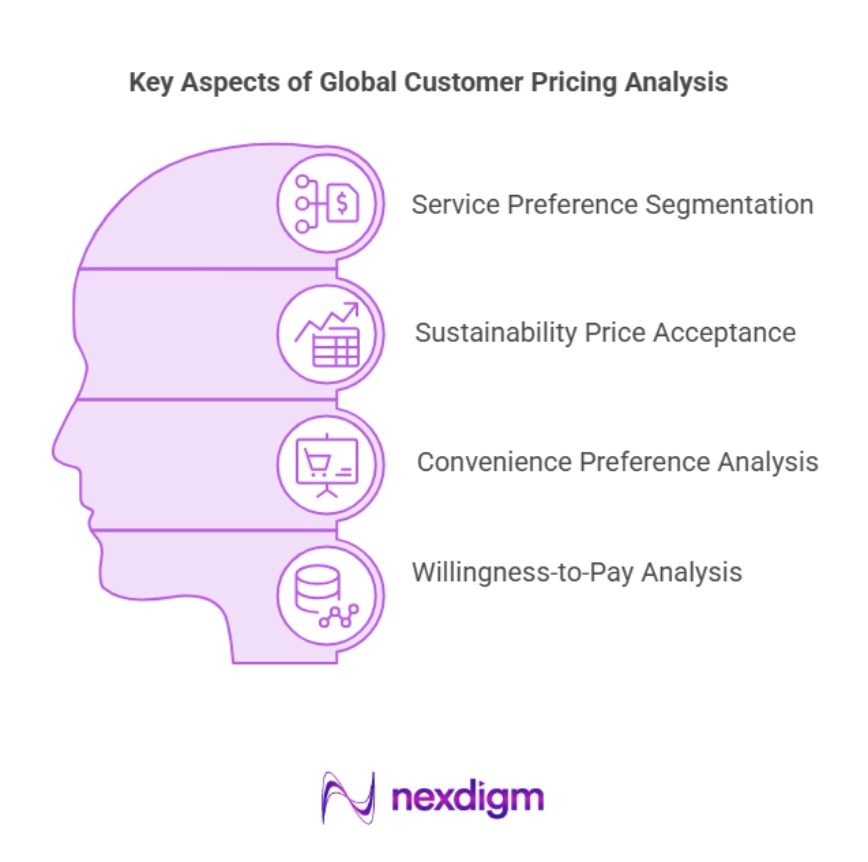
- Willingness-to-Pay Analysis: Customer responses to alternative rates, service levels, and delivery commitments are analyzed to identify acceptable price ranges and reveal opportunities for premium logistics service monetization.
- Service Preference Segmentation: Customers are grouped by preferences for speed, reliability, visibility, flexibility, sustainability, and support, enabling differentiated offers that align pricing with distinct logistics service priorities.
- Convenience Preference Analysis: Flexible delivery windows, self-service booking, rescheduling, simplified documentation, and responsive support are evaluated to understand how convenience features influence service choice and price acceptance.
- Sustainability Price Acceptance: Customer preferences for lower-emission transport, carbon reporting, sustainable packaging, and greener delivery options are assessed to identify segments willing to support sustainability-related pricing premiums.
Nexdigm’s Pricing Expertise in Logistics Customer Willingness to Pay
Nexdigm helps businesses understand logistics customer willingness to pay through pricing analysis, global logistics customer pricing research, customer preference mapping, and demand sensitivity assessment. By analyzing price acceptance, delivery expectations, service reliability, visibility requirements, and value perceptions, Nexdigm enables organizations to refine pricing strategies, improve conversion rates, reduce margin leakage, enhance customer profitability, and develop differentiated freight and delivery offerings that support long-term commercial growth.
Nexdigm’s Integrated Architecture for Customer-Centric Logistics Pricing
Nexdigm’s integrated architecture aligns customer value, service expectations, willingness to pay, and cost economics to create differentiated logistics pricing that improves revenue quality, competitiveness, retention, and commercial scalability. Some industrial benefits of the integrated model are:
- Higher Revenue per Customer: Customer-specific value drivers, service priorities, and willingness-to-pay signals support better rate realization, helping logistics providers increase revenue without relying excessively on broad discounts.
- Stronger Premium Service Monetization: Express delivery, real-time visibility, guaranteed capacity, sustainability features, and priority support are priced according to perceived value, creating additional revenue from differentiated logistics services.
- Reduced Discount Leakage: Structured willingness-to-pay bands and approval controls limit unnecessary concessions, enabling sales teams to offer competitive rates without weakening revenue quality or long-term account profitability.
- Stronger Cross-Sell Potential: Customer needs across freight, warehousing, customs, fulfillment, and last-mile delivery are analyzed together, enabling bundled pricing that increases service penetration and account-level revenue.
- Greater Industrial Scalability: A repeatable customer-centric pricing architecture enables logistics providers to standardize decision rules across markets while maintaining flexibility for customer segments, service categories, and regional conditions.
Nexdigm’s Case
Nexdigm supported a logistics provider with customer-value segmentation and premium service pricing. Results found consumers valued reduced delivery waiting time at approximately CNY96.6 per hour, demonstrating strong willingness to pay for speed, supporting differentiated pricing and higher-value service monetization.
To take the next step, simply visit our Request a Consultation page and share your requirements with us.
Harsh Mittal
+91-8422857704