

A country can be growing quickly in trade and still be a difficult logistics market to enter. Strong cargo volumes may be offset by congested gateways, fragmented customers, established operators or regulatory barriers that make network expansion expensive. For an international logistics provider, the more useful question is whether demand, infrastructure and competitive conditions line up well enough to support a defensible entry.
The trade outlook provides some promising signals. The World Trade Organization’s March 2026 baseline expects Asia to record the fastest merchandise import growth among regions at 3.3% in 2026, followed by Africa at 3.2%. Asia is also expected to lead merchandise export growth at 3.5%, alongside South America. These figures point towards expanding trade flows, but they do not by themselves indicate where a logistics company should deploy capital.
Infrastructure can change that conclusion quickly. The World Bank’s Logistics Performance Index evaluates customs, trade and transport infrastructure, international shipments, logistics competence, tracking and tracing, and timeliness. Its underlying logic is particularly relevant to market entry because a logistics operator ultimately sells the ability to move goods reliably through these systems.
A high-growth market can still be a poor entry market
The first mistake in international expansion is usually treating trade growth as the market opportunity. A growing import market may be dominated by a handful of global operators. Another market may have lower trade growth but a fragmented customer base, rising manufacturing activity and limited availability of specialised logistics services.
The quality of infrastructure matters in similarly uneven ways. A country may have modern ports but weak inland connectivity. Customs processes may be efficient at one gateway and significantly slower at another. Warehousing capacity can be available in the capital while industrial customers are expanding elsewhere.
There is also a timing question. Entering a market while infrastructure is improving can create an opportunity to establish a network before competition becomes entrenched. Entering too early, however, can leave an operator carrying underutilised assets for several years.
The market needs to be viewed from the customer’s side
For global logistics market feasibility study work, country-level indicators are only the starting point. The assessment becomes more useful when the market is reconstructed around actual customers and cargo flows.
Manufacturing clusters, exporters, retailers, pharmaceutical companies, automotive suppliers and e-commerce businesses can have very different logistics requirements. A market with modest aggregate trade may therefore contain a highly attractive niche if several target industries are expanding along the same corridors.
The competitive question follows naturally. Existing providers should be mapped by corridor, customer segment, service type and pricing rather than simply counted. A market with many operators is not necessarily closed to new entrants if most of those providers compete for the same large accounts while smaller or specialised customers remain underserved.
How Nexdigm can separate attractive markets from expensive distractions
A useful market-entry assessment should progressively narrow the opportunity rather than assign a single score to every country and call the result strategy.
Five filters can make the decision more commercially grounded:
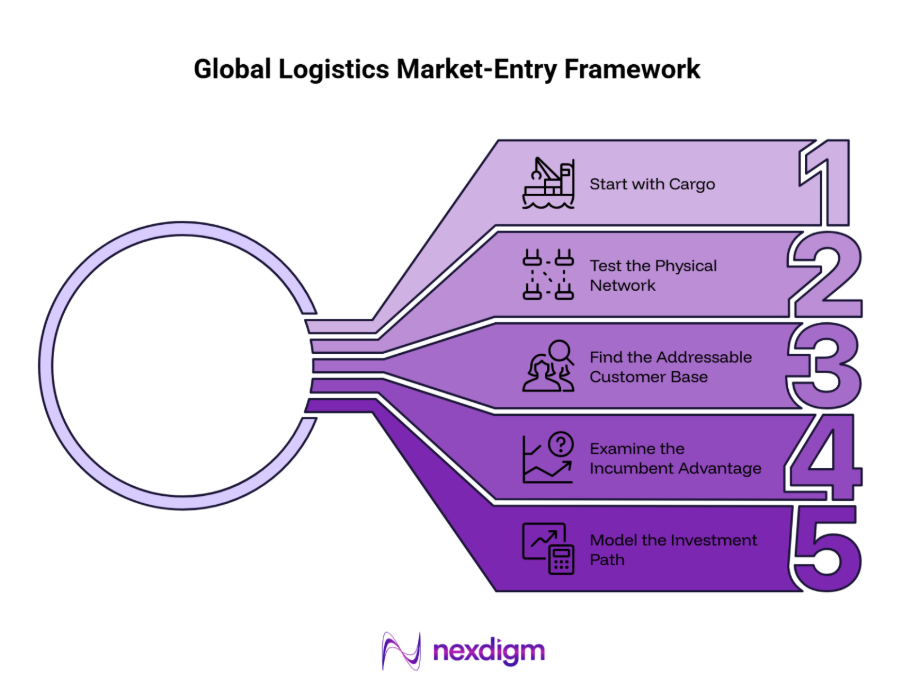
- Start with cargo, not GDP. Measure import, export, domestic freight and sector-specific flows that can actually generate logistics demand.
- Test the physical network. Assess ports, airports, roads, rail, warehouses, inland terminals and border infrastructure along the corridors relevant to target customers.
- Find the addressable customer base. Identify industries, company clusters and shipment profiles where a new provider could realistically win business.
- Examine the incumbent advantage. Map competitors by assets, coverage, pricing, contracts and service capabilities to determine where entry would require competing directly with scale.
- Model the investment path. Estimate network build-out, operating costs, customer acquisition, utilisation and the time required to reach an acceptable return.
The strongest markets are therefore those where several conditions reinforce each other: enough cargo to support a network, infrastructure capable of handling that cargo, customers that are accessible to a new entrant and competitive conditions that leave room for differentiation.
Nexdigm Case: Screening Markets for a Regional Expansion
A Nexdigm market assessment screened 12 countries across 34 demand, infrastructure, customer-access and competitive variables. Five met the initial operating thresholds; after incorporating incumbent pricing, network-build requirements and five-year investment returns, three remained viable entry markets, with two prioritised for phased expansion.
To take the next step, simply visit our Request a Consultation page and share your requirements with us.
Harsh Mittal
+91-8422857704