

Managing logistics procurement across international markets presents a complex cost challenge. Organisations may work with transportation providers, freight forwarders, warehouse operators, courier companies and specialised logistics suppliers across several countries. Each market has its own pricing structures, operating conditions, service standards and commercial arrangements.
When procurement decisions are made independently across regions, businesses can lose visibility into their total logistics expenditure. Similar services may be purchased at different rates, supplier contracts may follow inconsistent terms, and opportunities to consolidate demand can remain unidentified.
A structured global logistics procurement spend optimization approach helps organisations understand expenditure across markets, compare supplier economics and improve the commercial performance of their logistics networks.
Establishing Global Spend Visibility
The first challenge is creating a consolidated view of logistics procurement expenditure.
International businesses often maintain separate records for freight, transportation, warehousing and distribution. These records may use different cost classifications, currencies, reporting periods and supplier categories.
Before identifying savings opportunities, procurement teams need to standardise this information.
Global spend analysis should capture expenditure by country, region, supplier, service category, business unit and transportation mode. It should also distinguish between contracted rates, actual invoice payments and additional charges.
Currency conversion and differences in local billing practices must be addressed to ensure meaningful comparisons.
A consolidated spend database allows organisations to identify major spending markets, high-value suppliers and categories where commercial arrangements may be inconsistent.
Optimising Transportation and Freight Procurement
Transportation and freight frequently account for a substantial share of logistics expenditure. Costs vary according to route distance, fuel prices, shipment volumes, vehicle capacity, carrier availability and service requirements.
Road transportation procurement can benefit from route consolidation, improved load utilisation and more effective carrier allocation. Businesses should examine whether shipments are travelling with unused capacity or whether fragmented delivery schedules are increasing transportation costs.
Air and ocean freight require route-level analysis. Procurement teams should compare carrier rates, transit times, surcharges, capacity availability and handling charges across relevant trade lanes.
Freight forwarder contracts should also be examined for differences in documentation, customs brokerage, terminal handling and destination service fees.
A global sourcing strategy should account for local market conditions rather than applying one standard rate expectation across every region.
Reviewing Warehousing and Distribution Economics
Warehouse expenditure is influenced by facility location, storage requirements, labour availability, inventory levels and operational productivity.
Businesses operating across several countries may have overlapping distribution facilities or inconsistent warehouse utilisation. A network review can help identify locations where storage capacity is underused, inventory is unnecessarily fragmented or transportation distances can be reduced.
Procurement teams should compare warehouse providers using consistent measures such as cost per pallet position, handling cost per order, storage utilisation and fulfilment productivity.
The analysis should also account for the cost of relocating inventory or changing providers. A facility offering lower storage charges may create additional transportation or transition expenditure.
Distribution costs should be assessed alongside warehouse decisions because changes in facility locations can affect delivery distances and customer service requirements.
Identifying Supplier and Contract Inefficiencies
Global logistics procurement often involves a large supplier base. Different regions may use multiple providers for similar services, creating opportunities for consolidation and improved commercial negotiations.
However, supplier rationalisation should be based on operational requirements rather than supplier count alone.
A regional provider may offer stronger local coverage or specialised capabilities that a global supplier cannot match. Businesses should evaluate suppliers according to service quality, geographical reach, financial stability, capacity and compliance.
Contract benchmarking can identify differences in rate structures, escalation clauses, minimum volume commitments and payment terms.
Procurement teams should also review additional charges and invoice practices. Small discrepancies across high shipment volumes can accumulate into significant annual expenditure.
Balancing Global Procurement Leverage with Local Requirements
Centralising procurement can improve spend visibility and negotiating leverage, but global sourcing arrangements need to accommodate regional differences.
Some categories may be suitable for global or regional contracts, particularly where service specifications are consistent. Others may require local procurement because of regulatory conditions, infrastructure constraints or specialised service requirements.
A hybrid procurement model can provide central oversight while allowing local teams to manage market-specific supplier relationships.
This approach also improves accountability. Central procurement teams can establish common performance measures and commercial standards, while regional teams monitor operational delivery.
Global Logistics Procurement Spend Optimization Framework
A structured global logistics procurement spend optimization exercise should include:
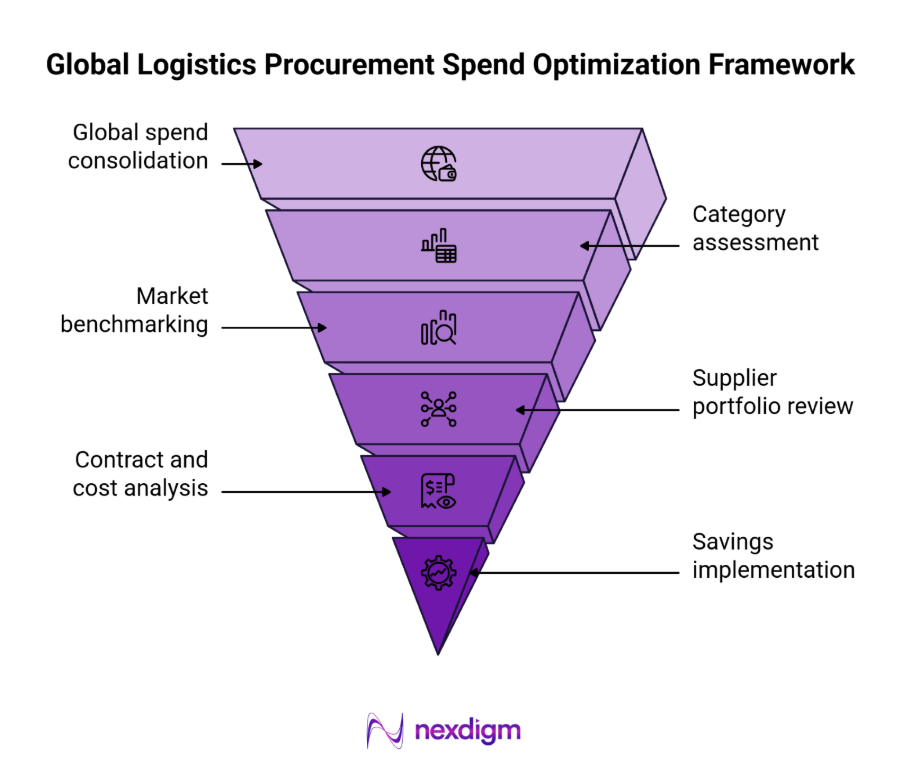
- Global spend consolidation: Standardise expenditure data across countries, business units and logistics categories.
- Category assessment: Map transportation, freight, warehousing, courier and specialised service costs.
- Market benchmarking: Compare supplier pricing and operating conditions across relevant regions.
- Supplier portfolio review: Identify overlapping providers, concentration risks and opportunities for strategic sourcing.
- Contract and cost analysis: Review rate structures, surcharges, volume commitments and invoice discrepancies.
- Savings implementation: Prioritise regional negotiations, supplier consolidation, network optimisation and process improvements.
Nexdigm can support organisations through global procurement research, logistics spend analysis, supplier benchmarking and market intelligence. These services help businesses compare costs across regions, identify sourcing opportunities and build a more coordinated approach to logistics procurement.
Nexdigm’s Case Study: Improving Global Logistics Procurement Visibility
Nexdigm analysed logistics expenditure across 8 countries, 6 procurement categories and 22 suppliers. The assessment identified 7 sourcing opportunities, highlighted a 13% variation in comparable service costs and prioritised 5 initiatives for regional procurement optimisation.
To take the next step, simply visit our Request a Consultation page and share your requirements with us.
Harsh Mittal
+91-8422857704