

Manufacturing growth is becoming increasingly uneven across countries, industries and technology levels. A rise in global production does not automatically mean that every manufacturing market offers the same opportunity. Demand may be growing in one geography while new investment is flowing elsewhere, following lower costs, stronger industrial ecosystems, policy incentives or supply-chain diversification.
For manufacturers, investors and industrial suppliers, the question is therefore twofold: where is manufacturing demand expanding, and which markets have the conditions to capture that demand?
Global Manufacturing Is Growing, But the Composition Matters
Global manufacturing production increased 1.2% quarter on quarter in Q1 2026, while manufacturing exports increased 3.5%. Higher-technology manufacturing recorded stronger growth, with production rising 1.9% and exports 4.7%. Asia and the Pacific led global manufacturing production and trade during the quarter.
These numbers reveal an important distinction.
Manufacturing opportunity is increasingly connected to the type of production being added, not simply the amount. Technology-intensive sectors can create greater requirements for specialized machinery, engineering services, skilled labour, energy infrastructure and supplier ecosystems.
A country attracting conventional production may therefore represent a different opportunity from one capturing semiconductor, electronics, advanced machinery or other higher-technology investment.
Three Signals Reveal Where Demand Is Moving
A useful global manufacturing assessment can begin by following three separate signals.
- Production growth
Industrial output shows where factories are already producing more. It provides the clearest view of current manufacturing momentum, but does not necessarily indicate where future investment will occur. - Export momentum
Rising exports can indicate that a market is becoming more competitive as a production base. They can also reveal which countries are gaining access to regional and global supply chains. - Investment flows
Greenfield projects, FDI, plant announcements and industrial capex provide a forward-looking signal. They show where companies are committing resources to future production rather than simply responding to existing demand.
Reading these three indicators together creates a more useful picture of manufacturing expansion.
Capital Is Becoming More Selective
Global investment reached $1.6 trillion in 2025, up 6%, according to UNCTAD.
Yet more than 80% of global FDI went to the world’s top 20 host economies. Strategic sectors including AI infrastructure, semiconductors, critical minerals and energy-transition technologies accounted for 44% of global greenfield project values, compared with 16% in 2020.
This concentration changes how manufacturing markets should be evaluated.
A market can have growing domestic demand but struggle to attract production investment. Another may have a smaller domestic market but offer strong export access, infrastructure, industrial capabilities or policy support.
The manufacturing opportunity therefore depends on the ability to convert demand into productive capacity.
What Makes a Market Capable of Capturing Manufacturing Growth?
Several conditions determine whether rising demand translates into local production.
- Industrial ecosystem
Availability of suppliers, logistics providers, engineering services, machinery and supporting industries can reduce the complexity of establishing new production. - Cost competitiveness
Labour remains important, but energy, logistics, land, financing and input costs can materially alter the economics of manufacturing. - Export connectivity
Trade agreements, proximity to major markets, port infrastructure and established export networks can make a location more attractive as a regional production base. - Workforce capability
Higher-technology manufacturing requires a deeper pool of engineers, technicians and skilled operators than many conventional production activities. - Policy and investment environment
Industrial incentives, infrastructure programmes, localization policies and regulatory conditions can influence where companies place new capacity. - Supply-chain resilience
Companies increasingly evaluate geographic concentration, supplier dependency and disruption exposure when determining where production should be located.
These factors need to be assessed against the requirements of the specific industry.
There is no universal “best manufacturing market” because the economics of automotive components, electronics, chemicals and industrial machinery are fundamentally different.
From Global Demand to Country-Level Opportunity
The next step is to connect manufacturing demand with the industries capable of generating it. For example, a country with strong electronics exports may offer an opportunity for component suppliers, contract manufacturers and specialized engineering providers. A market experiencing infrastructure-led construction growth may create stronger opportunities for building materials and industrial equipment. A country attracting semiconductor investment may generate demand well beyond chip fabrication, including testing, packaging, utilities, cleanroom systems and specialized services.
This makes sector-level demand mapping essential.
The IMF projects global growth of 3.0% in 2026 and 3.4% in 2027, but also emphasizes that growth is uneven, with technology-linked economies benefiting from AI-driven demand while some energy-importing economies face greater pressure.
A manufacturing assessment therefore needs to account for the economic environment surrounding each industry rather than applying a single global growth rate.
Nexdigm’s Global Manufacturing Market Opportunity Framework
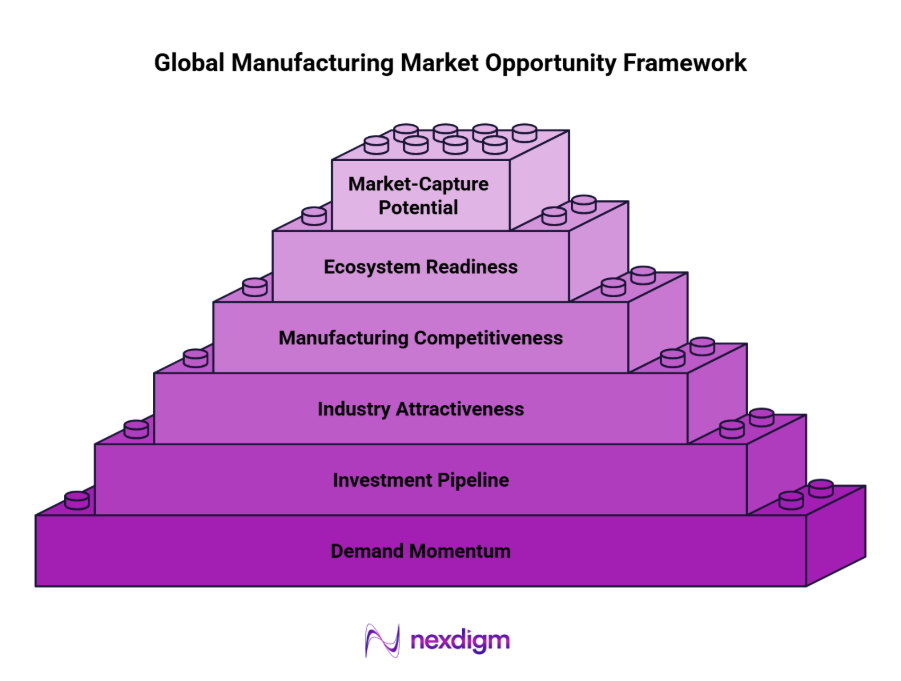
- Demand Momentum
Measure production, consumption and export growth across countries and manufacturing sectors. - Investment Pipeline
Track FDI, greenfield projects, factory announcements, capacity additions and industrial capex. - Industry Attractiveness
Identify sectors with strong end-use demand, technology investment and capacity-expansion potential. - Manufacturing Competitiveness
Benchmark labour, energy, logistics, land, financing and operating costs across candidate markets. - Ecosystem Readiness
Assess suppliers, skilled talent, infrastructure, engineering capabilities and supporting industries. - Market-Capture Potential
Estimate how effectively each geography can convert domestic and international demand into sustainable manufacturing activity.
Nexdigm can support global manufacturing demand assessment services through country benchmarking, industry sizing, investment tracking, supply-chain analysis, cost benchmarking, competitive assessment and market opportunity evaluation.
This approach allows a company to move from a global manufacturing map to a practical shortlist of markets, industries and investment opportunities.
Nexdigm Case Study: Prioritizing Global Manufacturing Markets
Nexdigm supported a manufacturing client evaluating international expansion by comparing production growth, exports, investment flows, operating costs and industrial ecosystems across target markets. The assessment helped narrow the opportunity set to markets aligned with both demand growth and future manufacturing investment.
The analysis gave the client a structured basis for prioritizing countries, evaluating entry requirements and aligning its expansion strategy with evolving global supply-chain patterns.
To take the next step, simply visit our Request a Consultation page and share your requirements with us.
Harsh Mittal
+91-8422857704