

Manufacturing location decisions increasingly balance operational cost with tariffs, export controls, geopolitical exposure, customer proximity, and technical capabilities. Rather than abandoning established hubs, companies are augmenting existing networks with strategically placed capacity.
Global investment patterns reflect this shift: while UN Trade and Development reported 2025 foreign direct investment grew 6% to $1.6 trillion, over 80% concentrated in the top 20 host economies, and strategic sectors captured 44% of greenfield value compared to 16% in 2020.
Geographic footprint strategy has shifted from pure cost arbitrage to targeted resilience and capability density.
Cost Arbitrage Is Being Recalculated
Traditional manufacturing location models often started with labour cost.
That calculation is becoming less sufficient.
A factory with cheaper labour may face higher logistics costs, longer lead times, greater inventory requirements, tariff exposure, or limited supplier depth.
Manufacturers are increasingly calculating total delivered cost rather than direct production cost.
The result can favour locations that are not the cheapest on paper but offer better access to customers, suppliers, ports, infrastructure, and trade agreements.
This is particularly relevant for products where freight costs or lead times represent a significant portion of total cost.
Resilience Is Becoming a Location Variable
Supply-chain resilience has moved from contingency planning into capital allocation.
The 2026 Reshoring Initiative survey of 249 US manufacturers found that 36% of OEM respondents had reshored or were actively engaged in additional reshoring during 2026, compared with 29% in 2025. Meanwhile, 32% of contract manufacturers were quoting reshoring projects, double the 16% reported in 2025.
The same survey found that 63% of OEMs planned US capital expenditure in 2026 or 2027 to support reshoring or other domestic expansion.
These figures show that resilience can translate into actual capital expenditure.
But resilience has a price. Duplicate capacity, additional suppliers, regional warehouses, and higher-cost production locations can all increase operating expenses.
The question is how much resilience customers are willing to fund through product pricing and how much risk the manufacturer is willing to absorb.
Capability Is Becoming as Important as Capacity
Manufacturers are also relocating specific capabilities rather than entire production networks. Semiconductor manufacturing provides a clear example.
Applied Materials announced a $5 billion investment in India over the next decade, focused on research, supply-chain development, and workforce expansion. The announcement came as more than 600 companies from 52 countries participated in SEMICON India.
The investment reflects the broader importance of building technical ecosystems around manufacturing.
A location may have inexpensive labour but lack semiconductor engineers, precision suppliers, advanced testing facilities, or reliable infrastructure.
For increasingly sophisticated industries, capability density can therefore outweigh labour arbitrage.
Asia Remains Central to Manufacturing Growth
Supply-chain diversification does not mean Asia is losing its manufacturing importance.
Asia and the Pacific recorded the strongest manufacturing production growth in Q1 2026. Global manufacturing production increased 1.2% quarter-on-quarter, while manufacturing exports rose 3.5%. Higher-technology manufacturing production grew 1.9%, with exports increasing 4.7%.
Companies can retain deep Asian supplier networks while adding capacity in India, Mexico, Southeast Asia, Eastern Europe, or North America to diversify customer coverage and geopolitical exposure.
The result is a multi-node manufacturing footprint rather than a complete relocation from one country to another.
Manufacturing Networks Are Becoming Portfolio Decisions
A resilient footprint can involve several layers.
One location may serve as the high-volume production base. Another may support regional customer demand. A third may provide specialized components or final assembly.
The optimal configuration depends on the product’s supply chain, customer geography, trade exposure, technology requirements, and capital intensity.
This is why global manufacturing market analysis needs to move beyond country rankings. A country with lower wages is not automatically more attractive if it has weak infrastructure or supplier depth. A higher-cost location may generate better returns through shorter lead times, lower inventory, stronger engineering capabilities, or customer proximity.
Nexdigm’s Global Manufacturing Footprint Assessment Framework
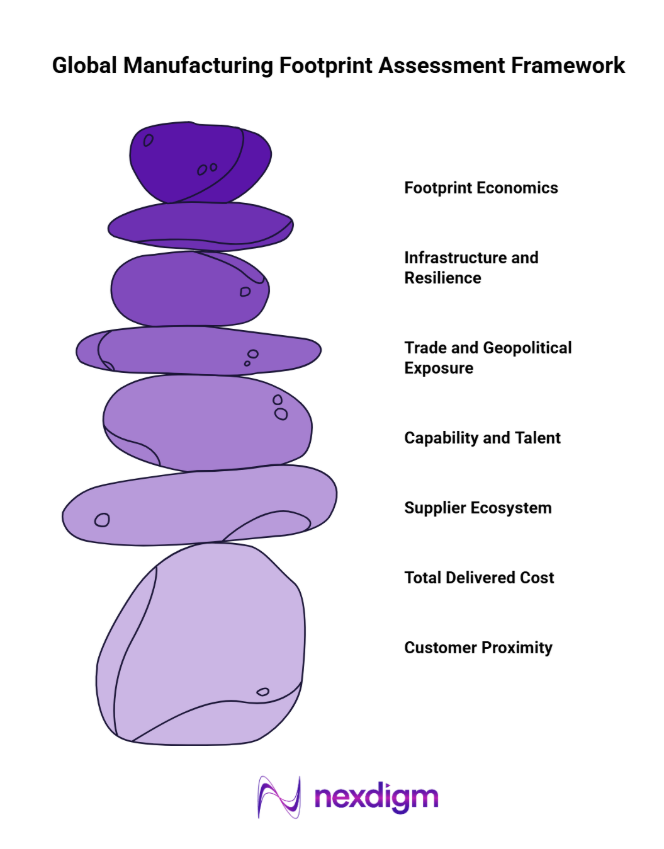
- Customer Proximity
Measure customer concentration, delivery requirements, lead times, regional demand, and service expectations. - Total Delivered Cost
Compare labour, materials, utilities, logistics, tariffs, taxes, inventory, and financing costs. - Supplier Ecosystem
Assess local suppliers, component availability, industrial clusters, tooling, maintenance, and raw-material access. - Capability and Talent
Evaluate engineering talent, skilled labour, technology infrastructure, R&D capacity, and workforce scalability. - Trade and Geopolitical Exposure
Map tariffs, export controls, trade agreements, geopolitical concentration, and supply disruption risks. - Infrastructure and Resilience
Assess power, water, transport, ports, digital infrastructure, disaster exposure, and availability of alternative suppliers. - Footprint Economics
Compare single-site, dual-source, regional, nearshore, and multi-node strategies under different cost and disruption assumptions.
Case Study: Global Manufacturing Market Analysis
Global FDI reached $1.6 trillion in 2025, up 6%, while strategic sectors accounted for 44% of greenfield project value, compared with 16% in 2020. Mapping these flows against cost, capability, trade exposure, and resilience can identify locations suited to future manufacturing expansion.
Nexdigm can support global manufacturing market analysis through country benchmarking, supply-chain mapping, cost analysis, competitive assessment, and footprint strategy.
To take the next step, simply visit our Request a Consultation page and share your requirements with us.
Harsh Mittal
+91-8422857704