

Manufacturing is being reshaped by changes in industrial investment, technology adoption, trade policy, energy costs and supply-chain design. Companies are reassessing where to produce, how much capacity to maintain and which technologies can improve output without increasing operational risk.
For manufacturers, suppliers and investors, understanding these shifts requires separating short-term production movements from structural changes in industrial competitiveness.
Track Changes In Global Manufacturing Capacity
Manufacturing growth is uneven across regions and sectors. Some economies are expanding production in higher-technology industries, while others are strengthening their positions in established manufacturing segments or building capabilities within global value chains.
UNIDO’s International Yearbook of Industrial Statistics 2025 reported global manufacturing value-added growth of 2.9% in 2024, with middle-income industrial economies recording stronger growth than high-income industrial economies. The report also highlighted the changing geographic distribution of industrial activity and the growing importance of innovation.
Businesses should track manufacturing output, capacity utilisation, new facility announcements, production investment and changes in sector composition. These measures help identify where additional capacity is becoming available and where production constraints may persist.
Capacity announcements should be treated cautiously. A planned factory does not create immediate supply. Construction timelines, equipment installation, workforce availability and customer qualification can delay commercial production.
Understand Investment And Automation Decisions
Investment patterns reveal where businesses expect demand or strategic value to develop. UN Trade and Development’s World Investment Report 2026 reported that global foreign direct investment rose 6% to US$1.6 trillion in 2025, although the recovery remained uneven and concentrated in a limited group of economies and sectors.
This broader investment picture does not mean that manufacturing investment is increasing uniformly. Businesses need sector-level and project-level evidence to identify where capital is being committed to production facilities, equipment and supplier ecosystems.
Automation is another important part of this shift. Robotics, machine vision, connected equipment and advanced production planning can improve consistency and throughput, but benefits depend on production requirements, integration costs, workforce skills and maintenance capacity.
The strongest investment cases begin with an operational problem. Manufacturers should identify whether technology can reduce defects, improve utilisation, shorten changeovers or increase production flexibility before selecting a solution.
Map Trade and Supply-Chain Shifts
global manufacturing trends become commercially meaningful when changes in production are connected to changes in international trade. A country may expand output for domestic consumption, while another may increase exports by serving new customers or attracting production previously located elsewhere.
Trade data can reveal changes in supplier shares, export destinations, imported components and dependence on particular production hubs. UN Comtrade provides annual and monthly product-level trade statistics that help businesses investigate these patterns.
Supply-chain diversification also needs careful interpretation. Adding a second supplier or production location can improve resilience, but it may increase qualification costs, inventory requirements and operating complexity. Businesses should compare the cost of diversification with the potential impact of a disruption.
Trade policy, tariffs, local-content requirements and changing technical standards can further influence where production is commercially viable. Companies should monitor these factors alongside freight costs, energy availability and access to skilled labour.
Assess Where Future Opportunities May Emerge
Manufacturing opportunities often appear at the intersection of new demand, production capability and supporting infrastructure. These may include components for advanced electronics, industrial automation, transport equipment, energy systems or specialised materials.
However, sector growth alone does not guarantee returns. Companies must assess the availability of qualified suppliers, customer requirements, capital intensity, regulatory obligations and likely competition.
Scenario analysis can help businesses compare alternative production locations and investment plans. Useful scenarios include slower demand growth, higher input costs, delayed factory commissioning and changes in trade policy.
The Manufacturing Transformation Assessment Framework
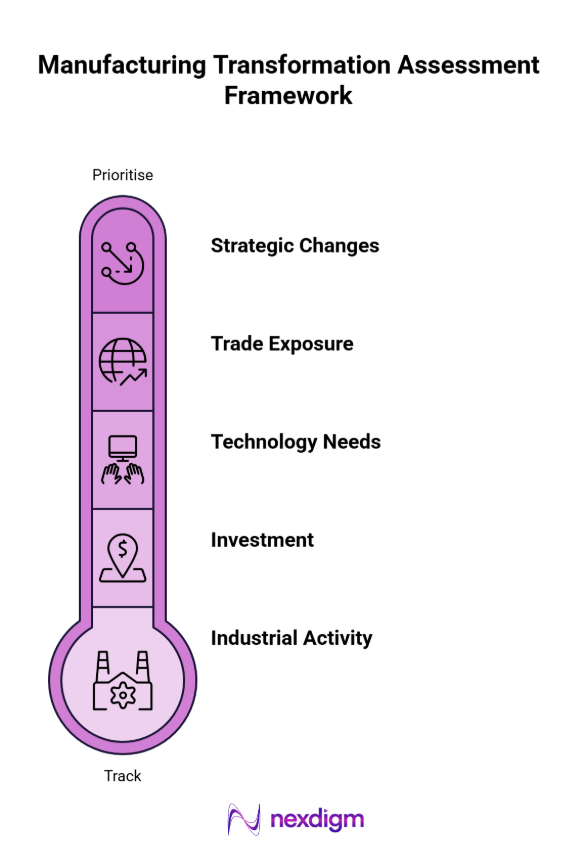
- Track Industrial Activity: Compare production growth, capacity utilisation and sector-level performance.
- Map Investment: Distinguish announced projects from funded investments and operational capacity.
- Evaluate Technology Needs: Identify where automation and digital systems can improve measurable outcomes.
- Review Trade Exposure: Assess export markets, imported inputs, supplier concentration and policy risks.
- Prioritise Strategic Changes: Compare expansion, diversification and technology investments against demand and execution risks.
Building A Forward-Looking Manufacturing Strategy
Manufacturers need to understand not only where production is growing but also what supports that growth. Combining capacity, investment, automation and trade data helps companies make better decisions about production locations, supplier networks and technology priorities as global industrial conditions evolve.
Case Study: Planning A Production Expansion
An equipment manufacturer considers expanding capacity in response to rising export orders. It reviews sector demand, competitor investment, component imports and workforce availability. The assessment indicates that supplier constraints could limit output, so the company qualifies alternative component sources before approving the expansion.
To take the next step, simply visit our Request a Consultation page and share your requirements with us.
Harsh Mittal
+91-8422857704