

A country with substantial mineral reserves is not automatically an attractive mining market. Geological potential is only the first part of the investment equation. The project must also have a credible route through permitting, infrastructure, processing, financing and ultimately into a market that can absorb the output.
The scale of the global resource base makes this distinction important. The US Geological Survey’s 2026 Mineral Commodity Summaries provides production, trade, reserve and resource data for more than 90 mineral commodities across global markets. It offers a useful starting point for comparing resource endowments, but country selection requires a much broader commercial assessment.
Resource Endowment Is Only the Entry Point
The first screen should establish what the country can actually offer.
A large reserve base may be commercially attractive when it is accompanied by established mining expertise, proven metallurgy and a pipeline of projects. The opposite can also occur. A country may hold significant resources but lack the infrastructure or technical capacity required to convert them into competitive production.
A market assessment should therefore examine:
- Quality and scale of mineral reserves
- Existing production and mine pipeline
- Ore grades and metallurgical complexity
- Domestic processing capacity
- Availability of power and water
- Transport and export infrastructure
- Local technical and supplier capabilities
The last three can materially change the ranking of otherwise comparable markets. A slightly smaller resource in an established mining district may be more investable than a larger deposit requiring entirely new roads, power and processing infrastructure.
The Processing Gap Can Create a Second Entry Opportunity
Latin America illustrates this clearly. The region produces around 40% of global copper mine output and roughly one-quarter of global lithium supply, but in 2025 it refined only around 20% of the key energy minerals it mined, excluding lithium. The IEA estimates that expanding local refining and processing could raise the region’s economic value from these minerals to around $220 billion by 2035.
That changes the market-entry question. The opportunity may be the mine itself, but it could also be a refinery, beneficiation facility, processing partnership or integrated downstream operation.
For an investor, this distinction matters because mining and processing carry different capital requirements, regulatory exposures and customer relationships. Countries that export large volumes of unprocessed material may offer opportunities for companies able to move further downstream.
Infrastructure Often Determines Which Resources Reach the Market
Mining is unusually dependent on physical infrastructure. Roads, railways, ports, power networks and water systems can determine whether a resource can be developed at competitive cost.
Infrastructure assessment should consider both current capacity and the projects expected to become available during the investment period. A new rail connection or port expansion can change the economics of an otherwise marginal deposit, while an overloaded corridor can constrain a high-quality mine.
The same applies to energy. Processing-intensive commodities can become particularly sensitive to electricity costs and reliability. Recent supply-chain disruptions have shown how exposed mining operations can be to fuel, reagent and transport shocks. S&P Global’s 2026 analysis projected a 5.1% increase in global copper mining costs under its disruption scenario, illustrating how quickly external conditions can move the cost curve.
The Investment Environment Has to Survive the Project Timeline
Permitting, taxation and regulatory conditions need to be evaluated against the actual development cycle of a mine rather than treated as a snapshot.
A country-screening exercise should assess:
- Regulatory predictability: How long do approvals take and how consistently are mining rules applied?
- Fiscal terms: What royalties, taxes, duties and government participation affect project returns?
- Permitting: What environmental, land-use and community approvals are required?
- Financing conditions: How easily can projects attract local or international capital?
- Operating ecosystem: Are skilled labour, contractors, equipment and technical services available?
These factors become particularly important for critical minerals, where governments are increasingly seeking both supply security and greater domestic value capture.
A Market Should Be Judged Across the Full Chain
Nexdigm can use a market-entry assessment to compare countries without reducing the decision to a single score. The objective is to identify where a resource can move from geological potential to commercially competitive production.
The assessment can examine:
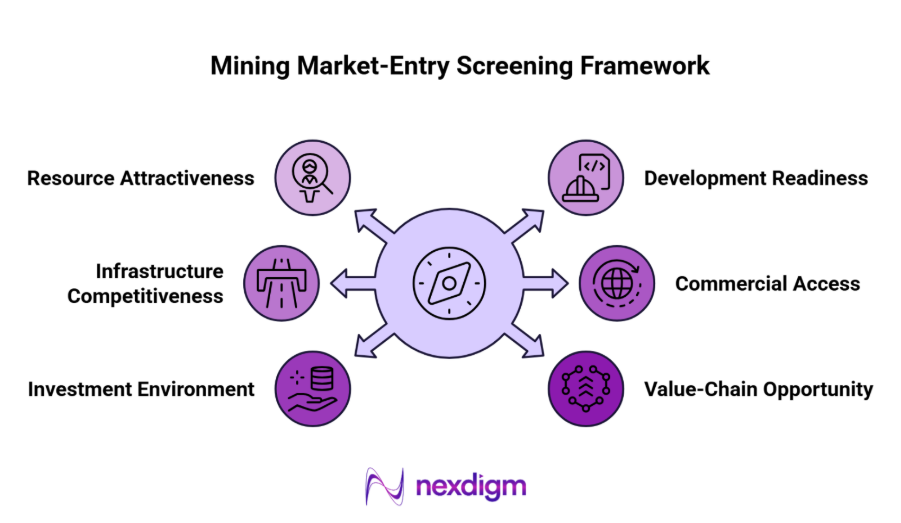
- Resource attractiveness: Size, quality, grade, reserves and existing production.
- Development readiness: Mine pipeline, permitting, technical capability and project maturity.
- Infrastructure competitiveness: Power, water, roads, rail, ports and processing access.
- Commercial access: Domestic consumption, export routes, customer base and downstream industries.
- Investment environment: Fiscal terms, regulation, financing conditions and political risk.
- Value-chain opportunity: Potential for mining, beneficiation, refining or downstream integration.
This provides the basis for global mining market entry consulting, particularly where investors are deciding between markets with similar geological potential but very different commercial conditions.
Nexdigm Case: Mining Market Entry Screening
A mining company evaluated eight countries across four critical-mineral markets. Nexdigm assessed resource potential, infrastructure, fiscal terms, processing capacity and downstream demand, narrowing the expansion pipeline to three markets with projected project returns above 15%.
To take the next step, simply visit our Request a Consultation page and share your requirements with us.
Harsh Mittal
+91-8422857704