

Global mining trade is shaped by the geography of mineral deposits, the location of processing facilities, industrial demand, and the cost of moving materials between markets. Changes in trade flows can reveal emerging export hubs, growing import dependence, and shifts in the competitive position of producing countries.
For mining companies, processors, industrial buyers, and investors, the objective is to understand not just how much a country trades, but why its position is changing and what that means for future commercial opportunities.
Distinguish Resource Producers From Processing Hubs
Countries with significant mineral reserves do not necessarily dominate exports of refined materials. Some specialise in extraction, while others import ores and concentrates for processing into metals or industrial inputs. These differences create interconnected trade relationships between resource-rich regions and manufacturing centres.
Analysis should separate raw ores, concentrates, refined metals, and processed mineral products. Each category has distinct production economics, transport requirements, and end markets. Trade data becomes more informative when compared with domestic production and processing capacity.
The distinction is particularly important for minerals used in energy technologies and advanced manufacturing, where processing and refining can be concentrated in different countries from extraction.
Identify The Markets Driving Import Demand
Mineral imports are influenced by industrial production, infrastructure development, manufacturing investment, and the availability of domestic resources. Steelmaking, electrical equipment, construction, and battery production each create demand for different commodities and grades.
For global mining trade analysis, researchers should connect import trends with the industries consuming the material. Rising imports may reflect expanding production, but they can also indicate declining domestic output, temporary supply disruptions, or a shift toward higher-quality inputs.
Demand should also be evaluated against future supply. New mines, processing projects, recycling capacity, and material substitution can change the balance between available supply and expected consumption.
Assess The Forces Behind Trade Shifts
Trade routes and supplier positions change when production costs, energy prices, freight rates, infrastructure, or government policies alter the economics of supply. A country may gain export share because its producers expand capacity, while another may lose competitiveness as costs rise or access to buyers becomes more difficult.
Market concentration adds another dimension. Heavy dependence on a limited number of exporting countries can expose buyers to production interruptions, transport bottlenecks, or regulatory changes. For exporters, concentration in a small number of destination markets can create a different risk if demand weakens or trade conditions change.
Build A Global Mining Trade Framework
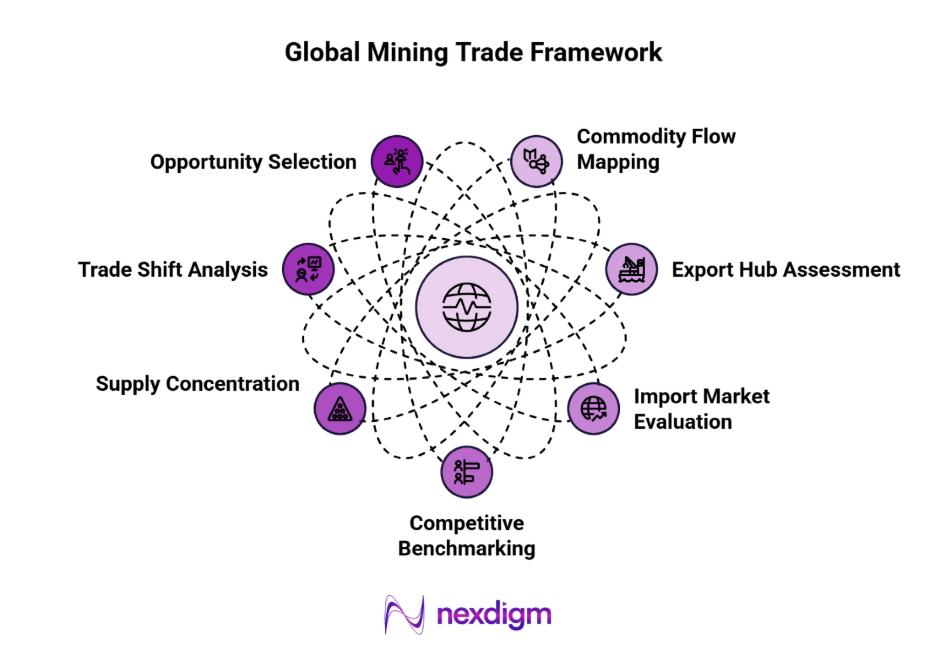
- Commodity Flow Mapping: Track imports and exports by mineral, product category, trading partner, and period to identify changes in the direction and scale of international trade.
- Export Hub Assessment: Compare extraction, processing, refining, and export capacity to determine which countries control different stages of the mineral supply chain.
- Import Market Evaluation: Examine downstream industrial demand, domestic production, and import dependence to identify markets likely to require continued external supply.
- Competitive Benchmarking: Compare suppliers on production costs, product quality, freight, delivery reliability, and market access to establish why particular exporters are gaining or losing share.
- Supply Concentration: Assess dependence on leading origins and processing centres to identify commodities vulnerable to disruptions or limited sourcing alternatives.
- Trade Shift Analysis: Investigate changes in tariffs, export controls, infrastructure, production capacity, and logistics to distinguish temporary fluctuations from longer-term changes in trade relationships.
- Opportunity Selection: Prioritise markets and routes according to demand potential, supplier gaps, competitive conditions, and total delivered cost rather than trade volume alone.
The framework should be applied at commodity level. An exporter may be competitive in one mineral but face different cost, quality, or regulatory barriers in another. Broad country rankings can hide these differences and lead to poor market-entry decisions.
Use Trade Shifts To Inform Market Strategy
Tracking global mining trade helps businesses identify destination markets, compare sourcing locations, and assess exposure to concentrated supply networks. When trade flows are examined alongside production, processing capacity, and industrial demand, companies can better understand where market opportunities are developing and which risks may affect future supply.
Nexdigm’s Case Study
A mineral producer exports 100,000 tonnes annually to three markets, with 60% of volume going to its largest destination. When freight costs to that market rise by 12%, the company assesses two alternative destinations with annual import demand of 25,000 and 40,000 tonnes. Comparing freight, tariffs, buyer requirements, and achievable prices helps the exporter evaluate whether reallocating 15,000 tonnes could reduce market concentration without sacrificing its contribution margin.
To take the next step, simply visit our Request a Consultation page and share your requirements with us.
Harsh Mittal
+91-8422857704