

Oil and gas investment opportunities rarely emerge from a single strong indicator. High demand can coexist with abundant supply. Resource availability can be undermined by weak infrastructure. A large market can remain difficult to enter because of fiscal terms, price controls, state participation or limited contractual protection.
The stronger opportunities are found where several conditions reinforce one another: customers require additional supply, the supply gap is difficult to fill through existing capacity, infrastructure can support the required investment and the regulatory environment allows investors to capture sufficient value.
The IEA’s World Energy Investment 2025 forecast global energy investment at around $3.3 trillion, with clean-energy investment continuing to exceed spending on fossil-fuel supply. For oil and gas investors, this makes capital discipline particularly important. Demand growth alone cannot justify investment if competing energy sources, efficiency measures or domestic supply can address the requirement more economically.
Begin With the Market Balance
The first stage is to establish what the market actually needs.
Forecast oil and gas consumption by product and end use, then compare it with domestic production, reserves, decline rates and import dependence. For oil, this may reveal opportunities in refined products rather than crude supply. For gas, a market may have strong consumption growth but insufficient pipeline, LNG or processing infrastructure to translate that demand into investable projects.
The supply assessment should distinguish operating assets from projects that are merely announced. Refinery capacity, gas processing plants, pipelines, LNG terminals, storage and export infrastructure should be classified according to their development stage and actual utilisation.
This creates a more realistic view of the market gap. A projected deficit that disappears once an underutilised refinery or pipeline is considered is fundamentally different from a structural shortage that requires new infrastructure or production.
The Same Market Can Support Different Investments
Market attractiveness also depends on what the investor is actually trying to build.
An upstream investor needs recoverable resources, exploration or production potential and a workable fiscal regime. A midstream developer needs dependable throughput, contracted volumes and access to infrastructure. An LNG project requires both supply economics and credible offtake. A downstream investment depends on product margins, feedstock availability and access to customers.
Regulation therefore needs to be assessed alongside the physical market. Licensing requirements, taxes, royalties, local ownership, price controls, subsidies, tariff structures and repatriation rules can materially change project economics. Contract enforceability and counterparty credit become especially important where state-owned utilities or national oil companies provide the primary demand anchor.
Existing international operators can reduce execution risk by providing established supply chains, technical talent and local partnerships. Their presence can also indicate that competition for attractive assets is already intense.
A Country Ranking Is Not an Investment Strategy
A broad screening exercise becomes useful only when it leads to a specific entry thesis.
Rather than assigning every market a single attractiveness score, separate the underlying dimensions. One market may offer strong gas demand but limited infrastructure. Another may have modest growth but highly reliable contracts and established logistics. A third may offer upstream potential but require greater tolerance for fiscal or political risk.
Scenario testing should then examine oil and LNG prices, currency movements, project delays and policy changes. The objective is to identify what remains attractive when assumptions weaken and what condition would invalidate the investment case.
For oil and gas market assessment services, Nexdigm can combine market balances, infrastructure, regulation and project maturity to determine not only which countries rank highly, but which specific investment opportunities are accessible within them.
Oil and Gas Market Investment Screening Framework
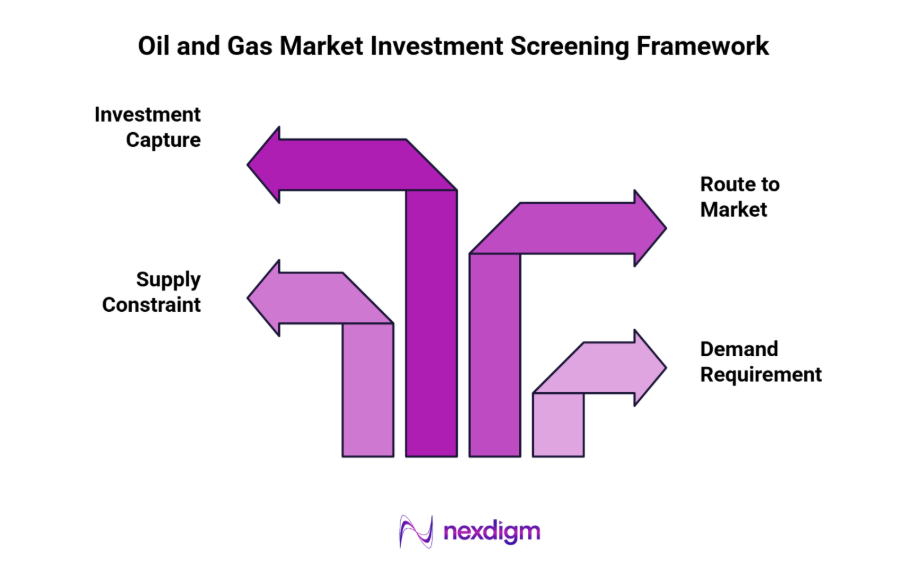
- Establish the Demand Requirement
Measure consumption growth by product and end use, identifying where additional oil or gas supply is structurally required. - Test the Supply Constraint
Compare domestic production, reserves, imports, refining and processing capacity with actual utilisation and credible future additions. - Assess the Route to Market
Evaluate pipelines, terminals, storage, ports, distribution networks and customer access to determine whether supply can reach the market competitively. - Test Investment Capture
Assess fiscal terms, regulation, contracts, competition and project economics to establish whether an investor can convert the market opportunity into an acceptable return.
Nexdigm can use the framework to move from country-level screening to asset-level opportunities, with the final recommendation tied to a specific customer base, investment type and market-entry condition.
Nexdigm Case Study
Nexdigm screened 12 oil and gas markets across demand growth, import dependence, resource potential, infrastructure, fiscal terms and project maturity. 3 markets advanced for distinct opportunities: gas distribution, brownfield refining and upstream tiebacks. The client sequenced market entry around contract readiness and infrastructure access rather than demand growth alone.
To take the next step, simply visit our Request a Consultation page and share your requirements with us.
Harsh Mittal
+91-8422857704