

A country’s resource base is only one part of its oil and gas opportunity. Commercial attractiveness depends on demand, production costs, infrastructure, fiscal terms, political and operating risk, capital access and the ability to move products to market.
The market outlook is mixed across fuels and regions. Oil demand grew by about 0.65 million barrels per day in 2025, while natural gas demand grew by around 1%, down from 2.8% in 2024. Those global numbers conceal very different local conditions: gas demand growth was concentrated in the United States, the European Union and the Middle East, while Asia Pacific demand was nearly flat.
Investment signals also matter. The IEA expects global oil investment to fall below USD 500 billion in 2026, its third consecutive annual decline. For companies screening markets, this points to the need for disciplined capital allocation and a clear advantage in cost, access or execution.
Screen countries through the full value chain
Begin with the country’s resource and production outlook, then assess the commercial system around it. Upstream opportunities may depend on resource quality, decline rates, licensing terms, service availability and export access. Midstream potential may be shaped by pipeline bottlenecks, storage, processing, terminals and cross-border connections. Downstream cases require product demand, refinery configuration, petrochemical feedstock and customer access.
Demand should be measured by product, sector and region. Test whether expected consumption growth is supported by industrial activity, power needs, transport or imports. For gas, check whether pipelines, LNG terminals, storage and pricing arrangements can connect supply with buyers. For oil, examine crude quality, refining compatibility, export routes and competing sources.
A global oil and gas opportunity assessment should distinguish announced projects from funded and executable projects. Review permitting, local content, taxation, currency exposure, sanctions, infrastructure access and contract enforcement. These conditions can affect both project value and the time required to realize it.
Rank by risk-adjusted value and strategic fit
Use consistent assumptions to compare countries. A low-cost upstream resource may be less attractive if evacuation routes are unavailable. A smaller opportunity may rank higher if existing facilities reduce capital requirements or if the company can use established customer relationships.
Evaluate the value chain as a connected system. A gas resource could support domestic power, industrial demand, LNG exports or petrochemical feedstock, but each pathway has different infrastructure needs and offtake risks. A refinery or terminal investment should be tested against feedstock availability, utilization, product demand and competing capacity.
Build scenarios for commodity prices, costs, demand, policy and schedule. Rank opportunities by risk-adjusted returns, capital at risk, time to cash flow, strategic fit and the next evidence needed. Revisit the ranking as market conditions and project readiness change.
Turn screening into an investment sequence
The purpose of screening is to identify what to investigate next. For leading markets, define a diligence plan covering data gaps, partner discussions, asset access, regulatory questions and commercial validation. For weaker cases, record the conditions that would change the decision, such as a new pipeline, revised fiscal terms or a confirmed buyer.
This keeps the portfolio active without treating every promising market as an immediate investment. It also makes country-level decisions comparable across upstream, midstream and downstream opportunities.
Framework: Country-to-Value-Chain Prioritization
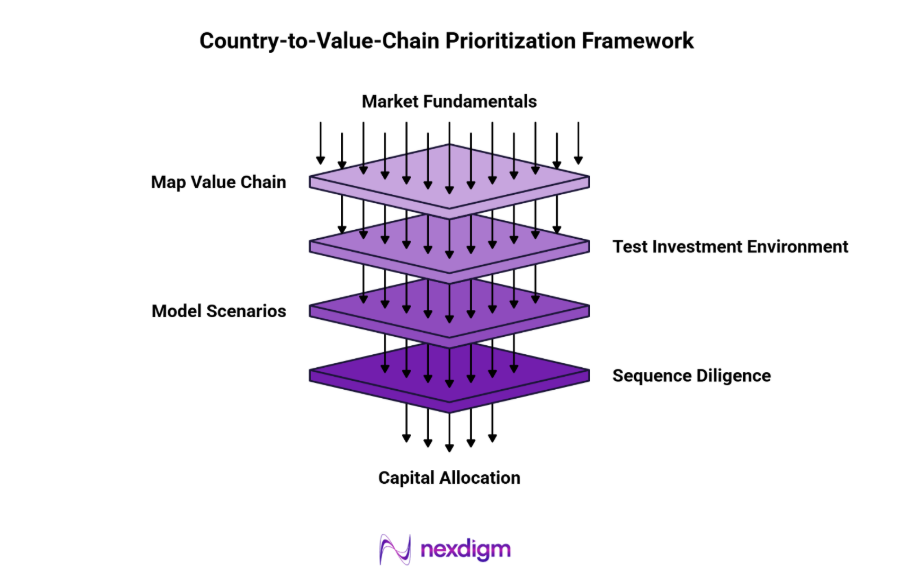
- Establish market fundamentals
Assess resource potential, production trends, demand, imports, exports and the competitive supply outlook. - Map the value chain
Identify infrastructure, processing, transport, storage, market access and customer constraints. - Test the investment environment
Review fiscal terms, licensing, regulation, political exposure, local content and execution capacity. - Model comparable scenarios
Apply consistent assumptions for price, cost, schedule, utilization, demand and downside risk. - Sequence diligence and capital
Rank opportunities by risk-adjusted value, strategic fit, capital at risk and the next decision gate.
Nexdigm Case Study
Nexdigm compared 12 countries across upstream, gas infrastructure and downstream opportunities, scoring market demand, asset economics, fiscal conditions, logistics and execution risk. Our model reduced the initial list to four priority markets and identified two value-chain combinations with stronger downside resilience than standalone asset cases. One gas-linked opportunity met the client’s return threshold only when contracted demand and existing pipeline access were included; a refinery case fell below threshold under lower utilization. We recommended directing diligence toward the four priority markets, validating offtake before committing to infrastructure, and pausing the refinery case pending stronger demand evidence.
To take the next step, simply visit our Request a Consultation page and share your requirements with us.
Harsh Mittal
+91-8422857704