

Global oil trade is being reshaped by changes in production, refinery activity, regional demand, and export capacity. The U.S. Energy Information Administration projects U.S. crude oil production to average around 13.7 million barrels per day in 2026, while OPEC’s latest outlook places global oil demand at around 106 million barrels per day in 2026.
The U.S. also remains a major petroleum exporter, with total petroleum liquids exports continuing to support international supply. These movements show why global oil trade analysis needs to examine not only volumes, but also origins, destinations, products, suppliers, buyers, pricing, and trade routes to understand how the international oil market is evolving.
Crude Flows Show Where Global Supply Is Moving
Crude oil movements provide a view of how production, refinery requirements, inventories, and trade routes are changing across regions. A rise in exports from one origin may reflect increased production, while higher imports elsewhere may indicate stronger refinery demand or declining domestic supply. Analyzing these flows across markets can help businesses identify changing supply relationships and potential sourcing opportunities.
Refined Products Reveal Changing Regional Demand
Refined-product flows can tell a different story from crude trade because markets have varying refining capabilities and consumption requirements. A country may increase diesel or gasoline imports even when its crude imports remain stable because of refinery outages, capacity limitations, seasonal demand, or changes in product economics. Tracking these movements can reveal where specific product requirements are developing and where supply gaps may emerge.
Nexdigm’s Global Oil Trade Intelligence in Assessing Changing Regional Demands
Nexdigm combines trade intelligence with energy-sector research, market intelligence, pricing analysis, competitive intelligence, company research, and supply-chain assessment to understand how oil flows are changing across international markets.
Our global oil trade analysis can examine crude oil and refined products across origins, destinations, suppliers, buyers, trade routes, shipment activity, volumes, values, and indicative pricing through:
- Crude Market Intelligence: Analysis of production-linked supply movements, exporter participation, refinery demand, and destination markets.
- Refined Product Intelligence: Tracking product-level imports, exports, pricing, buyer activity, and market requirements.
- Global Trade Intelligence: Connecting oil flows with infrastructure, logistics, company activity, competition, and market conditions.
This helps businesses move beyond tracking oil movements to understand where supply is shifting, where demand is developing, and where commercial opportunities or risks may emerge.
Why Nexdigm’s Global Oil Trade Approach Is Different
Nexdigm’s approach goes beyond tracking where crude and refined products are moving. It connects trade data with the commercial, operational, and competitive factors that influence global oil markets:
- Crude-to-Product View: Nexdigm can assess crude flows alongside refining activity and refined-product movements to understand how changes at the supply end affect downstream markets.
- Trade-to-Market Context: Import and export movements are interpreted alongside demand, pricing, infrastructure, company activity, and competitive conditions to explain the drivers behind market shifts.
- Insight-to-Decision Link: Findings can be translated into practical priorities across sourcing, market entry, supplier diversification, export development, and competitive positioning.
This integrated perspective helps businesses move beyond tracking global oil flows to understand the commercial implications of changing supply, demand, and trade patterns.
What Nexdigm Assesses Across Global Oil Markets
Global oil opportunities can differ significantly by product, market, supplier, and trade route. Nexdigm assesses these dimensions together to understand:
- Supply and Product Movements: Analyze crude and refined-product flows, origins, destinations, volumes, suppliers, and shipment patterns.
- Market and Commercial Conditions: Evaluate demand, pricing, refining capacity, infrastructure, buyers, and competitive activity across relevant markets.
- Trade Opportunities and Exposure: Identify emerging suppliers, market gaps, sourcing alternatives, route dependencies, and potential competitive risks.
These focus areas provide the foundation for a structured global oil trade assessment, helping businesses move from market observation to prioritized commercial action.
Nexdigm’s Global Oil Trade Assessment
Nexdigm can structure the assessment around the factors that determine how crude and refined products move between markets. This takes place through:
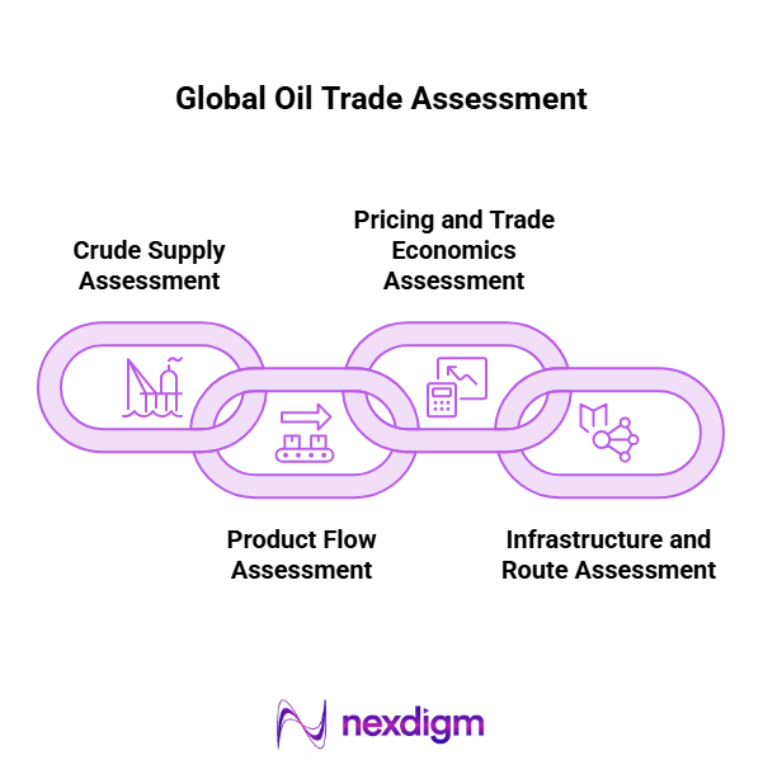
- Crude Supply Assessment: Analyzing producing countries, exporter shares, crude volumes, origins, destinations, production trends, and supplier concentration to identify changing sources of crude supply and potential sourcing dependencies.
- Refining and Product Flow Assessment: Examining refinery capacity, utilization, crude intake, refined-product exports and imports, and product-level trade movements to understand how refining dynamics influence international product availability.
- Pricing and Trade Economics Assessment: Comparing indicative trade values across products, suppliers, origins, destinations, and periods to identify pricing differences, changing trade economics, and potential commercial advantages.
- Infrastructure and Route Assessment: Assessing ports, pipelines, storage, shipping routes, refinery infrastructure, and logistics networks to determine how efficiently oil can move between supply and demand centres.
The assessment creates a connected view of where oil is coming from, where it is going, what is driving the movement, and where businesses may have an opportunity to act.
Nexdigm’s Case
Nexdigm supported an energy-sector client by assessing 6 regions, trade and market indicators, and multiple supply routes. The analysis identified 8 priority markets, 12 potential supply sources, and 3 high-priority trade corridors, helping strengthen sourcing decisions and international market-expansion planning.
To take the next step, simply visit our Request a Consultation page and share your requirements with us.
Harsh Mittal
+91-8422857704