

Global retail pricing feasibility research helps retailers understand how prices should vary across markets without weakening brand consistency or profitability. Through practical Pricing Strategy Analysis, businesses can compare purchasing power, competitor pricing, taxes, channel costs, customer expectations, and demand sensitivity before setting market-specific prices.
Such an approach helps teams avoid simple currency conversions, identify realistic price corridors, and make better launch or expansion decisions. It also supports stronger value positioning, healthier margins, and clearer pricing governance across countries, product categories, sales channels, and diverse consumer segments worldwide with greater commercial confidence.
OECD data shows household price levels can range from about 50% above its average to roughly 60% below it across member markets. Such variation makes local pricing research essential for protecting affordability, maintaining competitiveness, reducing errors, and improving sustainable margins.
Global Retail Pricing Strategy for Local Affordability and Profitability
A global retail pricing strategy helps businesses adapt prices to local purchasing power, customer expectations, market costs, and competitive conditions while protecting affordability, profitability, brand consistency, and sustainable international growth. Its major advantages are:
- Improved International Margin Control: Detailed analysis of duties, logistics, currency movements, channel fees, and operating costs enables retailers to protect margins and avoid hidden profitability gaps across global markets.
- Reduced Cross-Border Price Distortion: Structured price comparisons limit excessive differences between countries, reducing grey-market activity, customer dissatisfaction, and brand inconsistency while preserving justified local variations in retail pricing decisions.
- Faster Response to Currency Changes: Regular monitoring of exchange rates and cost movements enables timely price adjustments, reducing margin volatility and preventing sudden increases that may disrupt customer demand across markets.
- Stronger Regional Portfolio Performance: Market-level pricing insights help retailers optimize product mix, price tiers, and category roles, improving revenue quality and profitability across countries with different consumer needs and economics.
Nexdigm’s Strategic Pricing Support for International Retail Growth
Nexdigm helps retailers expand confidently across markets through Global Retail Pricing Analysis, Pricing Strategy Analysis, International Retail Pricing Strategy, and Cross-Market Price Benchmarking. By evaluating purchasing power, customer demand, competitor prices, taxes, duties, channel costs, and currency movements, Nexdigm develops market-specific pricing strategies that strengthen affordability, protect margins, improve local relevance, support market entry decisions, and enable sustainable international retail growth.
Nexdigm’s Integrated Roadmap for Global Pricing and Local Adaptation
Nexdigm’s integrated pricing roadmap helps retailers balance global pricing consistency with local market realities, enabling stronger affordability, competitive relevance, margin protection, and sustainable international growth across diverse regions worldwide. Its major steps are:
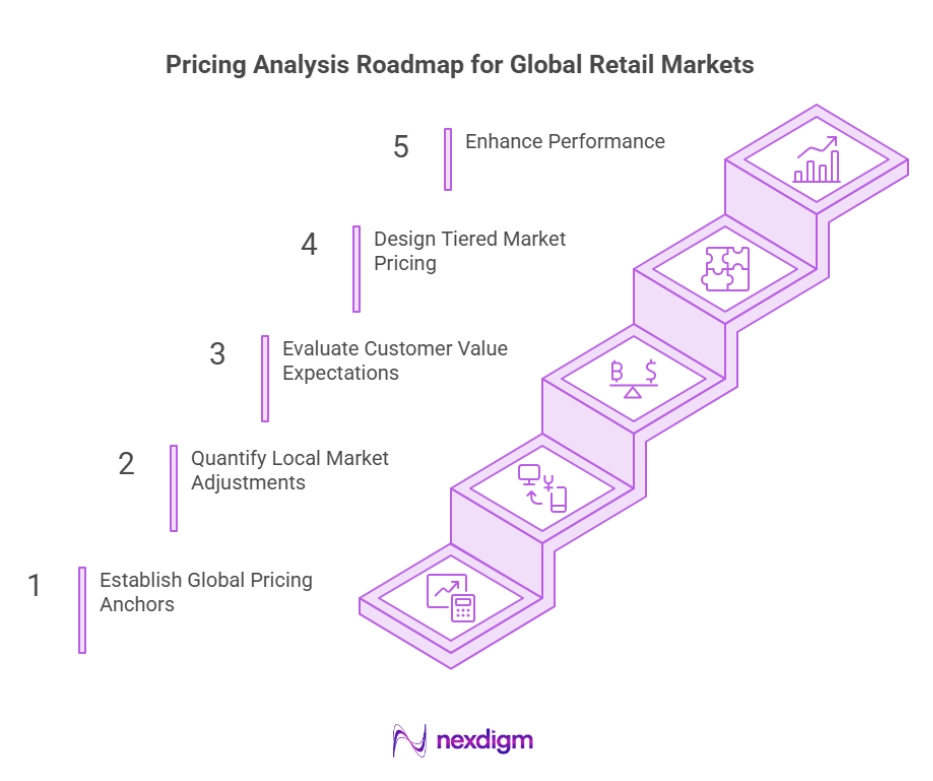
- Establish Global Pricing Anchors: Defining reference prices, margin expectations, brand positioning, and strategic thresholds that create a consistent global foundation while allowing controlled adaptation across individual priority retail markets.
- Quantify Local Market Adjustments: Measuring taxes, duties, purchasing power, logistics, competition, and channel costs to determine the adjustments required for commercially viable and locally acceptable retail prices across regions.
- Evaluate Customer Value Expectations: Assessing how customers perceive quality, convenience, brand strength, and affordability in each market to align local prices with willingness to pay and purchase priorities effectively.
- Design Tiered Market Pricing: Creation of differentiated price tiers for mature, emerging, premium, and value-focused markets, ensuring each level supports accessibility, positioning, and targeted profitability without weakening overall global consistency.
- Validate Cross-Market Price Relationships: Comparing final prices across neighboring markets, channels, and currencies to identify unjustified gaps, reduce arbitrage risk, and maintain credible global pricing relationships for customers consistently.
Nexdigm’s Case
An international retailer engaged Nexdigm to align pricing across eight markets with differing costs and purchasing power. The analysis improved local price acceptance by 14%, increased market-level margins by 8%, reduced unjustified cross-border price gaps by 21%, and lowered currency-related margin leakage by 11%, supporting stronger, locally relevant global growth.
To take the next step, simply visit our Request a Consultation page and share your requirements with us.
Harsh Mittal
+91-8422857704