

Retail procurement teams are under pressure to find savings without weakening supply resilience or customer-facing operations. NRF forecasts 2026 retail sales growth of 4.4% to $5.6 trillion, creating continued scale but also greater pressure to protect margins. At the procurement level, 71% of organizations say balancing cost and risk now drives strategy, while only 45% report being prepared for supply-chain disruptions, according to 2026 research from ISM.
The challenge is therefore not simply finding cheaper suppliers, but determining which categories offer meaningful savings potential across different markets. Global retail procurement category benchmarking can help retailers compare category economics, supplier pricing, sourcing structures, and market conditions to identify where procurement intervention could deliver the greatest commercial impact.
Why Savings Potential Differs Across Retail Categories
Retail categories do not offer equal savings opportunities. Merchandise, packaging, logistics, store supplies, technology, facilities, and professional services have different supplier structures, cost drivers, purchasing volumes, and levels of competition. A category with high spend may have limited savings potential if supplier pricing is already competitive, while a smaller category with fragmented sourcing or significant price variation may offer greater opportunity. Cross-market benchmarking helps retailers distinguish between spend size and actual improvement potential.
The Hidden Reasons Behind Category Savings Potential
A useful comparison should examine both the size of the opportunity and the factors that create it.
- Category Economics: Compare prices, volumes, supplier concentration, and cost structures across markets to identify categories with meaningful commercial gaps.
- Market Competitiveness: Assess supplier availability, local cost conditions, sourcing alternatives, and competitive intensity to determine where stronger procurement leverage exists.
- Savings Feasibility: Evaluate potential value alongside switching complexity, specifications, contracts, supply risks, and implementation requirements to identify realistic opportunities.
Together, these signals help retailers move from high-spend categories to high-potential categories, creating a more focused basis for procurement action.
Nexdigm’s Market-Led View of Retail Savings
Nexdigm helps retailers assess savings potential by looking at procurement categories across markets, suppliers, cost structures, and purchasing patterns. Its experts combine spend analytics, category benchmarking, supplier intelligence, market research, and procurement expertise to understand where meaningful differences exist.
Rather than applying a uniform savings target across categories, Nexdigm can consider the specific economics and competitive conditions of each market. This helps retailers distinguish between theoretical savings and opportunities that are commercially achievable.
Nexdigm’s Approach to Translating Category Benchmarking to Opportunity Identification
Nexdigm moves beyond identifying cost differences to understand what is driving them and whether they represent actionable savings opportunities. By bringing together category spend, supplier dynamics, market conditions, pricing variations, and sourcing considerations, its experts create a clearer picture of where procurement performance can be improved.
This provides the foundation for a more focused assessment of which categories warrant attention, what is creating the opportunity, and where procurement teams can realistically intervene. The next step is to identify and prioritize these high-potential categories.
How Nexdigm Identifies High-Potential Categories
Nexdigm’s global retail procurement category benchmarking approach can examine categories through several areas. These are:
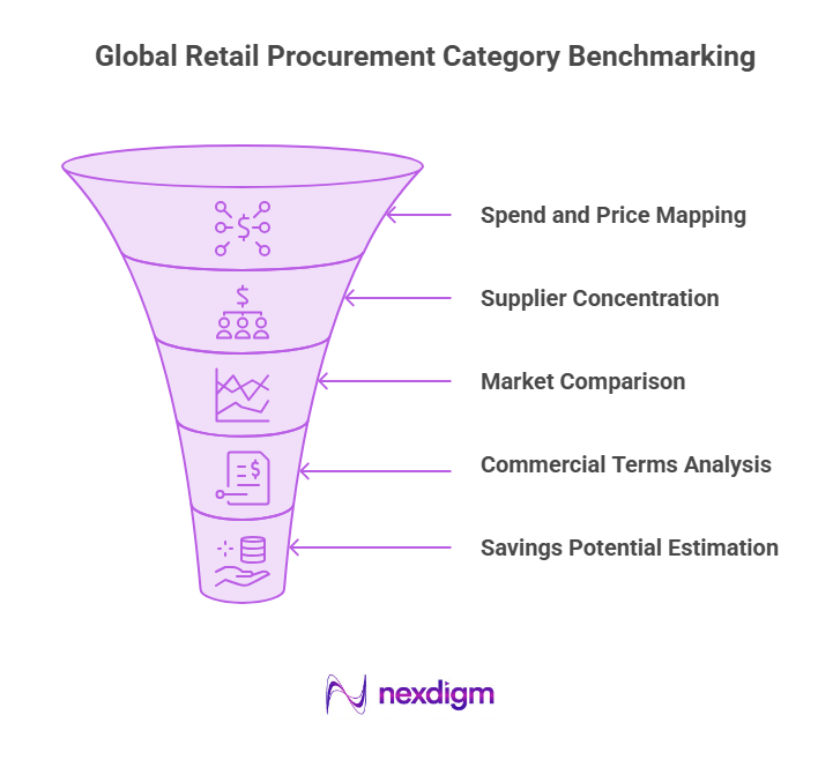
- Spend and Price Mapping: Mapping expenditure and unit pricing across categories, suppliers, markets, and business units to identify significant variations and areas requiring deeper review.
- Supplier Concentration: Assessing how spend is distributed among suppliers to identify categories where consolidation, competitive sourcing, or diversification could improve purchasing leverage.
- Market Comparison: Comparing sourcing markets based on supplier availability, input costs, labor, logistics, trade conditions, and other relevant factors affecting category economics.
- Commercial Terms Analysis: Reviewing discounts, rebates, payment conditions, freight arrangements, minimum order quantities, and contractual structures that influence effective procurement cost.
- Savings Potential Estimation: Assessing opportunity based on spend, price variance, supplier competition, market alternatives, and the feasibility of implementing changes.
By combining category benchmarking with detailed market and supplier analysis, Nexdigm helps retailers prioritize opportunities that offer the strongest balance of savings potential, sourcing efficiency, supplier competitiveness, and implementation feasibility.
Business Impact of Nexdigm’s Category Benchmarking Approach
Nexdigm’s structured category assessment can help retailers translate market comparisons into measurable procurement priorities by offering the following advantages:
- Focused Savings: Direct procurement resources toward categories where spend, price variation, supplier competition, and market conditions indicate stronger savings potential.
- Stronger Negotiations: Equip procurement teams with category and market benchmarks that provide greater context for supplier discussions and commercial negotiations.
- Smarter Sourcing: Identify markets, suppliers, and categories where alternative sourcing or demand consolidation could improve purchasing economics.
- Better Risk-Return Balance: Evaluate savings opportunities alongside supplier concentration, switching complexity, supply continuity, and operational requirements.
Together, these outcomes help retailers build a more targeted savings pipeline, rather than pursuing broad cost reduction without sufficient visibility into category-level realities.
Nexdigm’s Case
Nexdigm’s assessment identified a 17% potential savings opportunity across prioritized retail procurement categories. Around 12% of benchmarked spend showed significant supplier-price variation, while 8% presented opportunities for stronger sourcing or supplier negotiations, enabling the retailer to focus procurement efforts on categories with the strongest combination of savings potential, supplier competition, and implementation feasibility.
To take the next step, simply visit our Request a Consultation page and share your requirements with us.
Harsh Mittal
+91-8422857704