

Retail procurement is operating under increasing pressure to understand not only how much is being spent, but where that spend sits and what is driving it. A recent Retail Industry Outlook found that 95% of surveyed retail executives expect global trade policies to increase costs, while 66% plan to restructure supply chains through measures such as supplier diversification, nearshoring, or onshoring if input costs rise.
Meanwhile, research from Impinj found that only 36% of retail supply-chain leaders consistently achieve accurate, 360-degree, real-time inventory visibility, despite 85% believing their organizations have the right tools.
These developments highlight why global retail procurement spend visibility research is becoming important for understanding vendor concentration, category exposure, market dependencies, and opportunities to improve procurement economics.
The Visibility Challenge Across Retail Spend
Retail procurement spend can be fragmented across thousands of suppliers, product categories, business units, countries, and purchasing channels. Without a consolidated view, high-value categories may remain dispersed across vendors while smaller transactions accumulate into significant unmanaged spend.
Visibility also becomes harder when supplier records, category classifications, currencies, and purchasing data differ across markets. Building a common spend view helps retailers understand where procurement value is concentrated and where greater control may be possible.
Understanding the Factors Behind Retail Procurement Spend
Spend visibility delivers greater value when it helps retailers understand the commercial drivers behind procurement activity. By analyzing vendor concentration, businesses can identify supplier dependencies, fragmented purchasing, duplicate vendors, and opportunities to strengthen negotiation leverage.
Examining spend across categories, countries, and regions further highlights cost concentration areas, sourcing risks, and markets that may require deeper assessment. This broader view enables retailers to move beyond tracking purchases and focus procurement efforts where they can generate the greatest strategic and financial value.
Nexdigm’s Approach to Understanding Retail Spend Drivers
Nexdigm helps retailers look beyond spend totals to understand the commercial factors shaping procurement costs. Our global retail procurement spend visibility research analysis connects:
- Supplier Drivers: Assess supplier pricing, concentration, commercial terms, and purchasing patterns to identify factors influencing spend and potential areas for negotiation or supplier strategy changes.
- Category Drivers: Examine volumes, demand patterns, category mix, price movements, and purchasing behavior to understand why expenditure is increasing, decreasing, or shifting across categories.
- Market Drivers: Connect spend patterns with commodity prices, logistics, trade conditions, regional costs, and broader market developments to distinguish external pressures from supplier-specific movements.
By connecting these drivers, Nexdigm helps retailers understand not just where spend is concentrated, but why it is changing and where action may create value.
How Nexdigm Assesses Retail Procurement Spend
Nexdigm takes a structured view of retail procurement spend to understand how expenditure is distributed and what the underlying patterns indicate. The assessment connects the following areas:
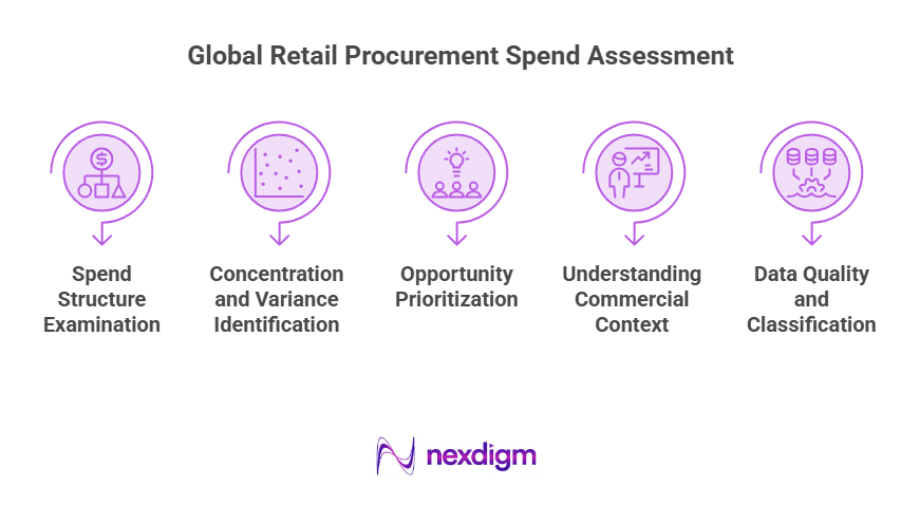
- Spend Structure: Examine how expenditure is distributed across vendors, categories, business units, markets, and purchasing channels to establish a reliable baseline.
- Concentration and Variance: Identify supplier dependencies, fragmented purchasing, unusual price differences, and variations in spend behavior that may warrant deeper investigation.
- Commercial Context: Overlay market prices, supplier economics, category trends, and geographic factors to understand whether observed spend patterns reflect market conditions or procurement-specific opportunities.
- Data Quality and Classification: Review supplier records, category classifications, currencies, transaction data, and duplicate entries to improve the consistency and reliability of the spend baseline.
- Opportunity Prioritization: Rank identified spend patterns according to value potential, supplier leverage, market attractiveness, sourcing complexity, and strategic importance to focus attention on the strongest opportunities
This approach helps retailers develop a clearer, evidence-based picture of their procurement landscape before deciding where deeper analysis or action is required.
Benefits of Nexdigm’s Retail Spend Assessment
Nexdigm’s assessment helps retailers convert fragmented procurement information into a clearer basis for commercial and sourcing decisions. Key benefits include:
- Greater Spend Visibility: Create a consolidated view of expenditure across suppliers, categories, markets, and business units, reducing blind spots in procurement spending.
- Improved Cost Opportunities: Identify pricing differences, fragmented purchasing, supplier leverage, and category-level opportunities that could support cost optimization.
- Stronger Supplier Decisions: Understand supplier concentration and purchasing dependencies to support consolidation, diversification, renegotiation, or alternative sourcing decisions.
- Better Procurement Prioritization: Focus management attention and analytical resources on categories, suppliers, and markets with the greatest potential business impact.
Overall, the assessment helps retailers turn spend visibility into clearer priorities, stronger procurement control, and more informed commercial decisions.
Nexdigm’s Case
Nexdigm assessed retail procurement spend across 15 categories, 120+ suppliers, and eight markets, creating a consolidated view of vendor and category concentration. The assessment identified three high-concentration categories, a 17% potential cost-optimization opportunity, and 9% of spend requiring deeper supplier or market review, helping the retailer prioritize sourcing and category-management efforts.
To take the next step, simply visit our Request a Consultation page and share your requirements with us.
Harsh Mittal
+91-8422857704