

Global retail trade is being reshaped by changing consumer demand, shifting sourcing networks, tariffs, logistics pressures, and the emergence of new production centres. Global trade reached a record US$35 trillion in 2025, while the WTO expects merchandise trade volume to grow 3.9% in 2026.
UNCTAD estimates that global goods trade reached approximately US$13.7 trillion in the first half of 2026, up 12.5% from the same period in 2025. At the same time, UNCTAD notes that higher prices contributed significantly to this increase. For retailers, manufacturers, distributors, and investors, these movements create both opportunities and risks.
Global retail trade analysis can help businesses determine which products are gaining cross-border demand, where sourcing is shifting, which suppliers are becoming important, and which markets may offer opportunities for expansion.
Trade Growth Does Not Mean Every Market Is Attractive
Global trade growth can conceal substantial differences between products, countries, suppliers, and destinations. A product category may show strong international growth while individual markets remain highly competitive or difficult to access. Businesses therefore need to examine trade at a granular level, combining product demand, supplier participation, pricing, market accessibility, and competitive conditions before making expansion or sourcing decisions.
Sourcing Networks Are Being Reconfigured
Businesses are increasingly reassessing sourcing strategies as trade policies, logistics economics, supply chain risks, and manufacturing capabilities continue to evolve across global markets. Emerging exporting countries with expanding production capacity and growing participation in international trade can offer viable alternative sourcing destinations, helping organizations diversify supplier bases and improve resilience. Understanding these shifts enables businesses to identify strategic sourcing and market opportunities while strengthening supply chain flexibility and competitiveness.
Nexdigm’s View of Changing Retail Trade
Nexdigm looks at global retail trade through both demand and supply. By combining trade data with market and industry research, it helps businesses understand:
- Track Product Movement: Nexdigm analyses imports, exports, suppliers, buyers, and shipment activity to understand how retail products are moving across markets.
- Identify Market Shifts: The analysis highlights growing demand, emerging suppliers, changing sourcing patterns, and markets where competitive conditions are evolving.
- Connect Trade with Decisions: These insights can support market entry, sourcing, supplier diversification, product expansion, and international retail strategy.
This gives businesses a clearer view of where global retail trade is moving and where the most relevant opportunities or risks may lie.
Nexdigm’s Expert-led Global Retail Trade Analysis
Understanding global retail trade requires more than tracking import and export values. Nexdigm combines trade intelligence with retail-sector knowledge, market research, competitive analysis, pricing assessment, and supply-chain intelligence to interpret changing trade patterns.
Our global retail trade analysis can help businesses understand which products are moving, where demand is growing, who the key suppliers and buyers are, how sourcing patterns are changing, and where new commercial opportunities may exist.
By connecting trade movements with broader market conditions, Nexdigm helps businesses turn cross-border trade information into clearer market-entry, sourcing, procurement, and international growth decisions through expert led structured framework process.
Nexdigm’s Global Retail Trade Analysis Framework
Experts at Nexdigm structure global retail trade analysis through four connected stages, helping businesses move from understanding trade movements to making informed sourcing and market decisions. These stages are:
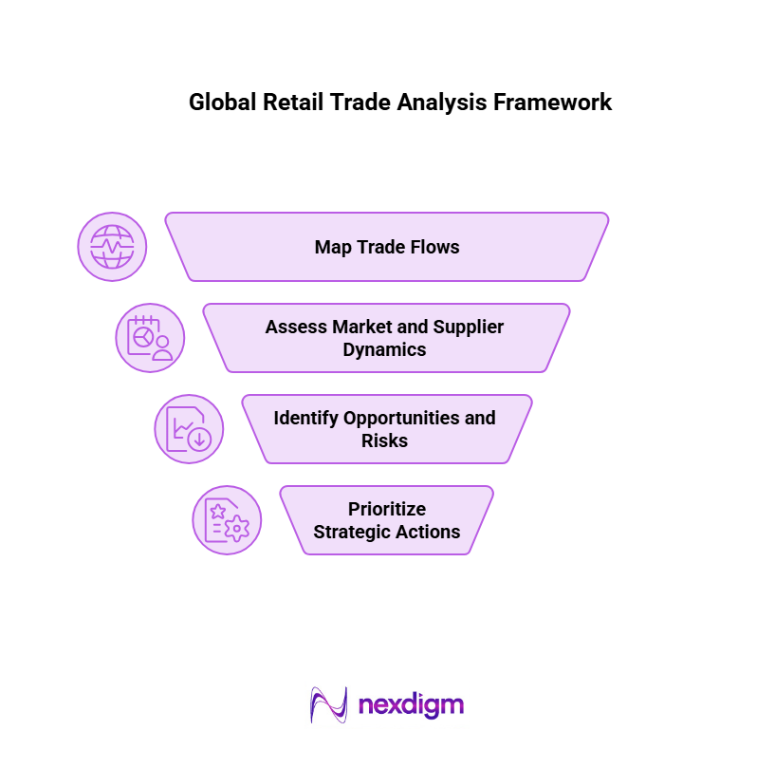
- Map Trade Flows: Analyse products, categories, importing and exporting countries, suppliers, buyers, shipment activity, trade routes, and sourcing origins to establish the overall trade landscape.
- Assess Market and Supplier Dynamics: Evaluate import growth, export performance, supplier participation, buyer activity, pricing, sourcing concentration, and competitive conditions to understand where demand and supply are shifting.
- Identify Opportunities and Risks: Determine potential markets, emerging product categories, alternative suppliers, sourcing opportunities, competitive gaps, and areas of supply or market-entry risk.
- Prioritize Strategic Actions: Rank products, markets, suppliers, and opportunities based on demand potential, competition, pricing, accessibility, supply resilience, and strategic fit, creating clear priorities for business action.
This framework helps businesses convert complex global trade information into focused market, sourcing, procurement, and international expansion priorities.
Benefits of Nexdigm’s Global Retail Trade Analysis Framework
Nexdigm’s four-step framework helps businesses move from fragmented trade information to clear commercial priorities. By linking trade flows with market, supplier, pricing, and competitive insights, the framework can support:
- Better Market Identification: Identify products and countries where import demand, market activity, and growth potential are strongest.
- Stronger Supplier Decisions: Compare suppliers and sourcing origins based on trade activity, pricing, capabilities, and concentration.
- Earlier Risk Identification: Detect changes in supplier participation, sourcing patterns, trade routes, and market conditions that may create exposure.
- Clearer Opportunity Prioritization: Rank markets, products, and suppliers using demand, competition, pricing, accessibility, and strategic relevance.
- Improved Market Entry: Assess demand, competitive conditions, supply availability, and market accessibility before committing resources to a new geography.
Nexdigm’s Case
Nexdigm used monthly trade-flow analysis to identify market shifts ahead of annual data. The approach helped a manufacturer achieve 18% export-volume growth, 24% higher distributor orders, and 15% fewer inventory gaps. By linking trade movements with market intelligence, the engagement supported faster decisions around demand, forecasting, and international market opportunities.
To take the next step, simply visit our Request a Consultation page and share your requirements with us.
Harsh Mittal
+91-8422857704