

Shipping opportunities are created along corridors, not neatly inside national borders. A country can have growing trade volumes while the routes connecting its major ports remain dominated by established carriers, constrained by terminal capacity or exposed to disruption. For a new entrant, the relevant market is therefore the combination of cargo flow, port connectivity, carrier structure and operating conditions on a specific trade lane.
Maritime transport carries around 80% of international trade in goods by volume, according to UNCTAD. Its liner shipping connectivity index captures factors including ship calls, container-handling capacity, services, carrier participation, vessel size and the number of economies connected through direct liner services.This makes connectivity a useful starting point, but not an entry decision by itself.
A highly connected lane can be difficult to penetrate because incumbent carriers already provide frequent services and benefit from established cargo bases. A less connected route may offer more room for a new service if trade volumes are expanding and customers face limited alternatives.
Start with cargo that needs another route
The first task is identifying where cargo demand is changing.
Manufacturing relocation, new export clusters, commodity flows and changing sourcing patterns can all create emerging trade lanes. The relevant measure is not simply total bilateral trade, but the portion of that trade that is containerisable, recurring and sufficiently concentrated to support a service.
Cargo characteristics matter as well. A lane dominated by low-value bulk commodities presents a different opportunity from one carrying high-value manufactured goods, components or time-sensitive products.
UNCTAD’s 2025 maritime assessment illustrates why this distinction matters. Global maritime trade grew 2.2% in 2024, but growth was expected to slow to 0.5% in 2025. At the same time, geopolitical disruption caused major rerouting, with ton-miles increasing by about 6% in 2024 as ships travelled longer distances around the Cape of Good Hope. A growing lane can therefore become more commercially interesting even when headline trade growth is modest if existing routes are becoming less efficient or reliable.
Connectivity tells only part of the story
Port connectivity is valuable because direct services can reduce transshipment and transit complexity. But a new entrant should also understand how that connectivity is created.
Some ports depend heavily on a small number of carriers. Others have broad carrier participation but face congestion or terminal constraints. A route may have several weekly sailings but little spare capacity during peak periods.
The competitive structure matters too. If a handful of carriers control most capacity, gaining share may require a substantially different proposition. If capacity is fragmented across several providers, a new entrant may have more room to establish a niche service.
Recent disruptions reinforce the point. UNCTAD reported that rerouting around the Cape of Good Hope increased voyage distances and vessel requirements, contributing to higher costs and weaker schedule reliability.
Where Nexdigm would look for an entry opening
A global shipping market entry research exercise should move through the trade lane rather than stopping at country-level market size.
The analysis can focus on:
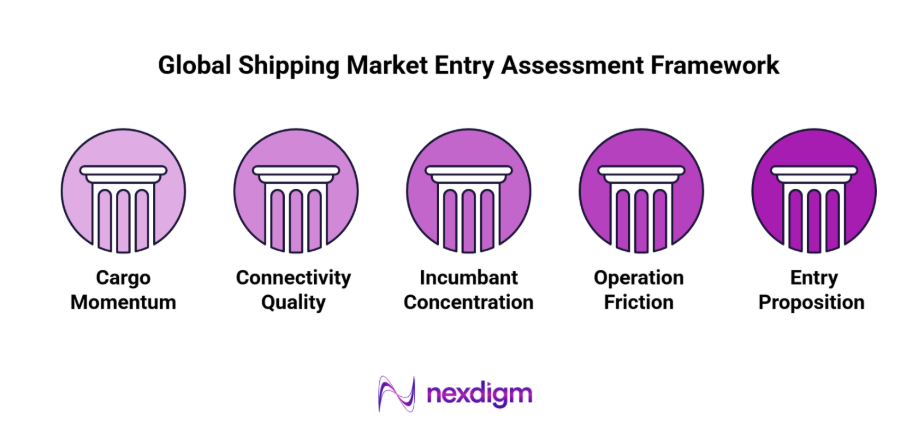
- Cargo momentum: Identify origin-destination pairs with sustained growth in relevant containerised cargo and expanding customer industries.
- Connectivity quality: Compare direct services, port calls, sailing frequency, transit times and transshipment requirements.
- Incumbent concentration: Determine which carriers control capacity and whether customers have meaningful alternatives.
- Operating friction: Assess congestion, terminal access, rerouting exposure, regulatory requirements, fuel costs and other factors affecting delivered economics.
- Entry proposition: Define what a new service would need to improve, whether that means frequency, transit time, reliability, equipment availability or a specialised customer proposition.
The final decision should distinguish between lanes that can support an independent service and those where partnership, feeder arrangements or slot-sharing provide a more realistic route into the market.
The best lane is not always the fastest-growing lane
A trade corridor with 12% cargo growth may still be unattractive if incumbents already operate dense services and customer acquisition costs are high. Conversely, a slower-growing corridor can offer a stronger entry case if capacity is constrained, service quality is inconsistent and several anchor customers are expanding.
This is why trade-lane selection needs to combine demand with competitive structure. The objective is to identify where a new service can achieve enough initial volume to build frequency and network density before competitors can easily neutralise the advantage.
For shipping companies considering expansion, the resulting assessment is less a ranking of countries than a map of commercially defensible corridors.
Illustrative Nexdigm Case: Screening Trade-Lane Entry Options
A Nexdigm assessment reviewed 24 international trade lanes using cargo growth, liner connectivity, carrier concentration, port conditions and conservative utilisation assumptions. Six lanes showed attractive demand and moderate competitive concentration. Two supported independent entry economics, while four were better suited to partnership or slot-based expansion.
To take the next step, simply visit our Request a Consultation page and share your requirements with us.
Harsh Mittal
+91-8422857704