

Global shipping pricing benchmarking helps logistics providers evaluate whether freight rates, surcharges, and service prices remain commercially sustainable across major trade lanes handling most international cargo flows. Global shipping pricing benchmarking combines pricing analysis with carrier rates, capacity trends, market demand, and competitor benchmarks to support informed pricing decisions.
By analyzing trade-lane economics, route profitability, cost-to-serve metrics, and regional pricing variations, businesses can optimize rate structures, protect margins, improve contract negotiations, and strengthen competitiveness in dynamic global shipping markets.
A recent study shows a global shipping operator used pricing analysis and trade-lane benchmarking to optimize contract rates across key corridors. The initiative reduced transportation costs by 12.4% and increased operating margins by 7.1%, strengthening profitability and pricing analysis results.
Global Shipping Pricing Analysis for International Trade Corridors
Global shipping pricing analysis evaluates trade-lane costs, capacity, demand, surcharges, and service performance to help businesses establish competitive rates and strengthen commercial decisions across international corridors with confidence. Steps followed for the structured process are:
- Build Trade-Lane Volatility Profile: Historical spot rates, contract variations, demand cycles, port constraints, and carrier behavior are mapped to identify corridors requiring stronger pricing safeguards and review frequencies.
- Calculate Imbalance-Driven Costs: Import-export imbalances, empty-container repositioning, equipment shortages, and one-way cargo flows are quantified to reflect hidden costs within corridor-specific shipping rates.
- Price Transit-Time Certainty: Schedule reliability, missed sailings, transshipment exposure, priority loading, and guaranteed space are evaluated to establish premiums for dependable and time-sensitive shipping services.
- Design Rate Adjustments: Canal disruptions, port closures, fuel spikes, currency movements, and regulatory changes activate predefined pricing responses, improving cost recovery during unexpected international shipping events.
- Optimize Pricing Rates: Revenue, margin, demand stability, capacity access, and customer importance are compared across corridors to prioritize commercially valuable routes and redesign underperforming pricing arrangements.
Nexdigm’s Pricing Support for Resilient International Trade Corridors
Nexdigm combines trade-lane intelligence, pricing analysis, and risk controls to help businesses strengthen shipping margins, improve pricing consistency, and build resilient international trade corridors across volatile markets. This advisory support helps businesses with:
- Improved shipping cost recovery
- Greater margin resilience
- Faster pricing decisions
- Better carrier negotiations
- Reduced rate volatility exposure
With this, businesses can manage corridor volatility, protect margins, strengthen commercial decisions, and build more competitive and resilient international shipping networks.
Nexdigm’s Adaptive Pricing Model for International Shipping Corridors
Nexdigm’s adaptive pricing model combines corridor economics, pricing analysis and intelligence and governance frameworks to create resilient shipping rates, protect margins, and strengthen commercial decisions across international trade networks. Major frameworks used in the adaptive pricing model, driving growth and success are:
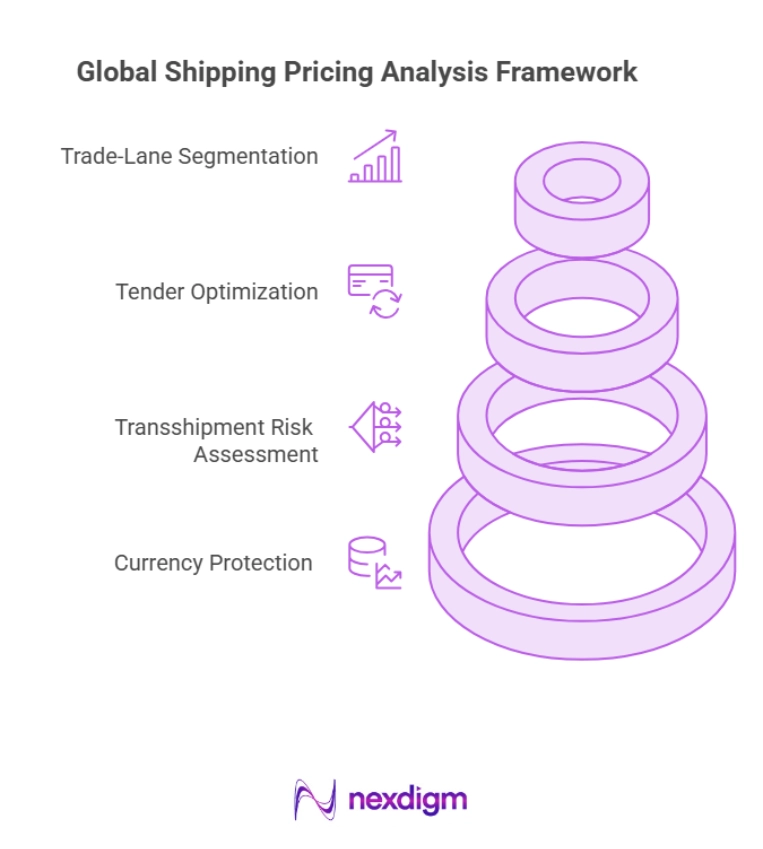
- Trade-Lane Segmentation Framework: Corridors are grouped by demand, cargo profile, risk exposure, service complexity, and margin potential, enabling differentiated pricing strategies across diverse global shipping environments.
- Transshipment Risk Framework: Connection reliability, port dwell time, missed sailings, cargo handling exposure, and schedule uncertainty are evaluated to price transshipment routes according to operational risk.
- Currency Protection Framework: Billing currencies, settlement timing, exchange-rate movements, and hedging costs are incorporated into corridor pricing to reduce foreign exchange exposure and margin volatility.
- Tender Optimization Framework: Historical rates, target margins, customer volumes, service requirements, and competitive intelligence are combined to strengthen bid pricing and improve tender conversion quality.
Nexdigm’s Case
Nexdigm supported an international shipper with corridor benchmarking, carrier negotiations, and reliability-based pricing. The initiative delivered 25%–30% first-round bid savings, reduced negotiation delays, improved rate transparency, strengthened carrier selection, and enhanced margin resilience across volatile global shipping corridors and contracts.
To take the next step, simply visit our Request a Consultation page and share your requirements with us.
Harsh Mittal
+91-8422857704