

Chemical supply chains are increasingly being designed around resilience as well as cost. Raw-material availability, geopolitical exposure, logistics disruptions, energy costs, production concentration, inventory requirements, and proximity to customers can all influence the reliability of a global network.
India demonstrates the scale of these interconnected flows. Chemical and petrochemical imports, excluding pharmaceuticals and fertilizers, reached approximately ₹6.32 lakh crore in FY2024–25, while domestic petrochemical production stood at 42.16 million tonnes against installed capacity of 52.29 million tonnes in FY2023–24. These figures highlight both the size of the market and the importance of balancing domestic production with international sourcing.
For chemical manufacturers, investors, and companies evaluating international expansion, global supply chain entry strategy chemicals can provide a framework for deciding where to source, manufacture, warehouse, and distribute while balancing cost, market access, resilience, and scalability.
Resilience Requires More Than Multiple Suppliers
Diversifying suppliers can reduce dependency on a single source, but resilience also depends on supplier location, capacity, quality, lead times, logistics infrastructure, and substitution options. A geographically diversified network can still remain vulnerable if critical intermediates depend on one country or transportation corridor.
Chemical companies therefore need to evaluate the complete supply chain rather than individual procurement relationships. Mapping dependencies across raw materials, production sites, logistics routes, warehouses, and customers can reveal vulnerabilities that may otherwise remain hidden.
The Best Production Location Is Not Always the Lowest-Cost Location
Manufacturing decisions increasingly require a broader view of economics. Labor and utility costs matter, but so do feedstock access, industrial infrastructure, ports, customer proximity, regulatory requirements, skilled talent, incentives, and supply reliability.
Similarly, distribution decisions need to consider demand concentration and delivery economics. Regional warehouses may improve responsiveness but increase fixed costs, while centralized facilities can provide efficiency but create longer transportation routes and greater disruption exposure.
Nexdigm’s Industry-led Supply Chain Advisory for Chemical Markets
Nexdigm combines market intelligence, supply-chain strategy, strategic sourcing, network design, competitive intelligence, demand forecasting, and logistics analysis to help chemical businesses evaluate global operating models.
Its chemical-sector research examines production capacity, imports, exports, feedstock availability, downstream demand, industrial clusters, and international supply-chain exposure. Nexdigm also applies supply-chain benchmarking to identify vulnerabilities across sourcing, logistics, inventory, and distribution.
This enables businesses to assess the network as an integrated system from source and make decisions through to inventory positioning and customer delivery.
Nexdigm’s Global Supply Chain Entry Assessment Framework
Expanding into new markets requires more than identifying demand opportunities. Businesses must evaluate market-access requirements to build an efficient and resilient supply chain. Nexdigm’s global supply chain entry strategy chemicals assessment follows a structured framework to evaluate network entry. The steps followed are:
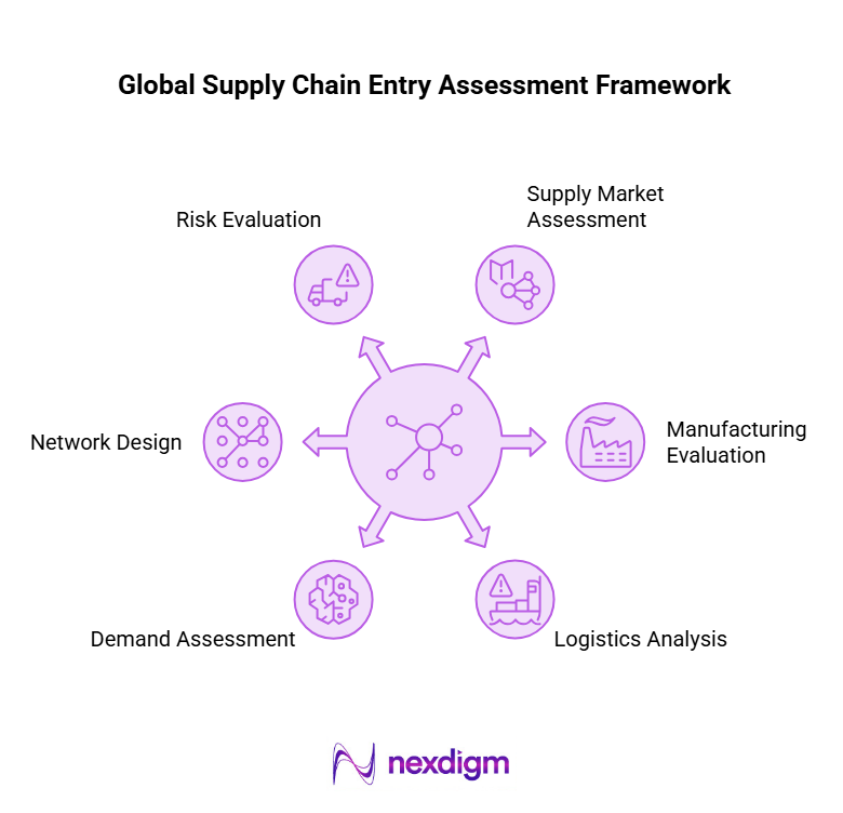
- Supply Market and Sourcing Assessment: Evaluate feedstock availability, supplier landscape, procurement risks, cost structures, and sourcing alternatives to identify sustainable supply options.
- Manufacturing and Capacity Evaluation: Assess production capabilities, industrial clusters, capacity utilization, infrastructure readiness, and scalability requirements within target markets.
- Logistics and Distribution Analysis: Analyze transportation networks, warehousing infrastructure, port connectivity, distribution models, and service-level requirements to support market access.
- Demand and Market Access Assessment: Examine downstream demand, customer locations, industry concentration, import-export dynamics, and regional growth opportunities.
- Network Design and Optimization: Determine the optimal supply chain configuration, including sourcing locations, production hubs, inventory positioning, and distribution routes.
- Risk and Resilience Evaluation: Identify potential vulnerabilities across sourcing, logistics, regulatory compliance, geopolitical exposure, and operational continuity.
This framework helps businesses design supply chains that balance cost efficiency, reliability, scalability, and customer responsiveness while supporting long-term market expansion objectives.
Applications of Nexdigm’s Global Supply Chain Entry Framework
Chemical supply chains are influenced by feedstock availability, production economics, hazardous-material handling requirements, regulatory compliance, and proximity to downstream demand centers. Nexdigm’s assessment helps chemical businesses address these industry-specific considerations through the following applications:
- Feedstock and Raw Material Sourcing: Identify sourcing locations that offer reliable access to critical raw materials, competitive costs, and supply continuity.
- Manufacturing Footprint Optimization: Evaluate production locations based on infrastructure, industrial ecosystems, utility availability, and market accessibility.
- Chemical Logistics and Distribution Planning: Assess transportation routes, storage infrastructure, distribution networks, and delivery capabilities for efficient market servicing.
- Import-Export and Trade Strategy: Analyze trade flows, port connectivity, tariffs, and regulatory requirements affecting cross-border chemical movement.
- Supply Chain Resilience Enhancement: Identify vulnerabilities across sourcing, production, logistics, and distribution to strengthen operational continuity.
By aligning supply chain networks with chemical industry requirements, Nexdigm helps businesses build operating models that support efficient market access, reliable supply, and long-term growth.
Nexdigm’s Case
Nexdigm supported a leading chemical company seeking greater resilience amid volatile market conditions. By applying supply-chain benchmarking and competitive intelligence, the engagement delivered a 13% reduction in logistics cost variability, an 18% improvement in inventory turnover, and stronger supply-chain stability across global operations. The results demonstrate how data-led sourcing, logistics, and inventory optimization can improve both resilience and operating performance.
To take the next step, simply visit our Request a Consultation page and share your requirements with us.
Harsh Mittal
+91-8422857704