

Global supply chains are being redesigned around more than production cost. Tariff volatility, geopolitical disruption, freight-rate fluctuations, and long transit times have exposed the risks of concentrating manufacturing and sourcing in a small number of locations.
For multinational businesses, the resulting opportunity is not simply to move production elsewhere. It is to determine which markets, supplier networks, and logistics corridors can provide a better balance of cost, resilience, lead time, and market access.
Diversification Is Creating More Complex Supply Chains
China +1 strategies allow companies to reduce dependence on a single manufacturing base without abandoning established production networks. India, Vietnam, Indonesia, Thailand, and Malaysia are among the markets attracting this diversification.
But adding a second manufacturing location can also create new dependencies. A factory may be in Vietnam or India while still relying on Chinese suppliers for raw materials, components, tooling, or specialized sub-assemblies.
This changes the logistics requirement. Instead of one consolidated finished-goods flow, companies may need to coordinate multi-country inbound shipments, additional customs processes, and higher inventory buffers.
Nearshoring Changes Where Logistics Value Is Created
Nearshoring brings production closer to major customer markets and can substantially shorten transportation cycles.
In North America, Mexico has become an important nearshoring location for industries including automotive, electronics, medical devices, and aerospace. European manufacturers are similarly developing production networks across Eastern Europe, Turkey, and North Africa.
Shorter corridors can reduce pipeline inventory and improve responsiveness, but they introduce their own constraints. Border congestion, customs requirements, labor availability, infrastructure limitations, and supplier depth can determine whether a nearshore location delivers the expected advantage.
The Cheapest Factory May Not Be the Cheapest Network
Comparing countries on factory wages alone can produce misleading conclusions. The economics of a new sourcing location depend on what it takes to move materials into the facility, operate it, and deliver finished products to customers.
A robust location assessment therefore considers:
- Landed cost: Production, freight, duties, customs, taxes, and destination transportation.
- Supplier ecosystem: Availability of local component, tooling, packaging, and raw-material suppliers.
- Infrastructure: Port capacity, roads, rail connectivity, and cargo-handling capabilities.
- Talent availability: Skilled manufacturing and engineering workforce, alongside labor-market conditions.
- Trade access: Tariff preferences, free-trade agreements, and customs requirements.
A market with lower labor costs can lose its advantage if critical inputs still must travel long distances from the existing manufacturing base.
Network Redesign Is Also a Capital Decision
Diversification requires investment before savings materialize. Companies may need to fund new facilities, supplier qualification, tooling, additional inventory, systems integration, and customs infrastructure while maintaining the existing network during the transition.
The resulting decision is therefore broader than “Where should we manufacture?” It is whether the reduction in landed cost, lead time, and concentration risk justifies the capital required to operate a more distributed network.
For some businesses, the answer may be a second manufacturing hub. For others, it may be a combination of regional assembly, diversified suppliers, and existing production facilities serving different markets.
Which Markets Can Capture the Shift?
The strongest opportunities tend to emerge where several conditions align: competitive production economics, established supplier ecosystems, reliable infrastructure, skilled labor, and favourable trade access.
Nexdigm evaluates these factors together rather than treating country selection as a labor-cost comparison. Its global supply chain opportunity study combines sourcing analysis, infrastructure benchmarking, landed-cost modelling, and risk assessment to identify locations that can support commercially viable network changes.
How Nexdigm Assesses Global Supply Chain Opportunities
Nexdigm evaluates potential network configurations across several dimensions:
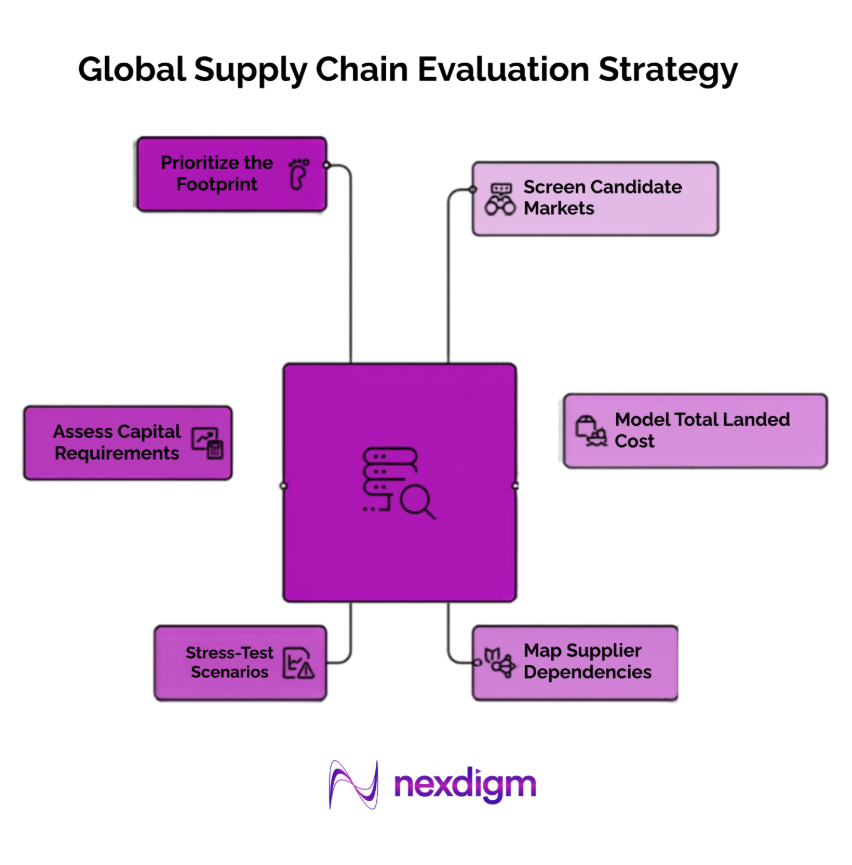
- Screen candidate markets: Compare manufacturing locations based on cost, infrastructure, talent, supplier depth, and trade access.
- Model total landed cost: Quantify production, freight, duties, customs, taxes, and inventory costs across alternative sourcing routes.
- Map supplier dependencies: Identify where a proposed diversification strategy remains dependent on the incumbent market for critical inputs.
- Stress-test scenarios: Evaluate the impact of tariff changes, freight volatility, geopolitical disruption, and alternative routing.
- Assess capital requirements: Compare facility, tooling, inventory, and integration investments against recurring network savings.
- Prioritize the footprint: Determine which combination of manufacturing, sourcing, assembly, and distribution nodes offers the strongest balance of cost and resilience.
How Nexdigm Helped Redesign a Global Manufacturing Footprint
A $1.4 billion industrial equipment manufacturer faced $38 million in annual tariff costs and 42-day delivery times from its China-centric network. Nexdigm evaluated eight potential sourcing markets and 180 component SKUs, ultimately recommending manufacturing in western India and final assembly in Mexico.
The redesigned network reduced North American delivery times to four days, lowered tariff liabilities by $34 million annually, cut supply chain costs by 11.4%, and improved EBITDA margins by 320 basis points within 18 months.
To take the next step, simply visit our Request a Consultation page and share your requirements with us.
Harsh Mittal
+91-8422857704