

Global telecom markets are increasingly diverging in their growth profiles. In mature markets, 5G adoption is approaching scale, network investment is shifting toward quality and monetization, and operators are looking for revenue beyond basic connectivity. In emerging markets, meanwhile, large portions of the population remain offline despite network coverage, while 4G, 5G, fixed wireless access and affordable devices are creating new demand.
That divergence makes global telecom opportunity mapping more complicated than comparing subscriber growth across countries.
GSMA estimates that mobile technologies and services generated $7.6 trillion in economic value globally in 2025, equivalent to 6.4% of global GDP, and projects the contribution to reach $11.3 trillion by 2030. At the same time, 45% of operators identify monetization as a strategic priority, signalling a shift toward extracting more value from existing networks and digital ecosystems.
The next growth market may therefore be defined by a combination of unmet connectivity demand, technology transition and monetization potential.
Mature markets are becoming markets for network quality and new services
In Europe, 5G adoption is projected to reach 88% of mobile connections by 2030. Yet GSMA estimates that Europe requires approximately €475 billion in investment over the next decade to achieve best-in-class connectivity, with an estimated €205 billion gap between required and expected operator investment.
The commercial question in such markets is less about basic network availability and more about what customers and enterprises will pay for on top of established connectivity.
Private 5G, network APIs, differentiated connectivity, edge services, security, enterprise connectivity and AI-enabled infrastructure can create additional revenue pools. The addressable market therefore needs to be assessed by use case and customer segment rather than by subscriber numbers alone.
Asia Pacific presents a different combination. Mobile technologies generated $1 trillion in economic value across the region in 2025, with the figure projected to reach $1.4 trillion by 2030. Nearly 2.7 billion mobile connections are already supported across the region, but adoption levels and technology maturity vary substantially between markets.
Emerging markets contain a different kind of opportunity
Africa illustrates why connectivity gaps can become commercial variables.
GSMA estimates that mobile technologies contributed $240 billion to Africa’s economy in 2025 and expects that contribution to reach $290 billion by 2030. Yet almost 1 billion people in Africa still do not use mobile internet, representing 63% of the population. Device affordability, digital skills and relevant content remain major barriers.
This means a market can have extensive network coverage without having reached its commercial demand ceiling.
Latin America is further along the adoption curve. Mobile technologies generated $600 billion in economic value in 2025, while 5G adoption is projected to reach 50% of connections by 2030. However, the region still has a 32% mobile internet usage gap.
For operators, infrastructure providers and investors, these differences create distinct entry models. One market may require network expansion, another affordable device financing, another enterprise services, and another differentiated 5G propositions.
A market map needs to distinguish growth from accessibility
A useful global telecom market opportunity mapping exercise can evaluate markets through five interconnected dimensions.
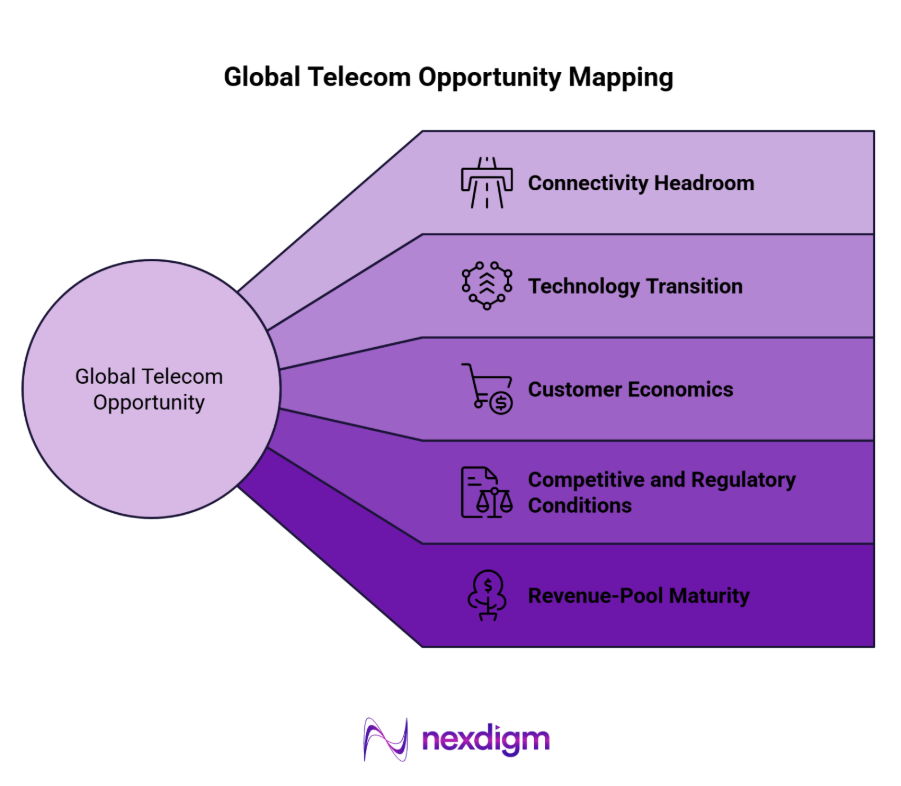
- Connectivity headroom
Measure smartphone penetration, mobile internet usage, broadband coverage, 4G and 5G adoption, FWA penetration and remaining coverage or usage gaps. A large offline population is only an opportunity if affordability and infrastructure barriers can be addressed. - Technology transition
Assess the migration path between 3G, 4G, 5G and eventually 5G standalone. The commercial implications differ considerably. Markets still migrating toward 4G can offer volume-driven opportunities, while advanced 5G markets may offer higher-value enterprise and differentiated connectivity opportunities. - Customer economics
Compare ARPU, disposable income, enterprise technology spending, data consumption and willingness to pay. A large subscriber base does not necessarily translate into an attractive revenue pool. - Competitive and regulatory conditions
Map operator concentration, spectrum availability, infrastructure-sharing rules, foreign investment restrictions, licensing requirements and digital regulations. These can materially affect the ease of market entry and capital requirements. - Revenue-pool maturity
Identify where additional revenue can realistically emerge from FWA, IoT, private networks, enterprise connectivity, APIs, cloud partnerships, cybersecurity and digital services.
The next telecom market is not necessarily the next country with the most subscribers
The distinction matters because telecom opportunity can emerge at very different stages of market maturity.
In Africa, the opportunity may involve closing usage gaps and moving customers toward smartphones and 4G. In Latin America, it may involve monetizing increasingly mature 5G networks. In Europe, investment gaps and enterprise digitalization can create demand for network modernization. Across Asia Pacific, the opportunity can vary sharply between advanced and emerging economies.
The assessment therefore needs to combine market size with technology readiness, customer economics, infrastructure requirements and competitive structure.
That provides a more useful basis for market entry, expansion, infrastructure investment and portfolio decisions than subscriber forecasts alone.
Nexdigm Case: Global Telecom Market Mapping
A telecom infrastructure provider with $420M revenue evaluated 11 countries. Nexdigm assessed 38 indicators across connectivity, ARPU, 5G maturity and enterprise demand, narrowing the pipeline to 4 priority markets representing a $2.8B five-year opportunity.
To take the next step, simply visit our Request a Consultation page and share your requirements with us.
Harsh Mittal
+91-8422857704