

Global trade patterns reveal more than which countries export the most. Changes in bilateral flows, import dependence, supplier concentration, and regional trade can indicate where production is shifting and where companies may find new customers. For businesses considering expansion, the challenge is distinguishing structural changes in sourcing from short-lived movements caused by price increases, inventory accumulation, or geopolitical disruption.
The most useful analysis identifies which products are gaining demand, which suppliers are capturing it and whether those changes create a commercially accessible opportunity.
Global Trade Growth Is Uneven Across Products and Regions
UN Trade and Development reported in April 2026 that global trade in goods and services reached approximately US$35 trillion in 2025, an increase of around 7.5%. Goods trade grew by about 7%, while services expanded by approximately 8%. Growth was stronger in developing economies in East Asia and Africa, while trade between developing economies grew by around 9%.
These aggregate figures conceal different market trajectories. A company supplying industrial machinery may find opportunities in expanding manufacturing networks, while a commodity exporter could face a very different outlook because of volatile prices or changing energy demand. Regional growth therefore needs to be broken down by product, destination, and supplier.
The distinction between nominal and real growth is essential. Higher trade values can reflect higher prices rather than increased quantities purchased. Companies should compare value, volume, and unit-value trends before treating a country as a rapidly expanding customer market.
Supplier Positions Are Changing Alongside Trade Routes
One of the clearest shifts has been the reorganisation of trade between major economies. UN Trade and Development estimated that US-China trade declined by roughly one-quarter in 2025, equivalent to approximately US$170 billion. At the same time, economies including Viet Nam, Cambodia, Egypt and Indonesia have played intermediary roles in selected supply chains, supporting logistics, assembly and alternative sourcing arrangements.
These changes create opportunities for suppliers able to serve new production locations. However, an increase in a country’s exports does not automatically mean that local firms have captured the underlying manufacturing activity. Goods may be assembled from imported components, re-exported through distribution hubs or recorded under different country-of-origin rules.
Companies should therefore examine the product composition of rising exports, the corresponding growth in intermediate-goods imports and evidence of local production capacity. A destination that is building manufacturing capabilities may generate demand for machinery, packaging, chemicals, components, and technical services. A transshipment hub may offer distribution opportunities, but less local industrial demand than its export statistics suggest.
Where Emerging Demand May Be Found
Three patterns are worth investigating when screening international markets.
- Expanding regional value chains: Rising trade among neighbouring economies can signal opportunities for intermediate goods, industrial inputs and services supporting regional production.
- New manufacturing and assembly locations: Countries gaining export share in specific product categories may require additional equipment, materials, logistics and supplier support.
- Markets diversifying their sourcing: Importers seeking alternatives to concentrated suppliers may be open to new vendors, provided that quality, cost and delivery reliability meet requirements.
These signals are starting points rather than proof of a viable market. Customer concentration, local production, regulatory conditions, and the economics of reaching buyers determine whether an opportunity can be captured.
How to Test Whether a Trade Shift Is Commercially Durable
A global trade analysis should compare several years of product-level data and identify whether a shift persists across different market conditions. Analysts should examine supplier market shares, import growth, price and volume movements, changes in product mix, and the role of intermediate goods.
The next step is to test the commercial implications. Can the business meet local standards? Are tariffs and freight costs competitive? Do potential buyers already have long-term supply contracts? Is the market large enough to support the required sales and service infrastructure?
It is also important to consider policy exposure. A trade route that becomes attractive following a tariff change may lose its advantage if the rules are revised. Companies should model the effect of plausible changes in duties, shipping costs, currency rates and supplier pricing.
Signals That Deserve Closer Investigation
A market should move from preliminary screening to deeper research when several indicators point in the same direction:
- Import volumes rise over multiple periods, rather than only in value terms.
- The supplier mix changes and new exporters gain a sustained share.
- Related intermediate goods and capital equipment show compatible trade patterns.
- New industrial capacity, infrastructure projects, or customer investments support the demand signal.
- Landed-cost analysis indicates that the company can compete without relying on temporary price advantages.
A Trade-Shift Opportunity Framework
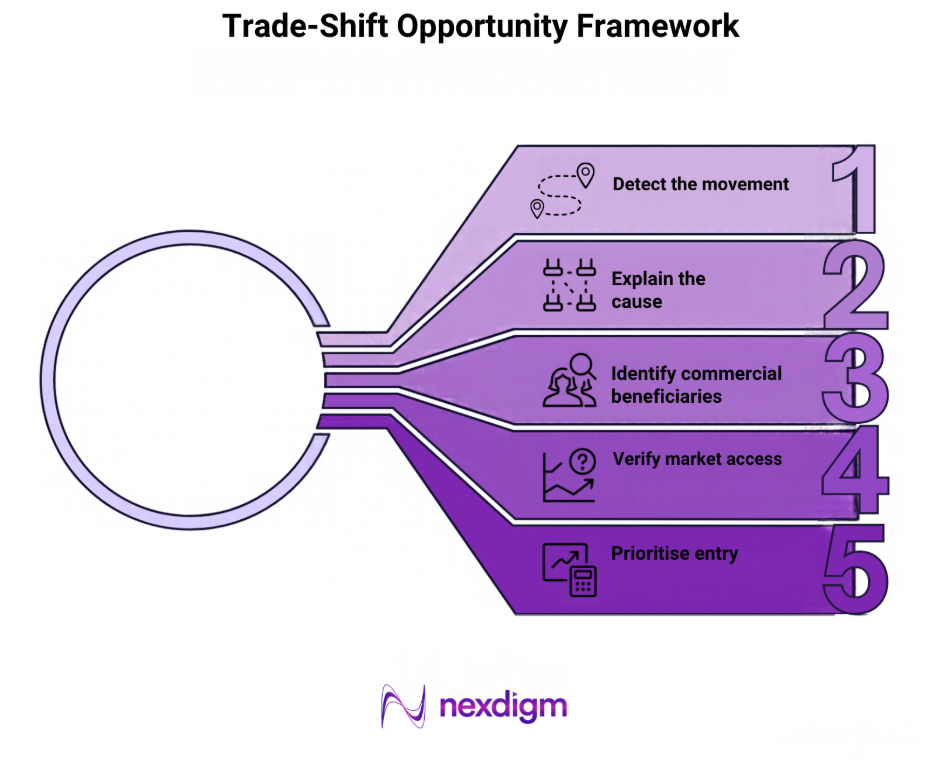
- Detect the movement: Identify products, routes and destinations with material changes in trade value, volume or supplier share.
- Explain the cause: Test whether the shift reflects final demand, price changes, production relocation, inventory cycles or re-export activity.
- Identify commercial beneficiaries: Map the industries, customers and adjacent products likely to gain from the change.
- Verify market access: Assess tariffs, technical requirements, logistics, and competitive costs.
- Prioritise entry: Advance markets where durable demand and reachable customers support a defensible commercial case.
Nexdigm Case Study
An industrial supplier screened six export destinations after identifying shifts in regional sourcing patterns. Product-level analysis and local market checks narrowed the shortlist to two markets with stronger evidence of industrial demand. The company prioritised buyer validation and distributor assessment before allocating resources to a wider export rollout.
To take the next step, simply visit our Request a Consultation page and share your requirements with us.
Harsh Mittal
+91-8422857704