

International expansion is becoming more selective as trade patterns, demand centres, tariffs, and competitive positions change rapidly. The WTO expects world merchandise trade volume to grow 3.9% in 2026 and 4.1% in 2027. Asia is projected to record the fastest merchandise export growth in 2026 at 9.9%, while import growth is expected at 9.5%.
At the same time, market opportunity is becoming more fragmented. The WTO reports that low- and middle-income economies now account for 45% of global merchandise trade, nearly twice their share in 1995. This changing geography creates new opportunities, but businesses need evidence of actual product demand, buyer activity, supplier competition, pricing, and trade accessibility before committing resources.
For manufacturers, exporters, investors, and international growth teams, global trade intelligence for market entry can provide that evidence. By analyzing actual import-export activity alongside market and competitive intelligence, companies can identify markets where demand and commercial conditions support a stronger entry case.
Understanding Buyer Ecosystems and Demand Concentration
Not all high-growth markets offer the same commercial opportunity. Businesses need to assess where demand is concentrated, who the major buyers are, and how purchasing patterns are evolving over time. Evaluating importer profiles, procurement volumes, supplier relationships, and industry consumption trends provides greater visibility into the market landscape. This helps organizations identify markets where demand is supported by an established customer base and where entry efforts can be aligned with real purchasing activity.
Identifying Sustainable Growth Opportunities Through Trade Intelligence
Trade intelligence helps businesses move beyond current demand indicators to identify markets with stronger long-term growth potential. By evaluating the following areas, organizations can prioritize opportunities that align with their expansion objectives:
- Emerging Demand Corridors: Trade-flow analysis highlighting markets experiencing sustained import growth, helping businesses target geographies with expanding demand and future potential.
- Long-Term Market Attractiveness: Assessment of industry growth trends, investment activity, and trade developments helps identify markets positioned for continued commercial expansion.
A forward-looking trade intelligence approach enables businesses to focus on markets where current opportunities are supported by favorable long-term growth fundamentals.
Nexdigm’s Trade Intelligence Approach to Sustainable Market Selection
As organizations evaluate new international markets, identifying opportunities with long-term growth potential requires a deeper understanding of trade dynamics, demand evolution, and market attractiveness. Nexdigm leverages Global Trade intelligence for Market Entry through:
- Buyer Demand Validation: Analysis of importer activity, purchasing trends, and trade volumes to identify markets with established demand and active buying ecosystems.
- Market Entry Readiness: Evaluation of trade accessibility, regulatory considerations, and sourcing dynamics to determine the practicality and attractiveness of entering target markets.
- Competitive Landscape Assessment: Assessment of supplier presence, market concentration, and trade flows to identify opportunities for differentiation and competitive positioning.
- Growth Opportunity Identification: Examination of emerging trade corridors and industry developments to highlight markets demonstrating strong potential for future expansion.
With this, Nexdigm helps businesses focus on markets where entry opportunities are supported by sustainable commercial fundamentals.
Why Businesses Choose Nexdigm for Global Trade Intelligence and Market Entry
Entering a new market requires more than identifying demand opportunities. Businesses need actionable intelligence on trade flows, buyer ecosystems, competition, and market accessibility to make confident expansion decisions. Nexdigm offers trade data analytics to help organizations with:
- Data-Driven Market Selection: Nexdigm leverages global trade data, demand trends, and import-export patterns to identify markets that align with product potential and growth objectives.
- Comprehensive Market Entry Evaluation: Nexdigm integrates trade intelligence, competitive analysis, and market-access assessments to provide a holistic view of market attractiveness and entry feasibility.
With Nexdigm’s expert-led assistance in trade intelligence, businesses get informed market-entry decisions, reduce uncertainty, and focus on investments on high-potential growth opportunities.
Nexdigm’s Global Trade Intelligence for Market Entry Assessment
Expanding into a new market requires a comprehensive understanding of demand patterns, trade dynamics, competitive intensity, and market-access conditions. Nexdigm’s Global Trade Intelligence for Market Entry Assessment leverages:
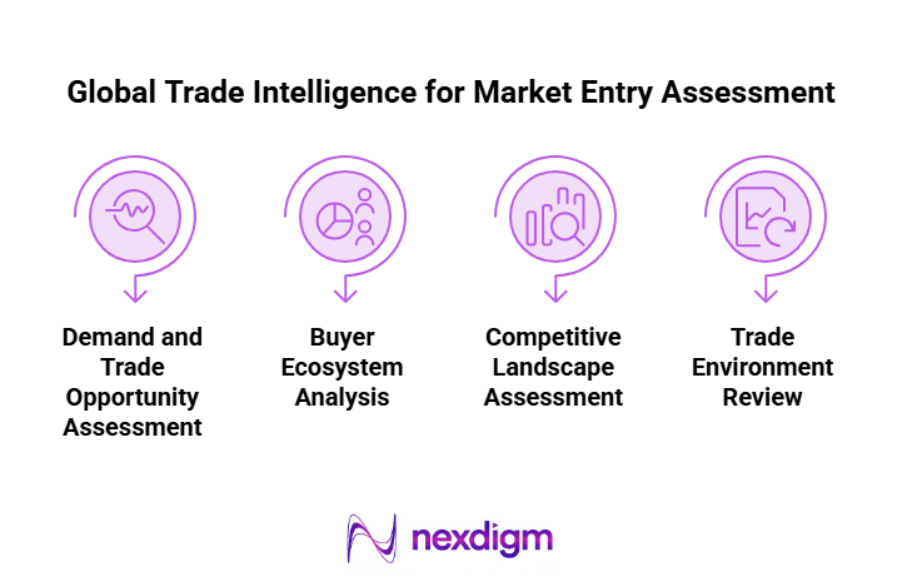
- Demand and Trade Opportunity Assessment: Nexdigm analyzes import trends, trade volumes, growth patterns, and buyer activity to identify markets demonstrating sustained demand and attractive expansion opportunities.
- Buyer Ecosystem Analysis: Evaluation of key importers, purchasing behavior, supplier relationships, and demand concentration to understand the structure and accessibility of target customer segments.
- Competitive Landscape Assessment: Nexdigm examines supplier presence, market concentration, and trade flows to assess competitive intensity and identify opportunities for market differentiation.
- Market Access and Trade Environment Review: Assessment of tariffs, trade regulations, import dependencies, and market-entry barriers to evaluate the ease and practicality of entering target markets.
By combining global trade intelligence with market and competitive analysis, Nexdigm helps businesses reduce market-entry uncertainty, validate growth opportunities, and make data-driven expansion decisions with greater confidence.
Nexdigm’s Case
Nexdigm supported a manufacturer using monthly trade-flow analysis to identify market movements before annual data became available. The approach contributed to an 18% increase in export volumes, 24% growth in distributor orders, and 15% reduction in inventory gaps. The result represents how continuous trade monitoring can strengthen post-entry forecasting, distribution, and inventory planning.
To take the next step, simply visit our Request a Consultation page and share your requirements with us.
Harsh Mittal
+91-8422857704