

Global trade data can reveal much more than import and export values. Shipment volumes, product movements, supplier relationships, pricing, origins, destinations, and changing trade corridors can reveal where demand is developing, where competitors are expanding, and where sourcing risks are emerging. The challenge is converting enormous datasets into decisions that commercial teams can actually use.
Trade intelligence has become increasingly important as supply chains become more geographically complex. A recent study reveals that businesses need to look beyond headline value, volume, and growth rates to identify supply chain shifts, competitive movements, emerging demand patterns, and market opportunities. Monthly trade data can also reveal changes before annual datasets become available, helping companies respond faster to market movements.
For manufacturers, exporters, importers, investors, procurement teams, and strategy leaders, a global trade intelligence platform should therefore combine large-scale trade datasets with product-level intelligence, company mapping, geographic analysis, competitive benchmarking, and strategic interpretation.
Why Businesses Need More Than Trade Data
Access to global trade data alone does not guarantee better business decisions. While import-export statistics, shipment volumes, and trade values provide useful visibility, organizations must understand the underlying drivers behind market movements. An effective analysis connects trade activity with supplier behavior, competitive developments, emerging demand trends, and sourcing patterns. This broader perspective enables businesses to identify risks earlier, uncover new growth opportunities, and make more informed commercial, procurement, and expansion decisions.
Key Capabilities of an Effective Global Trade Intelligence Platform
A successful global trade intelligence platform should go beyond data aggregation and provide actionable insights. Businesses require the ability to analyze product-level trade flows, track supplier and buyer relationships, monitor competitor activity, assess geographic demand shifts, and evaluate sourcing opportunities. Advanced visualization, customizable dashboards, and real-time monitoring further strengthen decision-making. By transforming complex datasets into clear intelligence, organizations can improve market assessments, strategic planning, and operational effectiveness.
Nexdigm Helping Businesses Unlock Actionable Trade Intelligence
Nexdigm helps organizations convert complex global trade datasets into actionable intelligence that supports market expansion, sourcing optimization, competitive assessment, and strategic decision-making through:
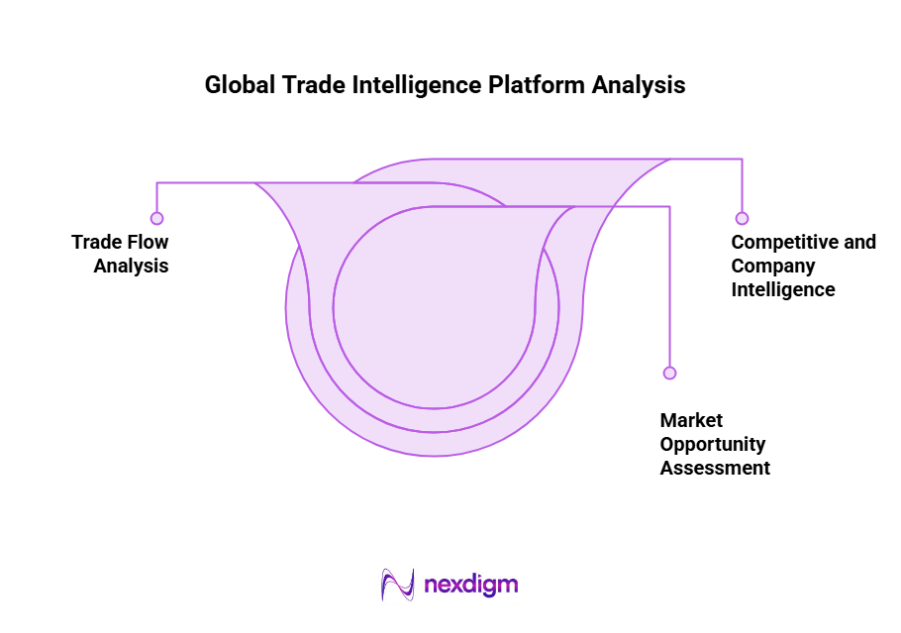
- Trade Flow Analysis: Analyzing product movements, trade corridors, import-export patterns, and market shifts to identify emerging opportunities, demand hotspots, and evolving trade dynamics.
- Competitive and Company Intelligence: Mapping buyers, suppliers, competitors, and trading relationships to help businesses understand market ecosystems, benchmark performance, and identify strategic opportunities.
- Market Opportunity Assessment: Combining trade data with commercial analysis to evaluate growth potential, prioritize target markets, and support expansion, sourcing, and investment decisions.
By integrating trade intelligence with strategic analysis, Nexdigm helps businesses move beyond data interpretation to uncover actionable insights that support informed decision-making and sustainable growth.
Why Trade Intelligence Matters
In an increasingly interconnected global economy, businesses need more than historical trade data to stay competitive. Trade intelligence provides visibility into market trends, demand shifts, supplier networks, and competitive activity, enabling organizations to identify opportunities, mitigate risks, and make faster, more informed strategic decisions.
Nexdigm’s Approach to Converting Trade Intelligence into Business Advantage
Nexdigm helps organizations move beyond interpreting trade data by transforming market insights into practical business strategies. Through global trade intelligence platform analysis, organizations can identify opportunities through:
- Emerging Demand Opportunity Assessment: Analyzing evolving trade patterns and purchasing trends to identify high-growth products, underserved markets, and demand shifts that may create new revenue opportunities.
- Trade Network and Ecosystem Mapping: Evaluating relationships across buyers, suppliers, distributors, and trading hubs to provide visibility into market structures and potential strategic opportunities.
- Supply Chain Risk Identification: Assessing trade dependencies, sourcing concentrations, and changing trade routes to help businesses anticipate disruptions and strengthen operational resilience.
- Growth Prioritization and Market Selection: Supporting evaluation of geographies and market segments with strong commercial potential, enabling organizations to focus resources on the most attractive opportunities.
- Strategic Investment and Expansion Support: Providing data-backed insights that help businesses evaluate expansion initiatives, partnerships, sourcing strategies, and investment opportunities with greater confidence.
By combining global trade intelligence with strategic analysis, Nexdigm helps organizations uncover opportunities, navigate market complexities, and make informed decisions that support sustainable business growth.
Nexdigm’s Case
Nexdigm supported an industrial company by analysing trade data beyond headline value, volume, and growth metrics. The assessment examined shipment frequency, supplier concentration, unit prices, and sourcing patterns, identifying actionable market signals. The resulting strategy contributed to a 17% increase in demand, 13% procurement savings, and 9% market-share growth, demonstrating how trade intelligence can translate granular records into measurable commercial outcomes.
To take the next step, simply visit our Request a Consultation page and share your requirements with us.
Harsh Mittal
+91-8422857704