

Global trade is expanding, but the direction of that growth is becoming increasingly uneven. Global trade reached a record US$35 trillion in 2025, up about 7.5%, while goods trade alone increased approximately 7%. In the first half of 2026, global goods trade reached an estimated US$13.7 trillion, up 12.5% year-on-year. At the same time, geopolitical tensions and changing supply networks are reshaping where products are sourced, manufactured, and sold.
The latest WTO outlook reinforces this complexity. World merchandise trade volume is now expected to grow 3.9% in 2026 and 4.1% in 2027. In the first half of 2026, AI-enabling goods accounted for 47% of global merchandise trade growth in value terms, while their trade increased 67% year-on-year. These movements create new opportunities, but they also make it harder for businesses to identify which changes represent sustainable demand, competitive shifts, or temporary trade effects.
This is where global trade intelligence becomes strategically relevant. For manufacturers, exporters, importers, procurement teams, investors, and market-entry leaders, trade data can reveal where demand is moving, which suppliers are gaining ground, how competitors are expanding, and where sourcing or market opportunities are emerging.
Trade Growth Creating More Signals
A rise in imports does not automatically mean stronger underlying demand. It may reflect inventory rebuilding, price increases, supplier substitution, or temporary disruptions. Similarly, falling exports could indicate weaker demand or simply a shift toward a different sourcing country. The challenge is therefore not collecting more trade records. It is interpreting value, volume, product, company, geography, pricing, and shipment patterns together so businesses can distinguish meaningful commercial movements from short-term fluctuations.
Understanding the Changing Trade Geography
Recent trade data shows how quickly supply networks can adapt. During the first half of 2026, Middle East disruptions reduced crude-oil exports from the region by roughly 24% and LNG exports by 47%, yet alternative suppliers helped limit the decline in global exports. Container throughput also remained resilient, increasing 3.9% year-to-date through July. For businesses, these changes demonstrate why monitoring origin countries, destination markets, suppliers, ports, products, and trade corridors can provide an early view of strategic shifts.
Nexdigm’s Approach to Assessing the Changing Trade Shifts
As global trade geography continues to evolve, businesses need a structured approach to interpret changing trade flows, supplier networks, and market dynamics. Nexdigm helps organizations move beyond transactional trade data by transforming cross-border trade movements into actionable intelligence that supports growth, sourcing, competitive positioning, and expansion decisions.
By offering global trade intelligence services, Nexdigm enables businesses to identify emerging opportunities, monitor strategic shifts, and make informed decisions in an increasingly complex global trade environment.
Nexdigm’s Expertise in Offering Global Trade Intelligence Services
Nexdigm treats trade intelligence as a business decision-support capability rather than simply a trade-data repository. Its Trade Analysis combines international trade data with market research to provide visibility across products, SKUs, industries, companies, and geographies.
The approach can support market opportunity identification, sourcing strategy, competitor intelligence, export assessment, supplier and buyer identification, trade-flow analysis, tariff assessment, and market-entry decisions.
Nexdigm’s Global Trade Intelligence Assessment
Nexdigm’s global trade intelligence capabilities can examine cross-border activity through multiple analytical lenses, such as:
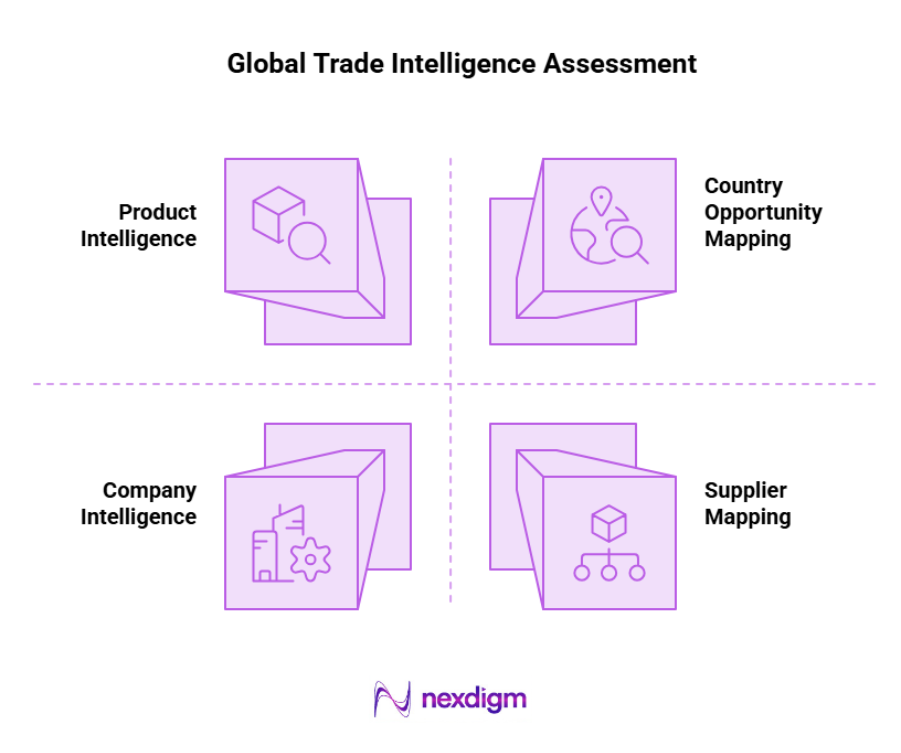
- Product Intelligence: Nexdigm analyses products, HS codes, categories, SKUs, and brands to identify growth products, declining categories, portfolio gaps, and emerging commercial opportunities.
- Country Opportunity Mapping: Comparing import and export trends across countries to identify attractive destinations, sourcing markets, demand shifts, and markets warranting deeper evaluation.
- Company Intelligence: Nexdigm maps importers, exporters, buyers, and suppliers to identify major market participants, purchasing relationships, competitive positions, and potential business targets.
- Supplier Mapping: Identifying supplier origins, sourcing relationships, concentration levels, and alternatives to support procurement diversification, supplier benchmarking, and sourcing-strategy decisions.
Nexdigm’s Assessment: Transforming Trade Intelligence into Strategic Advantage
As global trade patterns continue to evolve, businesses need the ability to interpret trade movements and convert market signals into strategic actions. Nexdigm combines trade intelligence insights to help organizations in the following ways:
- Decoding Global Trade Trends: Nexdigm analyzes import-export flows, product-level trade patterns, pricing movements, and trade corridors to help businesses understand evolving demand dynamics and identify commercially relevant market opportunities.
- Supply Chain and Sourcing Intelligence: Nexdigm evaluates sourcing dependencies, supplier concentration risks, alternative procurement markets, and shifting trade routes to support resilient and diversified supply chain strategies.
- Trade-Led Market Expansion Assessments: By leveraging trade intelligence alongside market attractiveness analysis, Nexdigm helps businesses identify priority geographies, assess growth potential, and support informed international expansion decisions.
This helps businesses move beyond raw trade data to uncover actionable opportunities, strengthen resilience, and achieve sustainable growth in an increasingly interconnected global marketplace.
Nexdigm’s Case
Nexdigm supported an India-based industrial-products company by analyzing product-wise import-export activity across key markets. The resulting insights contributed to a 27% increase in qualified export opportunities and 8% improvement in price realization, while helping the company sharpen product prioritization.
To take the next step, simply visit our Request a Consultation page and share your requirements with us.
Harsh Mittal
+91-8422857704