

Global trade is expanding while its geography is changing. Companies are adjusting sourcing, manufacturing, inventory, and distribution networks as geopolitical tensions, trade policies, supply-chain risks, and changing consumption patterns reshape established routes.
UNCTAD reported that global trade reached a record more than $35 trillion in 2025, with goods trade growing around 6.5% and services nearly 9%. At the same time, trade networks are becoming more fragmented, with regional and closer trade links gaining importance.
For manufacturers, retailers, logistics providers, shipping companies, ports, investors, infrastructure developers, and governments, the key question is where future trade flows will emerge and how logistics networks should respond.
A Global trade logistics market assessment helps evaluate trade corridors, sourcing shifts, freight volumes, infrastructure, ports, warehouses, transportation networks, and emerging logistics opportunities. Nexdigm connects these signals to identify where logistics networks may need to expand, diversify, or be redesigned.
Understanding the Changing Trade Routes
Global trade networks are becoming less predictable. Geopolitical tensions, tariffs, regionalization, manufacturing diversification, and disruptions at major maritime chokepoints are influencing where goods are sourced, manufactured, stored, and transported.
UNCTAD notes that geopolitical tensions and shifting trade patterns are restructuring maritime routes and increasing uncertainty across global supply chains. This creates both risks and opportunities for logistics infrastructure.
Why Supply Chains Are Becoming More Regional
Companies are increasingly considering multiple sourcing locations rather than relying heavily on one production geography. Regional manufacturing clusters can reduce transportation distances and provide greater flexibility when international routes are disrupted.
However, regionalization does not necessarily mean the end of global trade. Instead, companies may operate more diversified networks with multiple production and distribution points.
Nexdigm evaluates these changes to identify where new logistics capacity may be required.
Nexdigm’s View on Evolving Trade Networks
As global trade routes continue to evolve, logistics requirements are becoming increasingly dependent on sourcing strategies, manufacturing footprints, transportation corridors, and regional distribution networks.
Changes in trade patterns can create new infrastructure demands while reducing the importance of traditional logistics locations. Experts at Nexdigm evaluate:
- Manufacturing Diversification: Assess the impact of shifting production locations and multi-country sourcing strategies on logistics infrastructure, transportation networks, and distribution requirements.
- Regional Supply Chain Development: Evaluate emerging manufacturing and consumption clusters to identify regions where regionalization is creating new logistics demand.
- Trade Corridor Evolution: Analyze changing trade routes, freight movement patterns, and transportation flows to understand where logistics activity is expanding or shifting.
By evaluating these interconnected factors, Nexdigm develops a comprehensive understanding of how shifting trade routes influence logistics demand and infrastructure requirements.
How Nexdigm Evaluates Emerging Logistics Demand
Emerging logistics demand is shaped by several factors. Nexdigm evaluates these factors alongside existing infrastructure and connectivity to identify where logistics requirements are growing and where investment opportunities can create the greatest value. Such factors are:
- Trade & Freight Flows: Asessment of changes in trade volumes, import-export activity, and freight movement patterns to understand how logistics requirements are evolving across markets.
- Consumption & Market Growth: Evaluation of population growth, urbanization, consumer demand, and economic activity to identify areas where distribution and logistics capacity requirements are expanding.
- Manufacturing & Industrial Activity: Reviewing industrial production, sourcing networks, and manufacturing expansion to determine their impact on transportation, warehousing, and supply chain infrastructure demand.
By evaluating these factors together, they provide the foundation for Nexdigm’s Framework, enabling organizations to identify investment opportunities, and future growth corridors.
Nexdigm’s Global Trade Logistics Assessment Framework
The Global Trade Logistics Market Assessment provides a structured approach to evaluating the factors influencing logistics demand, infrastructure requirements, and supply chain connectivity across international markets. The framework helps organizations understand how evolving trade patterns through:
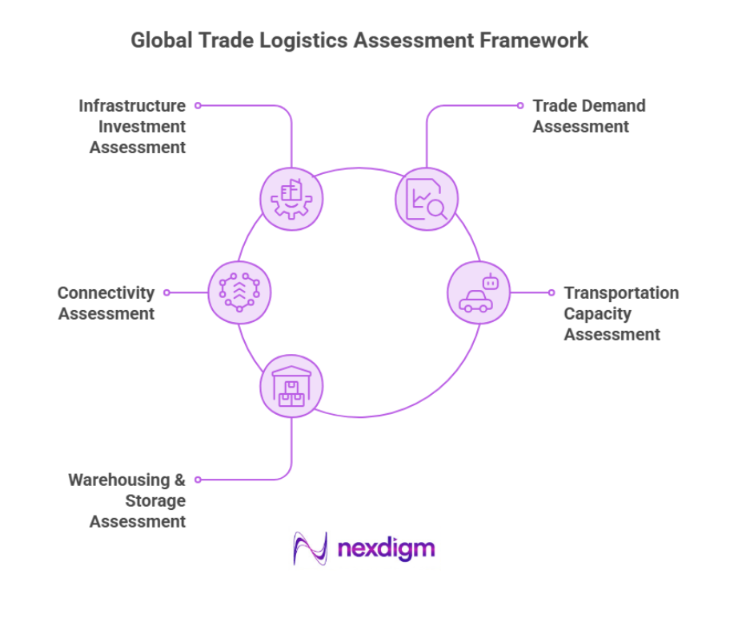
- Trade Demand Assessment: Evaluation of global trade activity, import-export volumes, freight movements, and economic growth trends to identify markets where logistics demand is expanding and creating new infrastructure requirements.
- Transportation Capacity Assessment: Assessment of the availability and capability of logistics networks, including ports, airports, railways, roads, and freight corridors, to support current and projected cargo volumes.
- Warehousing & Storage Assessment: Review of warehouse capacity, facility quality, location advantages, and storage capabilities to determine whether existing infrastructure can support growing trade and distribution requirements.
- Connectivity Assessment: Examination o the efficiency of links between production centers, trade gateways, logistics hubs, and consumption markets to identify bottlenecks and strategically important logistics corridors.
- Infrastructure Investment Assessment: Analysis of capacity gaps, development pipelines, investment economics, and future demand trends to identify opportunities for logistics infrastructure expansion and modernization.
By integrating these dimensions, the Global Trade Logistics Market Assessment helps organizations identify emerging logistics opportunities, prioritize investment decisions, and develop strategies that support efficient and resilient global supply chains.
Nexdigm’s Infrastructure Investment Opportunities
The Global Trade Logistics Market Assessment helps identify infrastructure investments that can deliver the greatest strategic value by aligning trade growth, freight demand, connectivity requirements, and capacity needs.
Nexdigm evaluates where investments in transportation networks, logistics hubs, warehouses, ports, and distribution infrastructure can address market gaps, improve supply chain efficiency, and support long-term growth.
These insights enable organizations to prioritize opportunities with strong commercial potential, operational benefits, and future scalability.
Nexdigm’s Case
A logistics company took Nexdigm’s support to evaluate shifting trade corridors, port capacity, and warehouse requirements. Within 12 months, transportation costs declined 16%, network utilization improved 24%, average transit times fell 19%, and route resilience increased, supporting more efficient regional expansion.
To take the next step, simply visit our Request a Consultation page and share your requirements with us.
Harsh Mittal
+91-8422857704