
Gold demand is decoupling: market value is surging to record highs even as physical consumption splits across sectors.
In 2025, total demand surpassed 5,000 tonnes to generate a record US$555 billion, propelled by an 84% surge in investment (2,175 tonnes) and 863 tonnes of central-bank buying. Conversely, high prices squeezed jewelry consumption down 18% to a five-year low of 1,542 tonnes.
This trend accelerated into H1 2026. While physical volume edged up just 2% year on year to 2,522 tonnes, total market value set a new benchmark at US$380 billion, reinforced by steady institutional allocation and emerging industrial demand from AI electronics.
Investment Has Become the Principal Growth Engine
Investment demand has become increasingly important to the gold market because it responds to macroeconomic and financial conditions that are distinct from jewellery consumption.
In 2025, investment demand reached its highest level on record. Bar and coin demand rose to a 12-year high, while gold ETFs added more than 800 tonnes. In Q2 2026, investment excluding OTC activity fell 46% year on year to 262 tonnes, largely because ETF holdings declined by 45 tonnes. Bar and coin demand, however, remained relatively stable at 307 tonnes.
The changing composition of investment matters for forecasting. Future demand is likely to depend on:
- ETF flows: Sensitive to real yields, monetary policy expectations, equity-market conditions and the US dollar.
- Bar and coin purchases: More closely linked to household wealth preservation, local prices and investor sentiment.
- OTC demand: Increasingly important, particularly through Asian markets and institutional investors.
- Geopolitical risk: Can accelerate demand for gold as a portfolio-diversification and safe-haven asset.
The World Gold Council expects investment to remain the principal source of gold-demand growth through the second half of 2026, with OTC activity and Asian investment making a larger contribution.
This makes investment behaviour one of the most important variables in a gold mining demand forecasting research exercise. A forecast based only on jewellery consumption can materially understate the forces currently shaping the market.
Jewellery Demand Is Becoming More Price-Sensitive
Jewellery remains a core pillar of physical gold demand, but soaring prices have severed the link between tonnage and expenditure. In Q2 2026, global jewellery consumption dropped 17% year on year to 278 tonnes, driven down by contractions in key markets such as India (down 15% to 75 tonnes) and mainland China (down 28% to 50 tonnes). Despite this volume slump, total global spending surged 14% to US$40 billion. Higher price levels are keeping aggregate market value resilient even as consumers buy fewer grams.
Consumers are adapting through:
- Lighter-weight jewellery.
- Lower-carat products in some markets.
- Old-for-new exchange programmes.
- Greater interest in bars and coins where investment products offer lower premiums.
- Greater selectivity around discretionary purchases.
India clearly illustrates this shift: H1 2026 bar and coin demand hit 113 tonnes, marking a 13-year first-half high, while jewellery volumes dropped sharply under record prices.
For mining operators and investors, jewellery demand must be tracked across both volume and aggregate value. Elevated price cycles can easily compress physical tonnage without eroding the overall economic size of the market.
Central Banks Are Creating a Structural Demand Layer
Central-bank gold purchases have formed a structural, long-term pillar of demand. Official buying reached 863 tonnes in 2025 and continued in 2026, rebounding from 57 tonnes in Q1 to 289 tonnes in Q2, with Poland, Uzbekistan, China, and Kazakhstan driving first-half volumes.
Because official accumulation is steered by geopolitical hedging and reserve diversification away from traditional assets, it operates independently of consumer price sensitivity and retail jewelry cycles. For accurate market forecasting, central-bank accumulation functions as an isolated demand pool that must be modeled separately from retail investment and consumer expenditure.
Industrial Use Is Smaller, but Its Composition Is Changing
Technology accounted for 80 tonnes of gold demand in Q2 2026 (up 2% year on year), led by electronics, which rose 4% to roughly 68 tonnes. While volume is modest next to jewellery and investment, the segment is structurally resilient: gold’s conductivity and corrosion resistance make it essential in high-performance electronics.
The rollout of AI infrastructure and advanced semiconductors provides a growing, steady demand stream that functions largely independent of spot price volatility.
A More Useful Framework for Forecasting Gold Demand
Future gold demand should be assessed as a combination of four distinct markets rather than a single consumption trend.
- Investment demand should be modelled against gold prices, interest rates, ETF flows, investor positioning, currency conditions and geopolitical risk.
- Jewellery demand requires analysis of income growth, affordability, cultural purchasing patterns, gold prices and substitution toward lighter or lower-value products.
- Reserve demand should incorporate central-bank purchasing behaviour, reserve diversification strategies and geopolitical conditions.
- Industrial demand should be linked to electronics production, semiconductor manufacturing, technology intensity and changes in material use.
The interaction between these segments is equally important. A sustained rise in gold prices can simultaneously increase investment demand while suppressing jewellery volumes. It can also encourage recycling, adding secondary supply and partially offsetting mine production.
Nexdigm’s Gold Demand Assessment Framework
Nexdigm can integrate these demand pools into a forward-looking market model by examining:
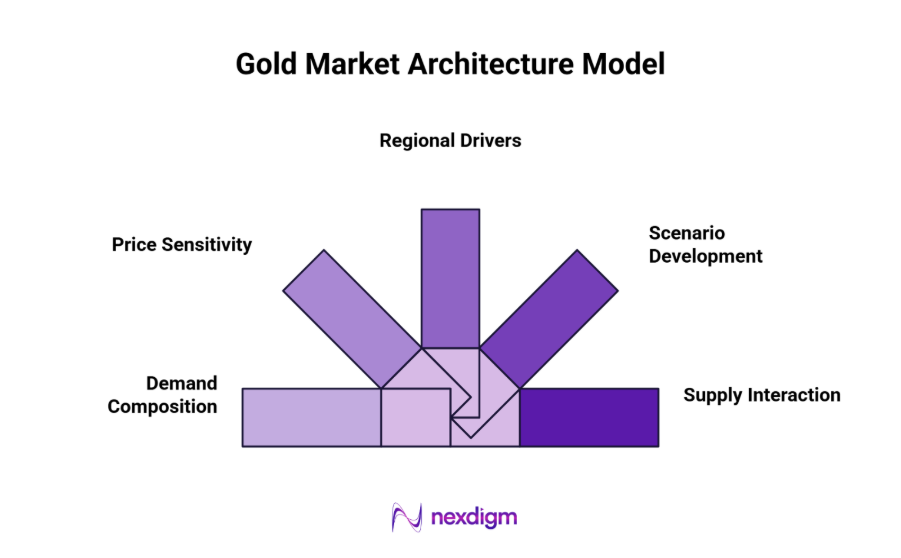
- Demand composition: Establish the contribution of investment, jewellery, central banks and technology to total consumption.
- Price sensitivity: Measure how changes in gold prices affect physical volumes across major markets.
- Regional drivers: Identify differences in investor behaviour, jewellery consumption and reserve accumulation across major consuming economies.
- Scenario development: Model demand under different price, interest-rate, geopolitical and economic conditions.
- Supply interaction: Assess how mine production, recycling and producer responses could influence the balance between demand and available supply.
The resulting forecast provides a more useful view of the market than a single global consumption figure. It identifies which demand segments are structurally expanding, which are becoming more price-sensitive and where changes in investor or central-bank behaviour could materially alter the outlook.
Nexdigm Case: Gold Demand Forecasting
A gold-sector client assessed six major consuming markets through 2030. Nexdigm modelled investment, jewellery, central-bank and technology demand under three price scenarios, identifying investment as the largest incremental demand source and a 9% potential divergence between base and downside scenarios.
To take the next step, simply visit our Request a Consultation page and share your requirements with us.
Harsh Mittal
+91-8422857704