

Gold producers can benefit from strong market prices and still lose value through weak commercial arrangements. Revenue depends on the quantity of recoverable gold, the quality of the material delivered, refining terms, pricing benchmarks, settlement timing and the costs incurred before payment is received. A sound commercialization strategy must account for the entire route from mine production to sale proceeds.
This matters because gold transactions can involve several counterparties and measurement points. Without reliable reconciliation, a producer may struggle to distinguish operational losses from commercial deductions or determine whether its sales arrangements remain competitive.
Gold Market Strength Makes Realised Value More Important
The World Gold Council reported that global gold demand, including over-the-counter activity, reached approximately 5,002 tonnes in 2025, valued at a record US$555 billion. The average annual gold price was about US$3,431 per ounce, 44% higher than in 2024. Estimated mine production increased by only around 1%, to 3,672 tonnes.
The figures indicate a strong market and a relatively modest supply response. They also show why a producer should avoid assuming that a rising reference price automatically translates into equivalent revenue growth. Actual realisation depends on product form, refining terms, payable content, fees and the timing of sales.
Map the Route From Production to Payment
The commercial pathway differs depending on whether a mine sells doré, concentrate or refined gold. A producer may use an internal processing plant, a third-party facility, an independent refinery, a trader or a direct buyer. Each arrangement creates different costs, risks and levels of control.
The first step is to document the transaction from the mine’s production records through processing, weighing, sampling, assay, shipment, refining and final settlement. Quantities and grades should be reconciled at each stage, with clear procedures for investigating differences.
Commercial terms must specify how payable gold is determined, which pricing benchmark applies, how treatment or refining charges are calculated, who bears transport and insurance costs, and when final payment becomes due. These provisions can materially affect cash conversion and the amount ultimately retained by the producer.
Where Revenue Leakage Can Occur
Several commercial and operational issues can reduce realised value even when the headline gold price is favourable:
- Assay differences: Sampling and measurement discrepancies can create disputes over payable metal and settlement.
- Recovery and reconciliation gaps: Incomplete reconciliation between feed, recovered gold, residues and inventory can obscure losses.
- Refining and treatment charges: Charges, deductions and minimum fees may vary across contracts and product types.
- Transport and security costs: Remote sites, specialised handling and insurance can add materially to transaction costs.
- Settlement delays: Provisional payments, final assay adjustments and long payment cycles increase working-capital requirements.
- Counterparty concentration: Dependence on one buyer or refinery can reduce negotiating leverage and increase disruption risk.
The correct response is not necessarily to replace an existing buyer. Producers should compare the full economics and operational reliability of available alternatives before changing a relationship.
Compare Sales Routes on Net Realisation
A gold mining distribution entry strategy services assessment should compare alternative sales arrangements using a consistent measure of net realisation. This includes the reference price, payable content, deductions, logistics, refining costs, financing and settlement timing.
Direct sales may provide stronger visibility and control but require the producer to manage counterparties, compliance and shipment arrangements. A trader may offer convenience and access to buyers but charge for that service. An offtake contract can provide volume certainty or support financing, though the pricing formula and commitment period may limit flexibility.
The analysis should also consider whether the producer can diversify counterparties without sacrificing reliability. Multiple qualified buyers can strengthen negotiating leverage, but only if the mine can meet their specifications and manage the additional administrative burden.
Protect Commercial Value Through Better Contracting
Gold commercialization requires coordination between production, finance, logistics, compliance and sales teams. A clear operating process should assign responsibility for assay verification, shipment documentation, insurance, invoice reconciliation and dispute resolution.
Contracts should specify pricing dates, benchmark adjustments, treatment charges, provisional payments, final settlement deadlines and the process for resolving assay disputes. Management should review performance regularly against realised price, total selling cost, payment days and counterparty exposure.
Gold Commercialization Framework
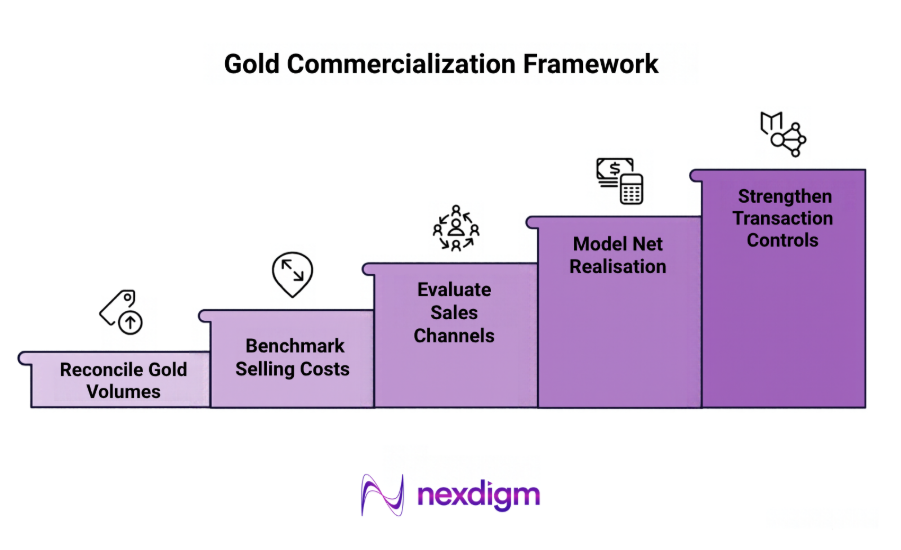
- Reconcile Gold Volumes: Match production records, recovered metal, shipment quantities and final buyer settlements to ensure accurate accounting and identify discrepancies.
- Benchmark Selling Costs: Compare refining charges, treatment fees, transportation, insurance and other transaction costs to understand their impact on realised gold prices.
- Evaluate Sales Channels: Compare buyers, offtake agreements and direct sales options based on pricing terms, market access, payment conditions and commercial flexibility.
- Model Net Realisation: Estimate revenue after selling costs and assess cash conversion under different gold price scenarios, settlement timelines and payment arrangements.
- Strengthen Transaction Controls: Verify assay results, shipping documentation, regulatory compliance and counterparty credentials to reduce settlement disputes, financial exposure and transaction risks.
Nexdigm Case Study
A gold producer compared 3 sales arrangements across refining charges, payable metal, transport and settlement timing. The preferred route offered a stronger projected net realisation and shorter payment cycle under the modelled assumptions. The producer prioritised contract renegotiation and independent assay reconciliation before changing its wider sales network.
To take the next step, simply visit our Request a Consultation page and share your requirements with us.
Harsh Mittal
+91-8422857704