

Gold prices can make a mining project appear attractive before its underlying economics have been established. A higher realised price improves potential revenue, but it does not resolve uncertain ore grades, poor metallurgical recovery, expensive processing or difficult site access. A viable gold mining opportunity depends on the amount of recoverable gold, the cost of producing it and the reliability of the assumptions behind the project model.
For a company considering entry, feasibility analysis must establish whether the deposit can support a sustainable operation under realistic technical, financial and market conditions.
Gold Market Conditions Strengthen the Case for Rigorous Screening
The World Gold Council reported that total global gold demand, including over-the-counter activity, exceeded 5,000 tonnes in 2025, reaching approximately 5,002 tonnes. The average annual gold price reached a record US$3,431.50 per ounce, up 44% from 2024. Global mine production increased only around 1%, to approximately 3,672 tonnes.
These figures indicate a strong price environment and relatively modest growth in mine supply. They do not mean that every undeveloped deposit is economically viable. High prices can support projects with higher production costs, but they can also encourage aggressive assumptions about future prices, making disciplined downside analysis more important.
Resource Quality and Ore Grade Determine the Starting Point
The first task is to understand how much gold is present, how confidently it has been estimated and how its distribution affects mine planning. Headline resource tonnage can conceal substantial variation in grade, depth, continuity and the proportion of material that can be recovered economically.
India provides a useful example of why resource classification matters. The Indian Bureau of Mines’ Indian Minerals Yearbook 2024 reported total primary gold resources of approximately 607.26 tonnes of contained metal in the National Mineral Inventory, based on data as of 1 April 2020. Of this, 92.76 tonnes were classified as reserves, with the remaining 514.50 tonnes in other resource categories. The figures should not be treated as current production or as entirely economically mineable gold.
For FY2023–24, reported Indian gold ore production was approximately 760,252 tonnes, with an average grade of 2.48 grams per tonne. Ore production increased by about 20% from the previous year, while the reported average grade declined from 2.67 grams per tonne. The divergence demonstrates why tonnage growth alone can be misleading. More ore does not necessarily mean proportionately more recovered gold or better project economics.
Metallurgical Recovery and Processing Costs
Gold feasibility depends on how the metal occurs within the ore. Mineralogy and grain size influence whether gravity separation, leaching, flotation or a combination of processes is appropriate. Some deposits require more complex treatment, additional reagents or tighter control of impurities, raising costs and operational risk.
The key variables include:
- Head grade and the expected grade of material delivered to the processing plant.
- Metallurgical recovery under representative test conditions.
- Throughput, plant availability and energy consumption.
- Reagent, water, labour and maintenance requirements.
- Tailings management, waste handling and environmental obligations.
Laboratory results must be assessed for their relevance to the proposed operation. Test work on a small, carefully selected sample may not represent variability across the deposit. Representative sampling, pilot testing where appropriate and a clear link between geological models and mine plans reduce the risk of overstating recoverable output.
Logistics, Infrastructure and Gold Market Access
Gold’s high value relative to its weight makes transport economics different from those of bulk commodities. Nevertheless, remote locations can face substantial costs for power, water, roads, accommodation, security and specialist equipment. Processing arrangements may also require investment in a plant, access to a third-party facility or a toll-treatment agreement.
Market access involves more than finding a buyer for refined gold. The project must understand concentrate or doré specifications, refining arrangements, payment terms, settlement timing and applicable licensing and traceability requirements. These factors affect working capital, revenue timing and operational control.
A gold mining market entry feasibility research assessment should therefore link resource estimates and metallurgical evidence with a detailed cost model and a realistic route to market. The model should test lower grades, reduced recovery, higher energy costs, capital overruns and changes in the gold price. A project that remains viable under conservative assumptions is generally a stronger investment candidate than one dependent on a single optimistic price forecast.
The Commercial Tests Before Investment
Before committing development capital, management should establish whether the project has a credible resource base, a technically demonstrated recovery route, an achievable production schedule and a complete estimate of development and operating costs. It should also examine the status of permits, land access, water rights, environmental obligations and closure provisions.
The most decision-relevant outputs are the break-even gold price, expected production cost per unit, initial capital requirement, cash-flow profile and sensitivity of returns to grade and recovery. These measures help distinguish a promising geological asset from a financeable mining project.
A Gold Mining Entry Feasibility Framework
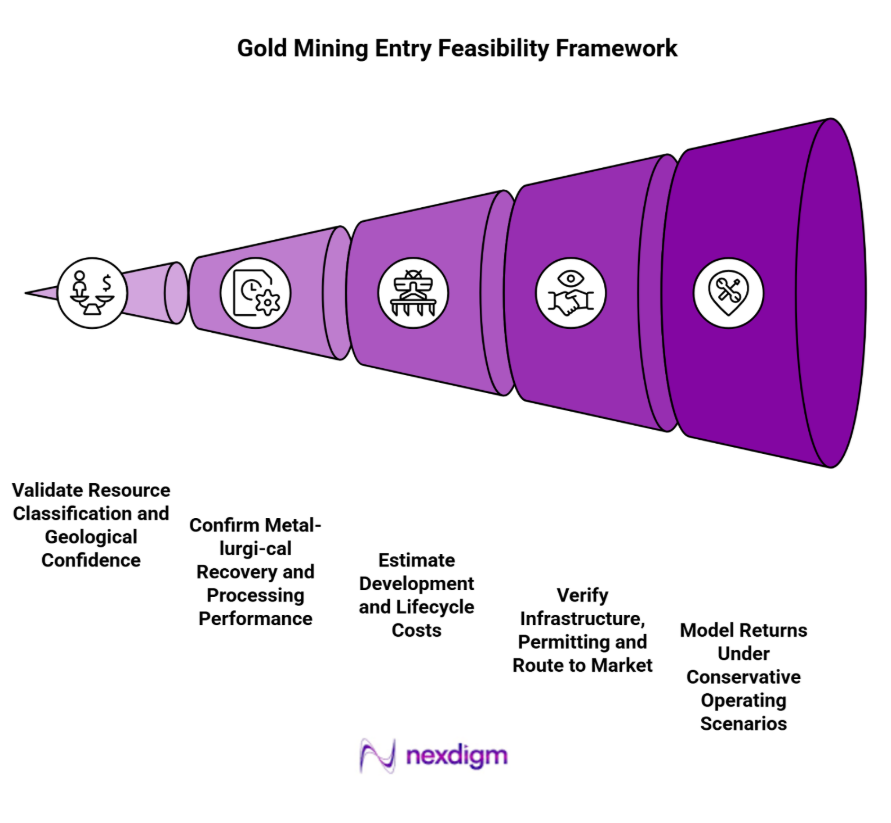
- Validate Resource Classification and Geological Confidence: Assess resource classification, drilling data, geological confidence and grade distribution to determine the reliability of resource estimates and the potential to support commercially viable gold production.
- ConfirmMetallurgical Recovery and Processing Performance: Evaluate representative metallurgical test results to establish expected gold recovery rates, processing requirements and potential variability across ore types.
- Estimate Development and Lifecycle Costs: Assess mine development, processing facilities, infrastructure, labour, operating expenses and mine closure obligations to establish the project’s total capital requirements and long term cost profile.
- Verify Infrastructure, Permitting and Route to Market: Examine transport access, power and water availability, regulatory approvals, refining arrangements and logistics to confirm that gold can be produced, processed and delivered to buyers efficiently.
Nexdigm Case Study
A mining investor reviewed three gold opportunities using resource classification, metallurgical test results, infrastructure costs and price sensitivities. One deposit showed a larger reported resource but weaker recovery assumptions and higher development costs. The investor prioritised a smaller opportunity with stronger technical evidence for the next stage of feasibility work.
To take the next step, simply visit our Request a Consultation page and share your requirements with us.
Harsh Mittal
+91-8422857704