

A gold resource becomes an investment opportunity only when geology can be converted into recoverable ounces at a competitive cost. The distinction is increasingly important as strong gold prices improve the economics of existing operations while the development pipeline remains constrained by permitting, financing, infrastructure and construction timelines.
Global gold mine production reached an estimated 3,672 tonnes in 2025, only around 1% higher than the previous year. The World Gold Council expects production to increase only modestly again in 2026, despite the exceptionally strong price environment. At the same time, average industry all-in sustaining costs reached a record US$1,785/oz in Q1 2026, up 16% year on year. The combination creates an unusual development environment: higher gold prices can support project margins, but rising costs mean that resource quality and operating efficiency remain decisive.
The development pipeline is also slow to respond to favourable prices. Recent analysis of 232 mining assets found that the average period from discovery to production was 16 years, while non-operating projects that had completed feasibility studies were taking nearly 30 years in some cases, largely because of permitting delays. For a new gold development, therefore, the commercial case has to remain viable across a long investment horizon.
From Geological Potential to Recoverable Ounces
The starting point is resource quality, but headline grade alone provides an incomplete picture of a deposit’s value. A feasibility assessment needs to establish how much of the resource can actually be converted into saleable gold and at what cost.
Key geological and mining variables include:
- Grade and continuity: Higher grades can reduce the volume of ore required for each ounce produced, while geological continuity affects mine planning and dilution.
- Resource confidence: Measured, indicated and inferred resources carry different levels of geological certainty and therefore different implications for mine planning and financing.
- Mine geometry: Depth, strip ratio, orebody accessibility and the choice between open-pit and underground mining can materially alter capital and operating costs.
- Metallurgical recovery: The percentage of contained gold that can be recovered is ultimately more important to project economics than the headline grade alone.
- Mine life: Production duration affects the ability to recover initial capital expenditure and sustain infrastructure investment.
Two deposits with similar grades can consequently produce very different financial outcomes. A free-milling orebody with established processing requirements may require substantially less capital and technical complexity than a refractory deposit requiring specialised treatment.
Processing Can Change the Economics of the Deposit
Metallurgy sits between geological potential and commercial production. Recovery assumptions influence both the number of ounces produced and the processing infrastructure required to achieve those ounces.
The assessment should consider:
- Ore characteristics and expected recovery rates
- Crushing, grinding and beneficiation requirements
- Gravity, flotation, leaching or refractory treatment
- Reagent, water and energy requirements
- Tailings and waste-management requirements
- Potential variability in metallurgical performance across the orebody
This is particularly important for deposits where recovery changes significantly between ore zones. A project may appear attractive under an average recovery assumption while becoming materially weaker if higher-grade zones have more difficult metallurgy.
Building the Investment Case
Once the resource and processing profile are established, the project needs to be positioned against the broader gold cost curve. Industry AISC reached US$1,785/oz in Q1 2026, demonstrating how quickly strong gold prices can be accompanied by cost escalation.
A robust feasibility model should therefore test:
- Capital intensity: Initial mine, plant, infrastructure and development expenditure.
- Operating costs: Labour, energy, diesel, reagents, maintenance, logistics and other consumables.
- Sustaining capital: Ongoing expenditure required to maintain production over the mine life.
- Production profile: Annual ounces, ramp-up period, mine life and grade progression.
- Price assumptions: Base, downside and upside gold-price scenarios rather than reliance on spot prices.
- Financial returns: NPV, IRR, payback period and sensitivity to changes in key assumptions.
The resulting economics should be tested against lower recovery, weaker grades, higher energy costs, construction delays and changes in gold prices. This matters particularly for projects with long development timelines, where assumptions made at feasibility can face several commodity cycles before first production.
Nexdigm’s Framework for Gold Mine Feasibility
Nexdigm can evaluate a gold development by connecting geological potential with market conditions and project economics.
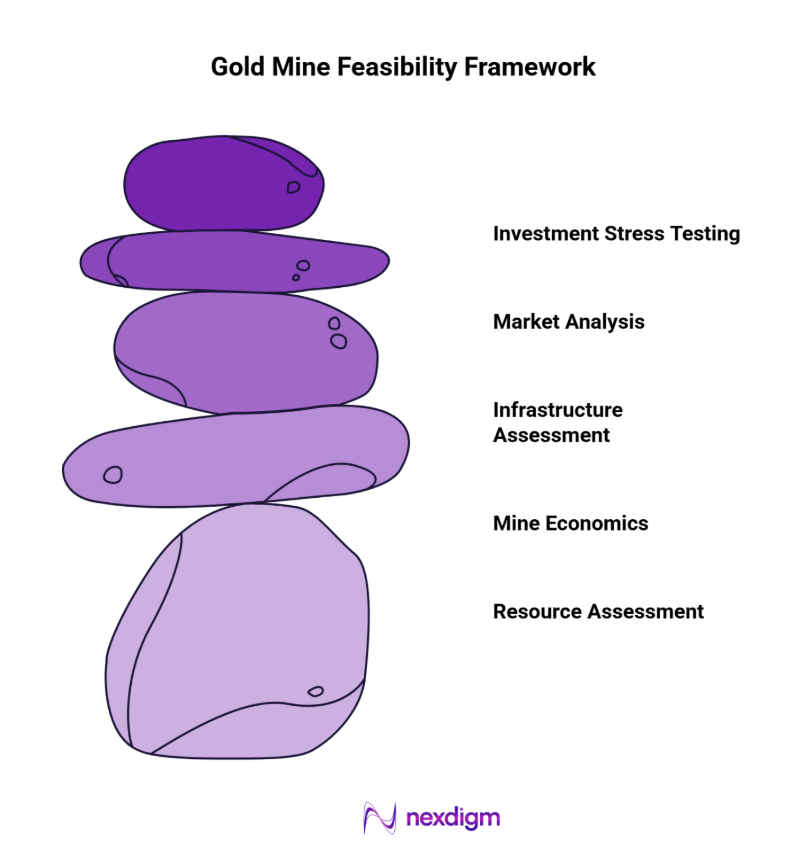
- Resource assessment: Establish the quality, confidence, recoverability and mine-life potential of the deposit.
- Mine and processing economics: Translate the resource into a production schedule, processing configuration and cost profile.
- Infrastructure assessment: Evaluate power, water, transport, site access and other infrastructure requirements.
- Market and price analysis: Assess gold-market fundamentals and develop defensible price scenarios for financial modelling.
- Investment stress testing: Test NPV, IRR and payback under changes in grade, recovery, costs, construction timing and gold prices.
The objective is to determine whether the deposit can support a competitive operation and where the principal risks to value creation sit before significant development capital is committed.
A gold mining market feasibility study consulting assessment should therefore connect the geological resource model with processing requirements, infrastructure constraints, market assumptions and project-level financial returns.
Nexdigm Case: Gold Development Screening
A mining investor screened 11 gold assets across four jurisdictions. Nexdigm assessed resource confidence, recovery, infrastructure, AISC and price sensitivities, narrowing the portfolio to three projects with projected IRRs above 18% under the base case.
To take the next step, simply visit our Request a Consultation page and share your requirements with us.
Harsh Mittal
+91-8422857704