
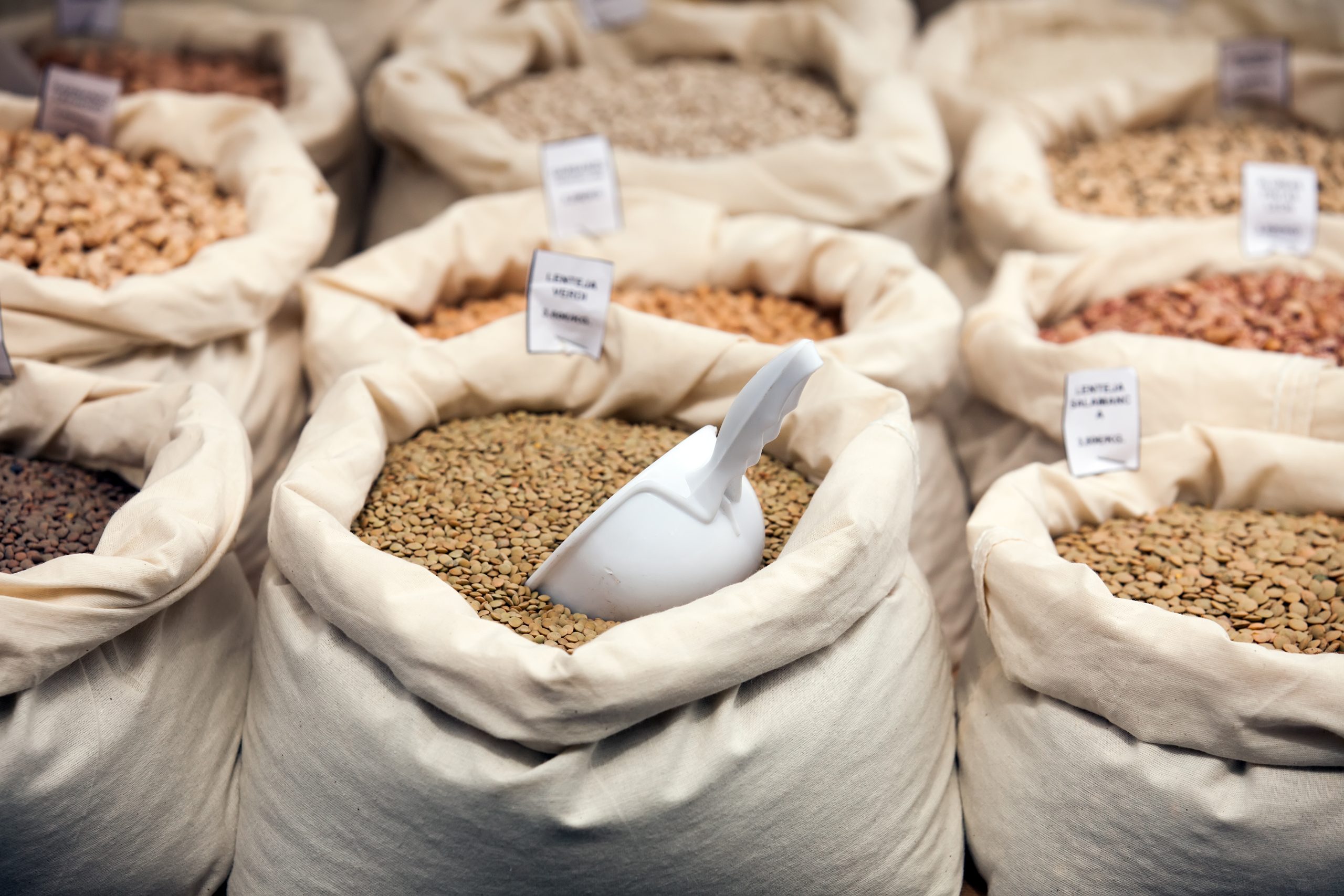
India’s grain market cannot be understood through production volumes alone.
Foodgrain output reached an estimated 357.73 million tonnes in 2024–25, but the commercial significance of another tonne of grain depends increasingly on where it goes. The same crop can enter household consumption, animal feed, ethanol production, starch processing, or export channels, each creating a different demand and pricing equation.
For grain producers, processors, traders, and investors, the relevant question is therefore how competing end uses are reshaping regional demand.
Food Remains the Base, but Its Growth Pattern Is Changing
Staple consumption provides the underlying volume requirement for rice and wheat, supported by population growth and public food-security programmes.
Yet dietary diversification is changing incremental consumption. Rising incomes and urbanization are increasing demand for dairy, poultry, processed foods, and higher-quality grain varieties. This creates differentiated opportunities within otherwise mature staple markets.
Milling wheat with specific quality characteristics, premium rice varieties, and nutrition-oriented coarse cereals can command different economics from undifferentiated commodity grain.
The result is a market increasingly segmented by quality and end use rather than simply by tonnage.
Feed Is Turning Grain Into an Industrial Input
Animal feed represents one of the most important sources of incremental grain demand.
Commercial poultry requires large quantities of energy-dense feed, with yellow maize forming a major component of feed formulations. Aquaculture adds another demand pool, particularly across major shrimp and freshwater fish-producing regions.
Feed demand also creates substitution dynamics. Depending on relative prices, formulators can adjust the balance between maize, wheat, broken rice, and other feed ingredients.
For grain suppliers, access to a feed cluster can therefore matter as much as proximity to a production region.
Ethanol and Starch Are Competing for the Same Grain
Industrial processing has introduced another layer of competition.
Grain-based ethanol distilleries can absorb maize, broken rice, and other eligible feedstocks, while starch processors require grain with appropriate quality and starch characteristics. These buyers compete with feed manufacturers and traders for regional supply.
The result is a shift in local procurement economics. A producing district may suddenly become more commercially attractive when a large distillery or starch plant enters the surrounding industrial network.
This makes processing capacity an important variable in forecasting grain demand.
Trade Policy Can Change Regional Economics Quickly
Export markets introduce another source of variability.
India’s rice and wheat trade has periodically been affected by export restrictions, duties, stock controls, and other policy measures designed to manage domestic food availability and prices.
For international traders and processors, this means projected export demand cannot simply be extrapolated from historical shipment volumes. Domestic policy can redirect supply toward internal markets, alter regional price relationships, and change procurement behaviour.
A grain market assessment therefore needs to connect production forecasts with policy scenarios.
Demand Is Ultimately a Geographic Problem
National demand figures conceal regional imbalances.
Large grain-producing states may sit far from feed mills, distilleries, starch plants, or export gateways. Conversely, industrial clusters can create concentrated demand that pulls grain across state boundaries.
Mapping production against processing capacity, mandi arrivals, transport costs, storage infrastructure, and competing procurement channels can reveal sourcing corridors that aggregate statistics miss.
The commercial opportunity lies in these intersections.
Nexdigm’s Grain Market Demand Assessment Framework
Nexdigm can assess grain markets through five analytical dimensions:
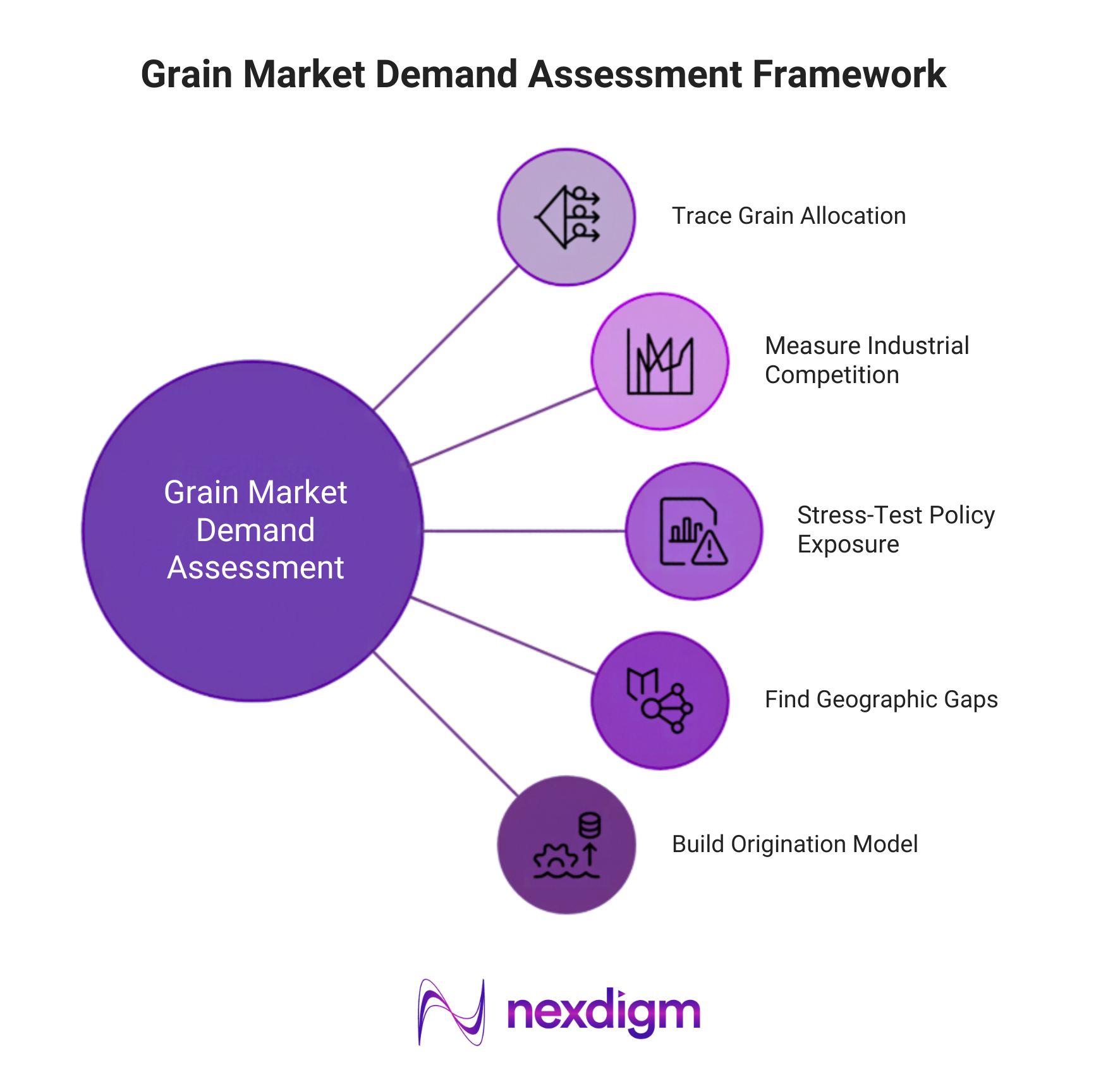
- Trace Where Every Tonne Is Going: Model grain allocation across food, feed, ethanol, starch, and export channels to distinguish structural demand from temporary procurement spikes.
- Measure Industrial Competition: Compare procurement requirements and buying behaviour of feed mills, distilleries, starch processors, and traders to identify where demand pressure is likely to increase.
- Stress-Test Policy Exposure: Model the impact of export restrictions, stock limits, government procurement, open-market sales, and other interventions on regional supply-demand balances.
- Find the Geographic Gaps: Overlay production volumes, industrial capacity, mandi arrivals, storage infrastructure, and transport networks to identify supply-deficit and high-growth demand clusters.
- Build the Origination Model: Evaluate farmgate procurement, FPO aggregation, intermediary structures, logistics costs, and seasonal availability to determine the most efficient sourcing configuration.
Case Study: Nexdigm’s Grain Origination Assessment
In a scenario-based assessment for an integrated feed and bioethanol operator, Nexdigm analysed five agricultural sourcing corridors covering 16 states and 2.4 million tonnes of annual procurement capacity.
The assessment mapped 186 feed, starch, and ethanol facilities and identified 14 priority sourcing clusters. A direct FPO-linked procurement model reduced average sourcing distance by 118 km and lowered estimated logistics costs by 13%, while creating access to approximately 420,000 tonnes of annual grain supply.
To take the next step, simply visit our Request a Consultation page and share your requirements with us.
Harsh Mittal
+91-8422857704